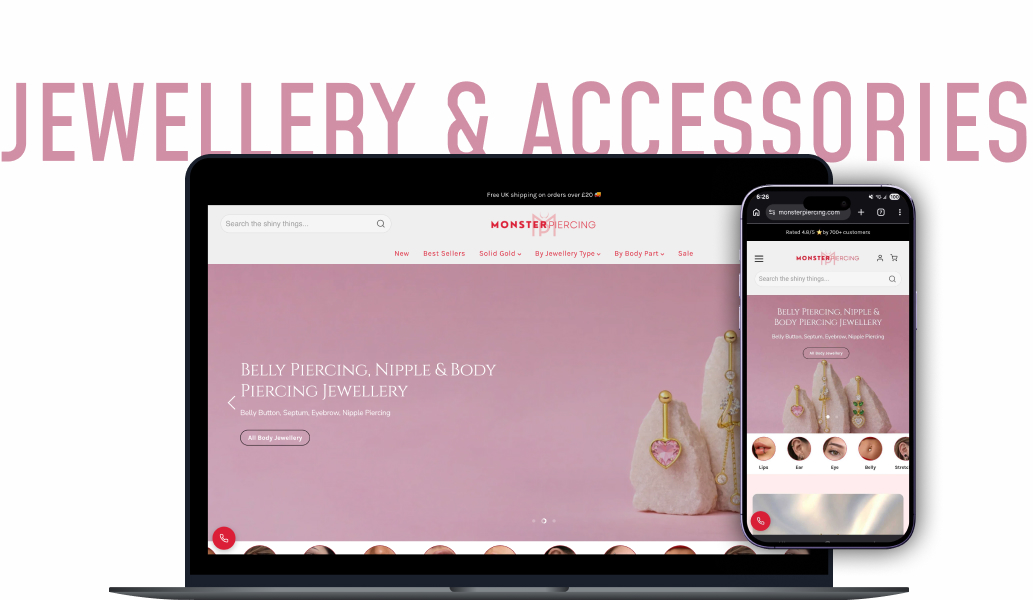


Industry: Jewellery & Accessories | Market: United Kingdom | Platform: Shopify
Migration: Klaviyo → Shopify Email
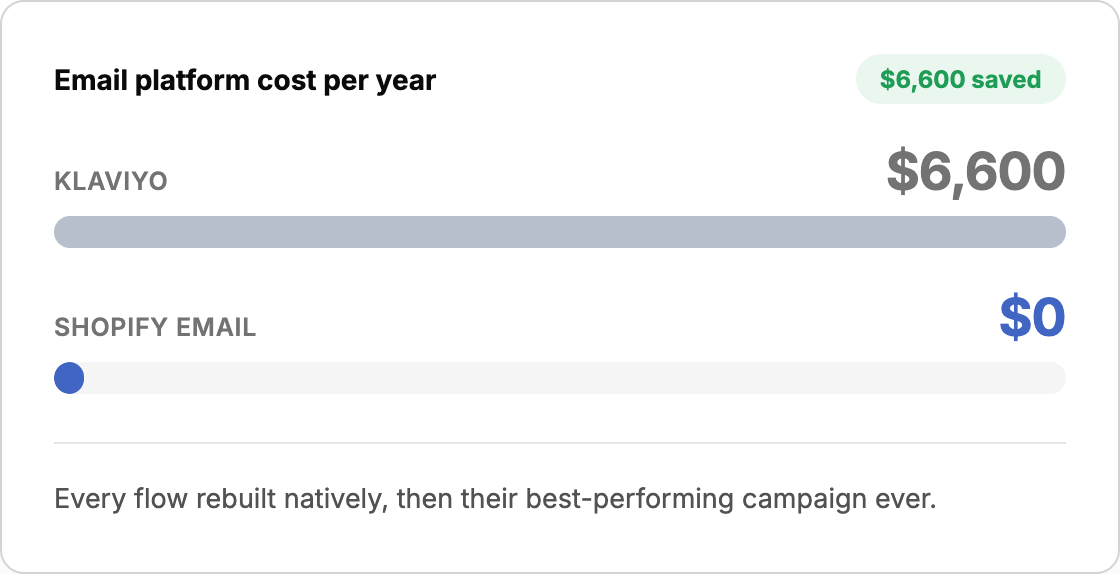
A UK piercing jewellery brand was paying $550+/month for an email platform that charged them for list growth, not results. We migrated them to Shopify Email, rebuilt every flow, added four new ones, and delivered the highest-performing campaign in the brand's history. Same audience. Same brand. Lower bill. Better numbers.
$6,600 saved in 12 months. 49.5% automation open rate. 335% lift in email sales. Zero drop in performance during migration.
What Klaviyo Was Costing Monster Piercing
Monster Piercing had the hardest parts of email already in place. An engaged list. A brand with a clear identity. Customers who buy with conviction, not coupon codes.
What they didn't have was an email setup worth the price tag attached to it.
The Klaviyo bill climbed every time the list grew, regardless of whether the platform was delivering anything new in return. Their flow stack had been built at launch and left untouched for years. Their review request system sent one identical email to every customer, treating a five-star experience and a complaint the exact same way.
The brand was working. The infrastructure underneath it wasn't.
Monster Piercing is a UK direct-to-consumer body piercing jewellery brand with a sharp, identity-forward aesthetic. We migrated their entire email operation off Klaviyo and onto Shopify Email, rebuilt every existing automation, added four new flows the account had never run, and executed a Spring Sale campaign that outperformed every send in the brand's history. All inside a single engagement.
Results at a Glance

The Four Headline Wins
| $6,600 | +335% | 49.5% | 3 → 7 |
|---|---|---|---|
| Saved in 12 months | Email sales lift | Automation open rate | Active flows |
| $550+/mo recovered | vs pre-migration baseline | ~2x industry average | 4 new flows built |
Performance Across the Account
Volume and deliverability 72,224 emails sent. 100% delivery rate. 0.2% bounce. 0% spam complaints.
Open and click 32.31% overall open rate. 35% campaign open rate. 49.5% automation open rate. 2.1% automation click rate.
Revenue and conversion £1,302.12 in email sales. 10.45% click-to-purchase rate. +177% conversion lift vs pre-migration. £600 in automation sales last 30 days, up +147% vs the prior 30-day window.
Spring Sale campaign £980.68 in email-attributed revenue. £436.17 from a single send. £41,984.62 in total store revenue during April.
Note on conversion rate: 10.45% is clicks to purchase, not sends to purchase. Industry benchmark for ecommerce email click-to-purchase rate sits around 3% to 5% (Klaviyo 2024 ecommerce email benchmark report).
All revenue figures sourced from Shopify, not Klaviyo.
The Audit: Three Issues With Their Klaviyo Setup
A platform bill that scaled with the list, not with results.
Klaviyo charges by contact volume. Every new subscriber Monster Piercing earned meant a higher monthly invoice, not because they were unlocking new features, but because the database grew. At $550+ per month, the cost had outpaced what the platform was actually delivering for this store.
Three flows on autopilot since launch.
The original automation stack hadn't been reviewed in years. Triggers were untested. Copy hadn't been updated as the brand evolved. Entire sections of the customer journey, post-purchase aftercare, browse behaviour, review handling beyond a single request, had no coverage at all.
A review system with zero intelligence.
One review request email went to every customer regardless of experience. A delighted buyer and an unhappy one received identical messaging. No follow-up. No brand protection. No mechanism to turn a five-star review into a second purchase or catch a one-star issue before it became a public review.
Rebuilding the Email Stack on Shopify Email
The Migration
We rebuilt every Klaviyo flow inside Shopify Email and Shopify Flow, validated each against live customer events, then deactivated the Klaviyo version only after the replacement was confirmed firing correctly. One flow at a time. No duplicate sends. No coverage gaps. No customer received the same email from two platforms.
The sequencing took discipline. On the abandoned checkout flow, we caught two test customers landing in both Klaviyo's queue and Shopify's during the validation window. We suppressed the affected segment on Klaviyo's side for 48 hours while Shopify's version ran clean. After that, every subsequent flow followed the same suppression protocol before switch-over.
See our full Klaviyo to Shopify migration process.
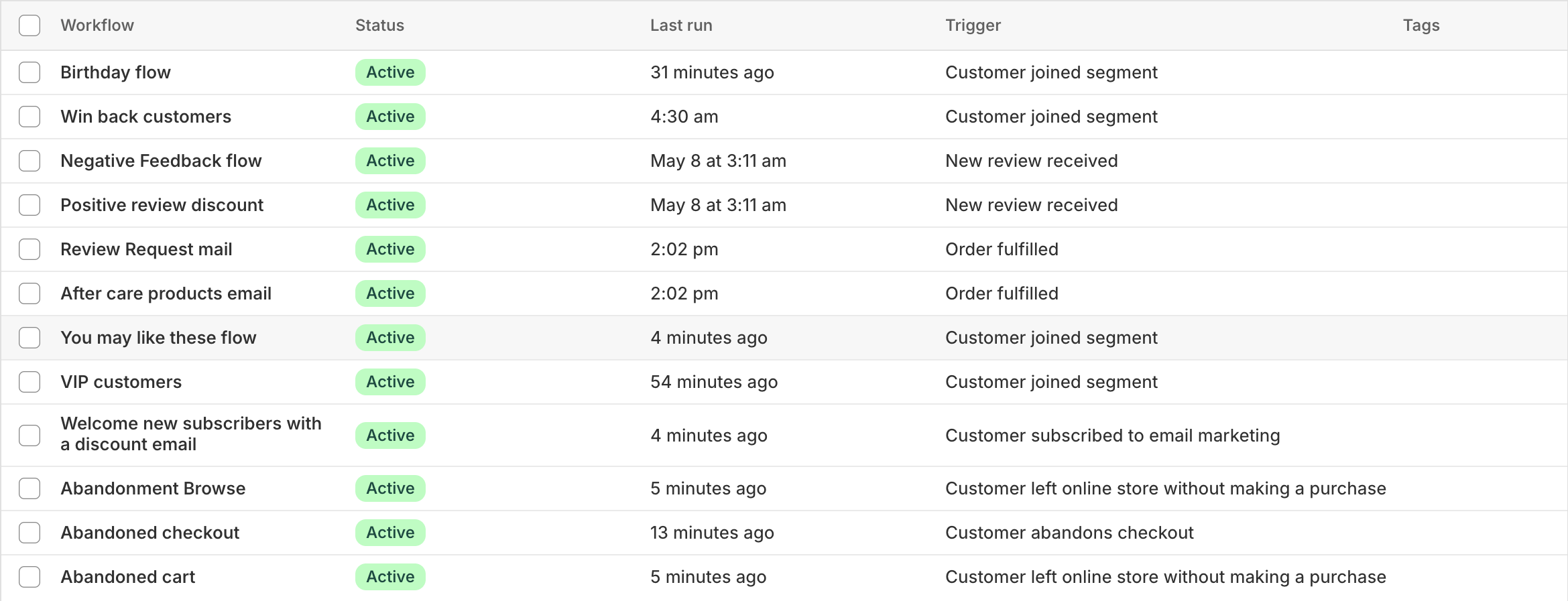
From 3 Flows to 7
| Flow | Status |
|---|---|
| Welcome Series | Migrated and rebuilt |
| Abandoned Checkout | Migrated and rebuilt |
| Win-Back | Migrated and rebuilt |
| Browse Abandonment | New, built by Webrex |
| Post-Purchase Aftercare | New, built by Webrex |
| Positive Review Follow-Up | New, built by Webrex |
| Negative Review Follow-Up | New, built by Webrex |
Automation Performance, Last 30 Days (vs prior 30 days)

Sends more than tripled. Orders up 136%. Sales up 147%. Every meaningful metric moved up at the same time, which is the actual signal of a flow stack working. Not just one number spiking while the rest sit flat.
A 49.5% automation open rate (lifetime, all flows) is roughly double the ecommerce industry average of 28% (Klaviyo 2024 ecommerce email benchmark report). That number reflects flows built with intent. Right trigger, right message, right moment. Not configured at launch and left to run.
Browse Abandonment
Not every interested customer adds to cart. Some browse, get pulled away, and leave already considering a product but not ready to commit. This flow catches that moment and sends a timely nudge back to the exact item they were viewing.
Trigger timing took two passes to get right. Our first version fired 45 minutes after the browse event, which caught some customers mid-purchase and felt intrusive. We pushed the delay to 4 hours, and the open rate jumped from 38% to 51% on the next batch.
Post-Purchase Aftercare
The sale completing isn't the end of the relationship. It's one of the most important moments to get right. A customer who just bought a piercing is thinking about healing time, care routine, and what to expect next. If the brand stays silent in that window, the customer finds answers elsewhere and the connection erodes.
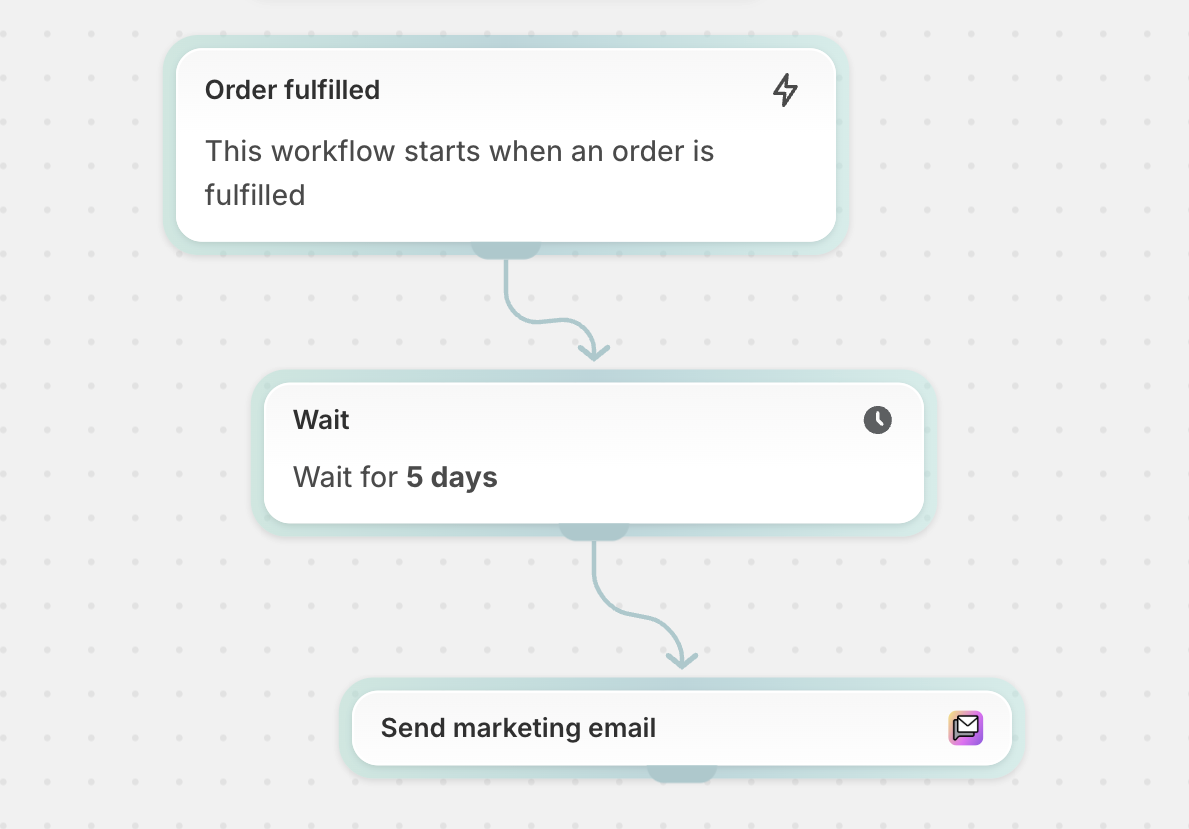
We built this flow because keeping that relationship alive past purchase is what turns a one-time buyer into a repeat customer. Order fulfilled, 15-day wait, aftercare email arrives when it's actually needed.
Browse all our automated email flow builds.
Review Flow: One Email Became Three
Monster Piercing's old setup sent a single review request to every customer with no follow-up logic. Same email to a delighted buyer and a frustrated one. No mechanism to turn the good experience into a second purchase, no way to catch the bad one before it became a public review.
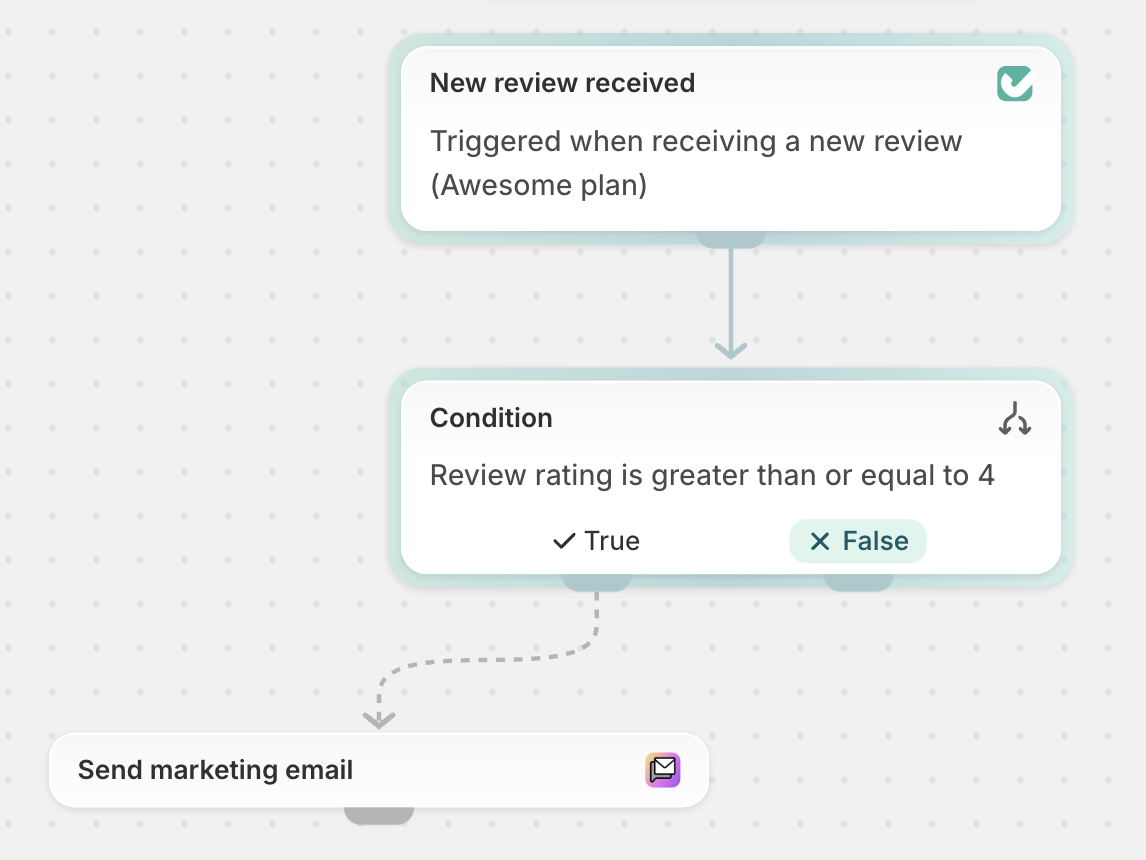
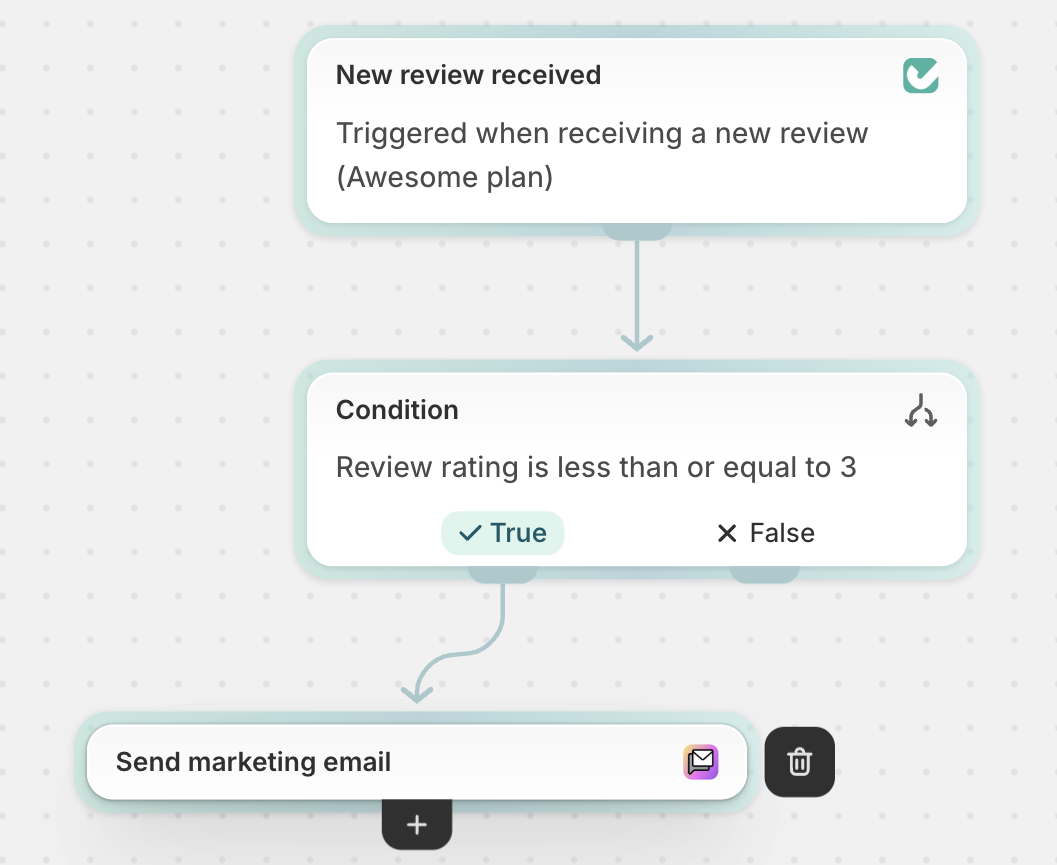
We rebuilt it as a three-email flow that responds to what the customer actually does.
Email one goes out asking for a review. The journey then splits based on the response.
A positive reviewer receives a thank-you email with a 10% discount. A reward for their feedback and a reason to come back.
A negative reviewer receives a different message entirely. A genuine, human response from the team offering to resolve the issue directly, before it becomes a public review.
Same starting point. Three emails. Every customer handled correctly.
Building the sentiment-based split required testing. Our first version routed too many neutral reviews into the positive path, which meant some customers received discount codes for 3-star feedback. We tightened the condition logic to only fire the positive thank-you for 4 and 5-star responses, with everything below routed to the resolution path.
Campaign Urgency Through Copy, Not Tools
On Klaviyo, urgency mechanics relied on third-party countdown tools and add-ons. We rebuilt that entirely through deadline-anchored subject lines, scarcity-driven body copy, and precise send timing. No external dependency required.
The Spring Sale ran on copy alone and became the best-performing campaign in the brand's history.
Book a free Shopify email audit and see what your account is leaving on the table →
Why Shopify and Klaviyo Show Different Email Revenue Numbers
Store owners who use both Klaviyo and Shopify notice it eventually. The numbers never match. Klaviyo shows more. Shopify shows less. Neither platform explains the gap.
Klaviyo uses multi-touch, cookie-based attribution. If a customer opens an email and purchases within a set window, usually five days, Klaviyo credits the sale to email regardless of how the customer actually returned to the site. Direct visit, Google ad, SMS click, brand search, Klaviyo still claims it. View-through attribution also applies, so a customer who opened the email but never clicked can still register as a conversion. Refunded and cancelled orders often stay excluded from revenue figures, keeping the dashboard inflated even when the sale never finalised.
Shopify records what actually happened at checkout. It credits the last channel the customer came through before purchasing. Someone who clicked your email, closed the tab, then returned via direct visit gets attributed to Direct. Refunds get deducted. Cancellations get removed. The number is lower, more conservative, and entirely real.
The gap isn't an error. It's a difference in philosophy. Klaviyo measures influence. Shopify measures transactions. Store owners reporting from Klaviyo are often making decisions on revenue that was never fully theirs to claim.
Every number in this case study comes from Shopify. When we say the Spring Sale generated £980.68 in email revenue, that figure is £980.68 in completed, non-refunded orders. No influenced sales. No view-through credit. No cancelled transactions inflating the dashboard.
This is the reporting standard we apply to every client.
The Spring Sale: Monster Piercing's Best Campaign Ever
The highest-performing campaign in the brand's history, built and executed entirely inside Shopify Email. No third-party urgency tools. Three phases across April, each sent to a segmented and warmed audience.
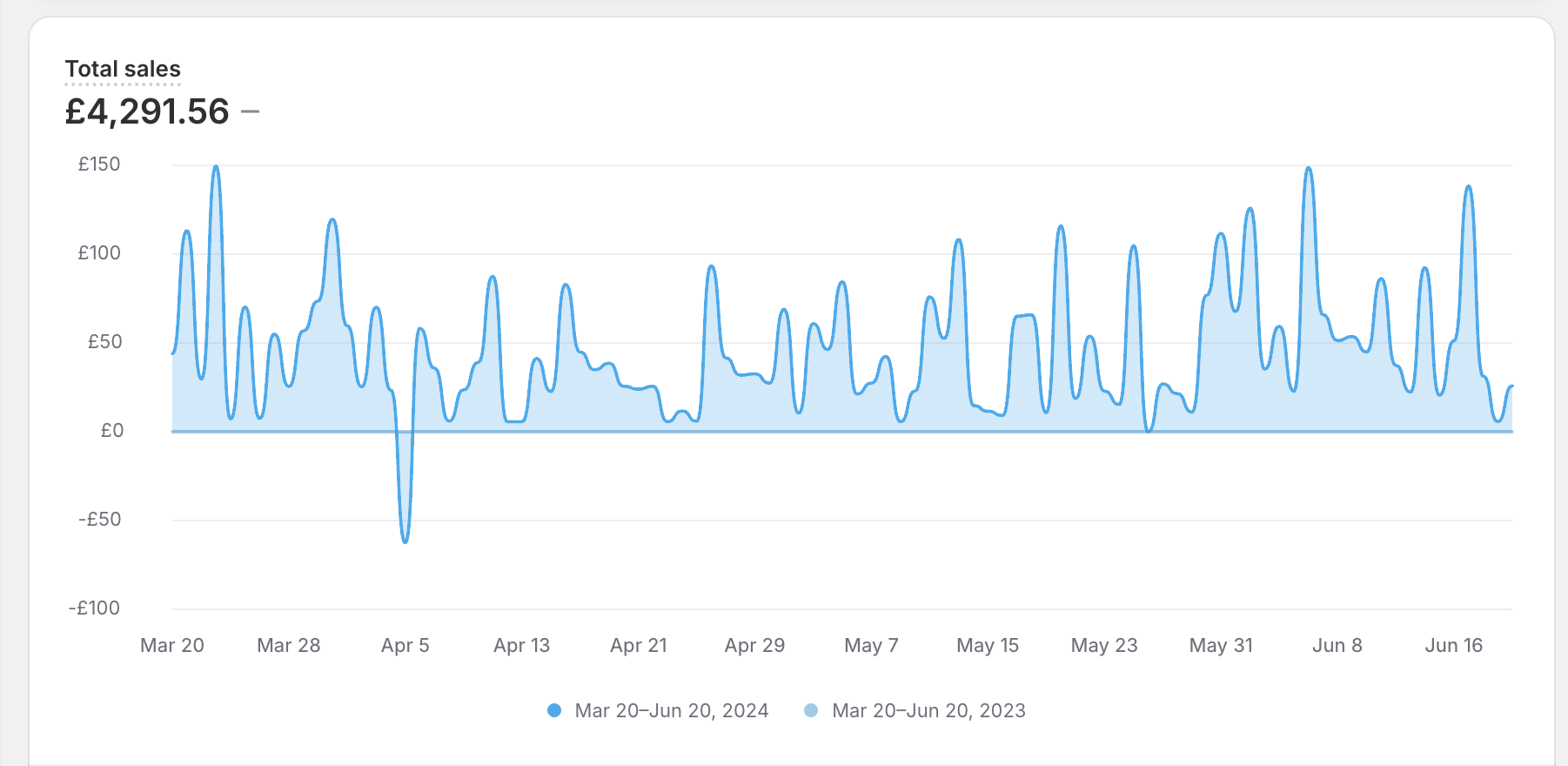
Results
| 35% | £980.68 | £436.17 | 0% |
|---|---|---|---|
| Open rate | Email revenue | Best single send | Spam rate |
| vs 28% industry avg | Shopify-attributed | One email | Zero complaints |
7,699 emails sent. 100% delivery. 1.8% click rate. 5.1% conversion rate. £23.67 average order value. 1,453 new customers acquired (74% of buyers). 459 returning customers (26%). 0.2% bounce rate.
The Three Phases
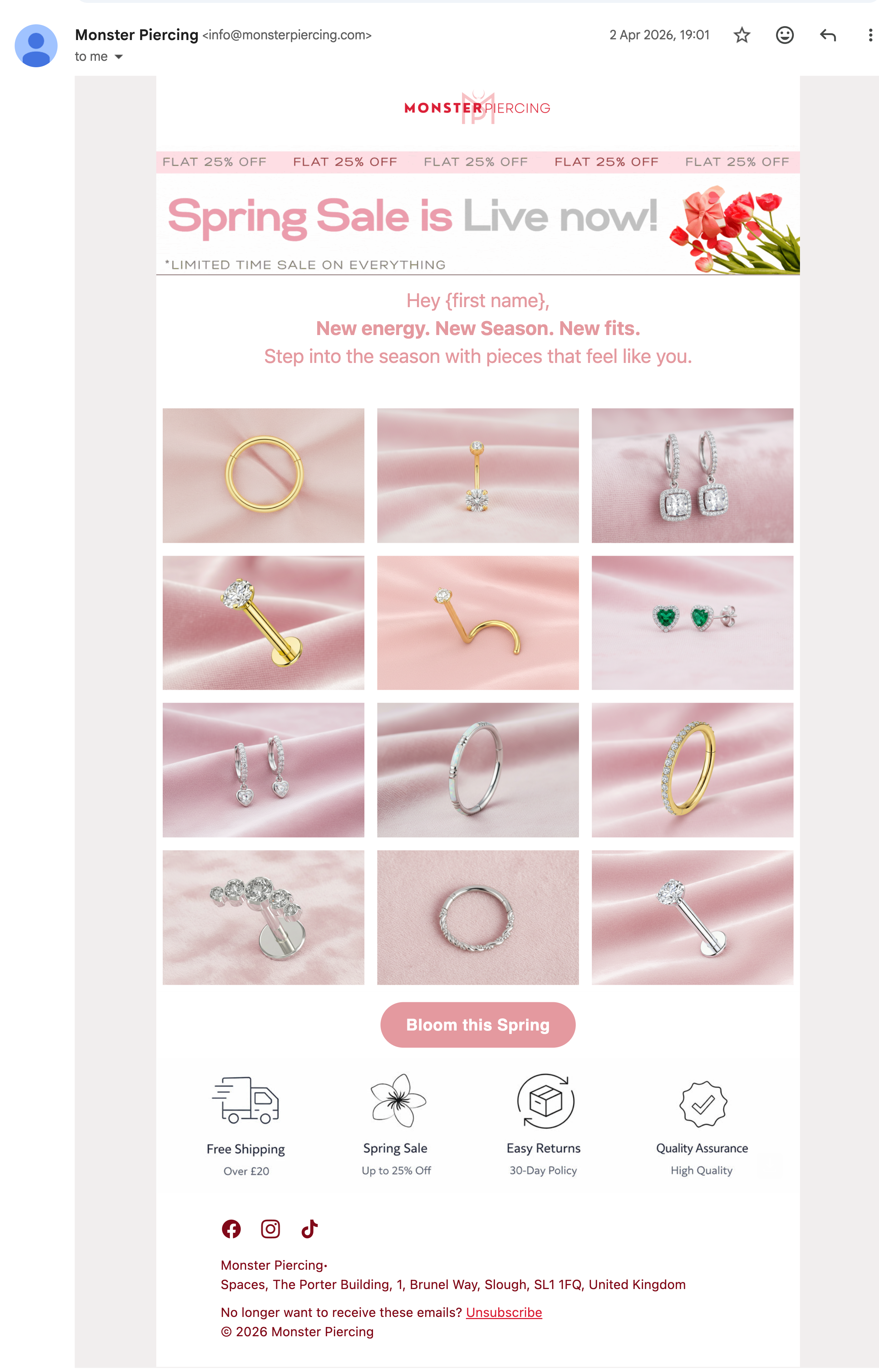
Phase 1, April 2: "A new season, worn your way"
The launch email led with identity, not discount. An invitation framed around who the customer is, not what they could save.
Peak open rate 34.55%. Revenue £168.91.
Phase 2, April 5: "We hate to say it, but it's almost over"
Mid-campaign urgency built entirely through subject line and body copy. No visual countdown tools. The open rate did the work.
Peak open rate 35.44%. Revenue £234.39.
Phase 3, April 10 to 11: "Last call to switch up your look"
The close. Hard deadline written into the subject line and reinforced through the body. The strongest send of the entire campaign.
Peak open rate 34.22%. Best single send £436.17. Phase revenue £577.38.
The Full Picture
$6,600 returned to budget every year. Zero performance lost during the switch. An automation stack that went from three untouched flows to seven purposeful ones. Email sales up 335%. Conversion rate up 177%. Last 30-day automation sales up 147% over the prior window. A Spring Sale that outperformed every previous campaign and ran without a single third-party tool. An email channel that now reports honestly from Shopify, not from a platform that inflates its own numbers.
72,224 emails sent. $6,600 saved annually. 7 flows live. 49.5% automation open rate. 35% campaign open rate. +335% email sales. +177% conversion rate. 100% delivery. 0% spam. 1 record-breaking Spring Sale.
Frequently Asked Questions
Why do Shopify and Klaviyo show different revenue numbers?
Klaviyo attributes revenue using multi-touch, cookie-based tracking. If a customer opens an email and buys within five days through any channel, Klaviyo claims the sale. Shopify only credits the last channel the customer came through before purchasing, deducts refunds, and removes cancellations. Klaviyo consistently shows higher numbers than Shopify. Neither is wrong. They measure different things. But if you want to know what your email channel actually generated, Shopify is the figure to trust.
Is Shopify Email capable enough to replace Klaviyo?
For most Shopify stores, yes. Especially when the Klaviyo bill is being driven by list size rather than feature dependency. Shopify Email covers campaigns, automations, segmentation, and flow logic natively, and it's included in your Shopify plan at no additional cost. If you're paying $500+/month on Klaviyo without actively using features Shopify Email can't replicate, the migration is worth a proper look. Monster Piercing maintained performance across every metric after switching and delivered their best campaign on the new platform.
What happens to existing flows during a migration?
Two risks. Duplicate sends, where both platforms fire at once. Coverage gaps, where a flow goes dark before its replacement is ready. We eliminate both by migrating one flow at a time. The new flow gets built, tested, and validated before the Klaviyo version is switched off. Every customer journey stays intact throughout. Our full Klaviyo to Shopify migration process walks through the sequencing.
How long does a Klaviyo to Shopify Email migration take?
Depends on flow count and logic complexity. For Monster Piercing we migrated three existing flows and built four new automations across a single engagement. To understand what your timeline looks like, the free audit below is the right place to start.
Will I lose subscribers during the migration?
No. Subscriber lists, segments, and consent records transfer in full. The migration only affects where the emails get sent from, not who they get sent to.