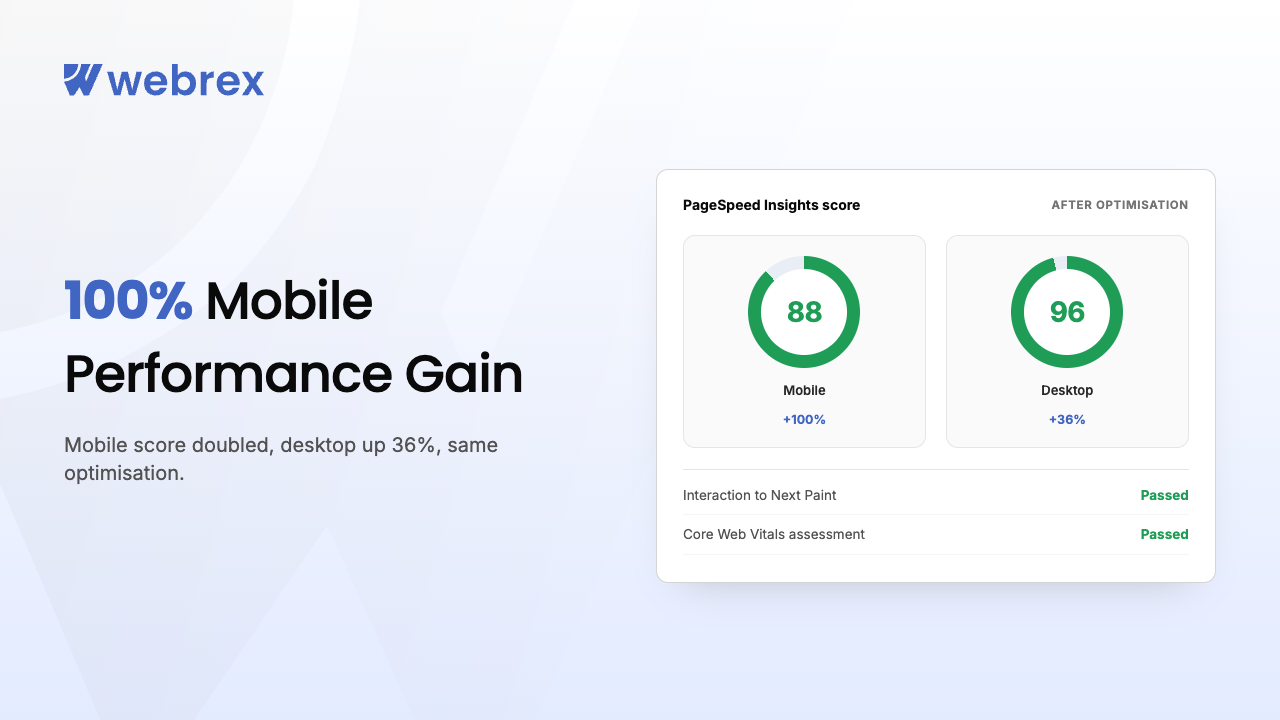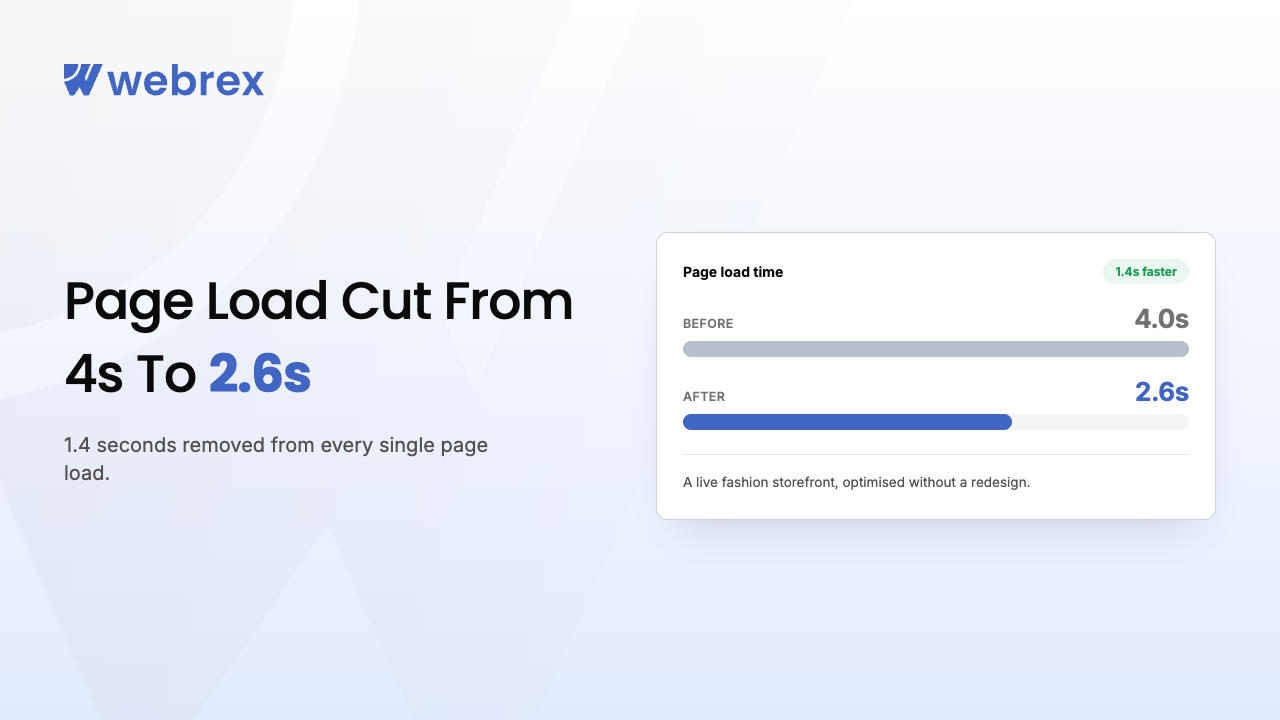







Explore how Hero Life Care achieved $23K in Shopify revenue gains — see the case study

See how we turned raw product photos into 50% higher-converting images — view case study

Shopify Speed Specialists

Shopify Speed
Optimization Agency
Specializing in Core Web Vitals

LCP ≤ 2.5s, INP ≤ 200ms, CLS ≤ 0.1. Real ecommerce results - 70% faster load times, 30–50% bounce reduction. Built exclusively for Shopify.

0+
Shopify stores
speed-optimized
0%
Avg load time
reduction
0%+
Pages reach
“Good” CWV status
5.1s→2.1s
Avg LCP across
client stores
LCP
5.1s 2.1s
Good
INP
890ms 140ms
Good
CLS
0.43 0.04
Good
PageSpeed Mobile
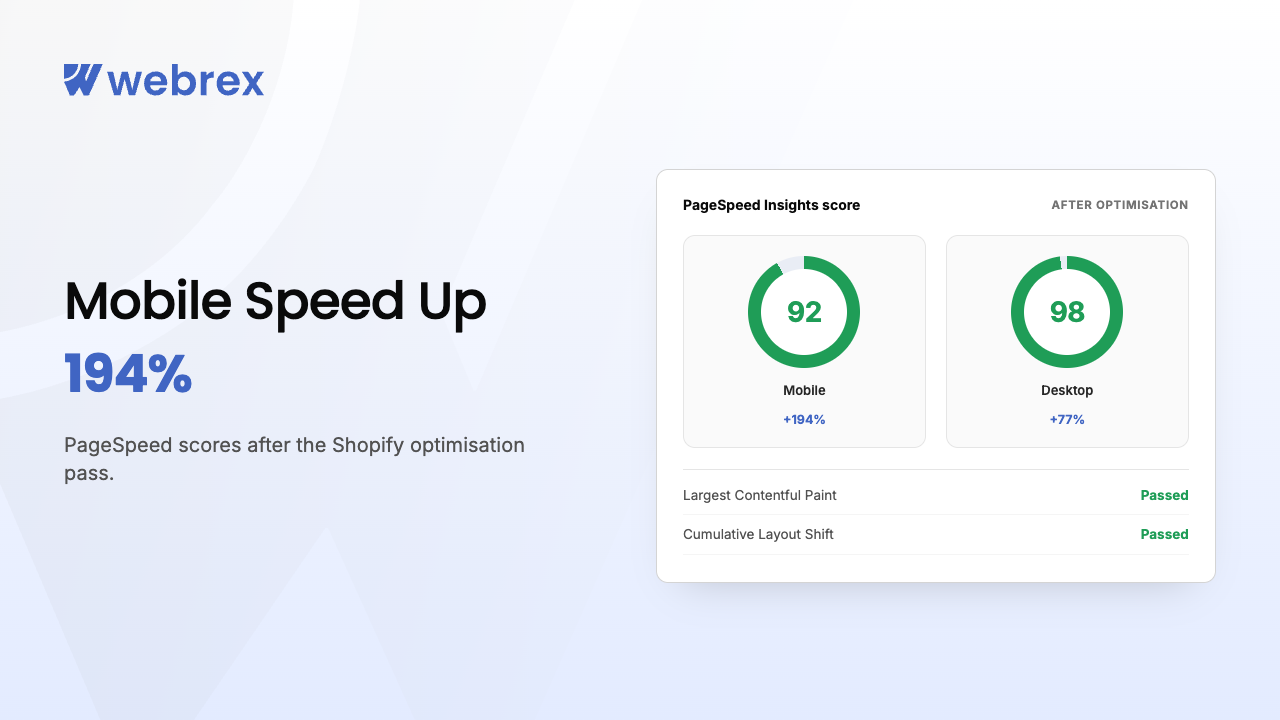
31 78
Bounce Rate
72% 51%
Stack
PageSpeed Lighthouse CrUX GTmetrix
The problem

Slow Shopify Stores Leak Revenue

Slow Shopify stores leak revenue. Every second of load delay costs 7% in conversions - and Google’s Core Web Vitals assessment directly impacts rankings. Most Shopify merchants run Lighthouse mobile scores under 40. Not because the product is weak. Because app bloat, unoptimized images, and render-blocking Liquid templates are quietly killing performance.

Core Web Vitals - LCP, INP, CLS - aren’t abstract benchmarks. They’re the metrics Google uses to decide whether your store earns page-one visibility. Fail them and you hand ground to competitors, even when your products are superior.

Fix them and the effect compounds: bounce rate drops, session depth rises, conversion rate improves, organic ranking climbs. Core Web Vitals are one ranking lever - see how they integrate with our broader Shopify ecommerce SEO services.

Webrex Studio’s Shopify performance optimization work is built entirely around ecommerce mechanics. Not generic page speed fixes. Our Shopify Speed Stack audit layers asset optimization, JavaScript architecture, CDN infrastructure, and Shopify-specific Liquid rendering into a single, sequenced implementation plan. Every client leaves with documented before-and-after scores and a maintenance roadmap.

Services

Our Shopify Speed Optimization Services

Core Web Vitals Audit
Full Lighthouse, PageSpeed Insights, CrUX, and GTmetrix audit. Lab data + field data analyzed. Identifies render-blocking scripts, image bottlenecks, slow TTFB, and layout instability per device type. Produces a prioritized fix list with projected metric shifts.
LCP Optimization
Hero asset conversion to WebP/AVIF, preload directives, TTFB reduction via caching and hosting tuning. Largest Contentful Paint brought to target threshold.
LCP target: ≤ 2.5s
INP Optimization
JavaScript deferral, main thread decongestion, event handler pruning, Shopify app script audit. Interaction to Next Paint brought to target threshold.
INP target: ≤ 200ms
CLS Fix
Media dimension reservation, font loading stabilization (FOUT prevention), ad/embed stabilization on scroll. Cumulative Layout Shift resolved.
CLS target: ≤ 0.1
App Bloat Removal
Every installed app audited for render-blocking scripts. Inactive app code removed from theme.liquid. Critical vs non-critical app load order sequenced correctly.
Theme & Liquid Optimization
Reduce Liquid render time, remove duplicate Shopify API calls, optimize section loading order. Shopify-specific - not WordPress fixes applied to the wrong platform.
CDN + Caching
Shopify CDN configuration, browser caching headers, HTTP/2 validation. Fast loads globally, including mobile on slower connections.
Shopify Plus Speed
Checkout.liquid optimization available for Plus stores. Critical for brands running Google Ads - checkout CWV directly impacts Quality Score and ROAS.
Plus-exclusive
Framework

The Shopify Speed Stack - 4-Layer Optimization Framework

Most page speed agencies apply the same WordPress-derived fix list to every platform. Shopify has unique performance constraints - app scripts injected at theme level, Liquid rendering on Shopify’s CDN, section-based architecture - that demand a purpose-built approach. The same approach that drives our technical SEO for Shopify work.

Layer 1
Asset Layer
  • Convert hero + above-fold images to WebP/AVIF
  • Implement responsive images via Shopify's native image_url filter
  • Lazy-load below-fold product images
  • Compress without visual quality loss
Layer 2
Code Layer
  • Defer non-critical JS (analytics, chat widgets, review apps, loyalty scripts)
  • Minify + concatenate CSS
  • Remove render-blocking scripts from
  • Prune unused Liquid template sections
Layer 3
Infrastructure Layer
  • Validate Shopify CDN edge delivery across regions
  • Configure browser caching for static assets
  • Enable HTTP/2 multiplexing
  • TTFB audit: identify and resolve slow server response times
Layer 4
Shopify-Specific Layer
  • Audit every installed app for injected scripts
  • Remove deactivated app remnant code from theme.liquid
  • Optimize section rendering order
  • Eliminate duplicate Shopify API calls from theme JS
Typical result sequence
Week 1–2 Audit + Asset Layer - LCP drops 40–60%
Week 3–4 Code + Infrastructure Layer - INP and CLS reach target thresholds
Week 4–6 Shopify-Specific Layer - sustainable score gains under real traffic
Real-world result
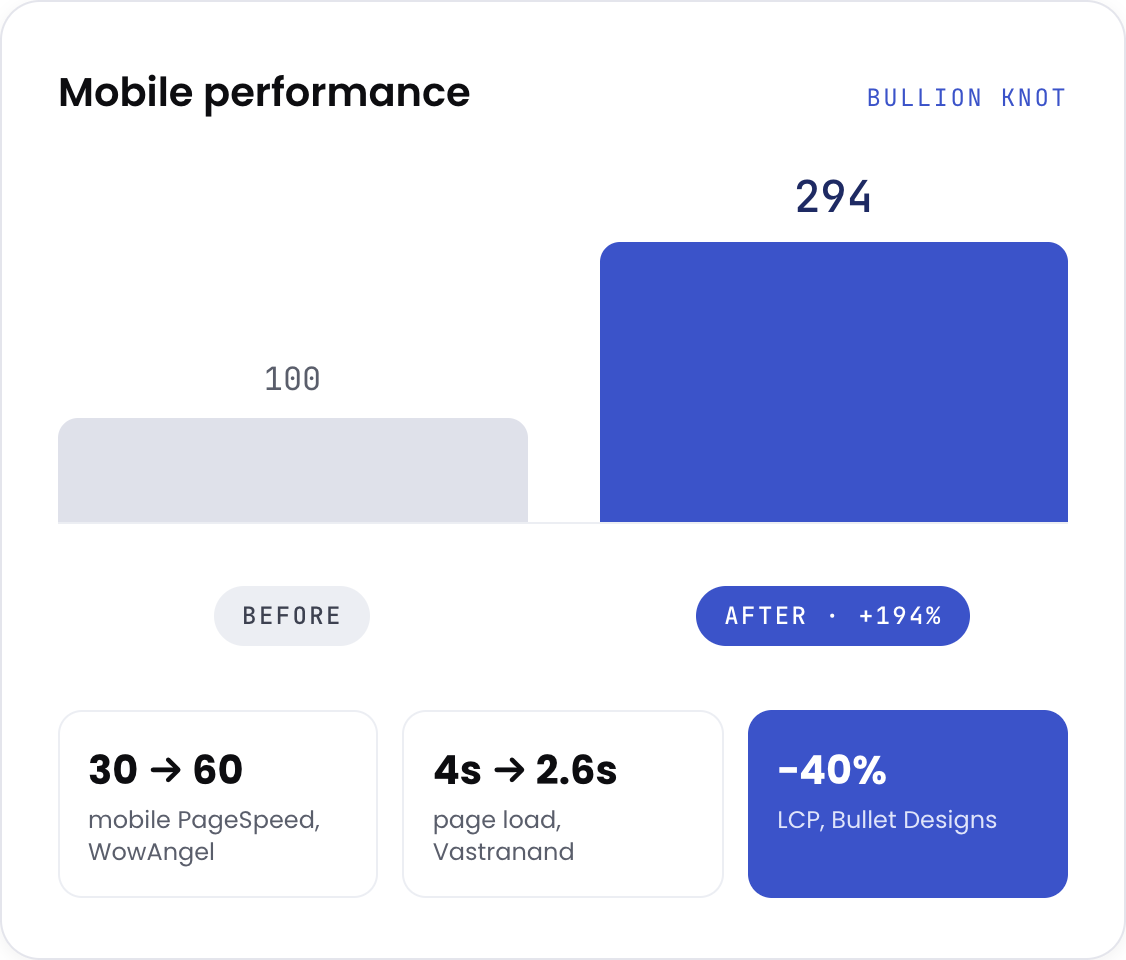
Shopify jewellery store (100+ SKUs, 6 installed apps) - PageSpeed mobile score 31 → 78 after full Shopify Speed Stack implementation. LCP: 5.8s → 2.2s. Delivered in 4 weeks.
How we work

Our Shopify Speed Optimization Process

Phase 01
Audit
Days 1–3
  • Full CWV audit: Lighthouse, CrUX, GTmetrix, PageSpeed Insights
  • Lab + field data per device type
  • App script inventory (every installed app catalogued)
  • TTFB and server response diagnosis
↳ Speed Audit Report - prioritized fix list + projected metric shifts
Phase 02
Strategy
Days 3–5
  • Shopify Speed Stack layers mapped to your store’s specific issues
  • Risk assessment (what changes could affect design or functionality)
  • Implementation sequence agreed with client
↳ Implementation Plan - timeline + expected metric shifts per layer
Phase 03
Implementation
Weeks 2–4
  • Asset layer: image conversion + lazy loading
  • Code layer: JS deferral, CSS minification, render-blocking removal
  • Infrastructure: CDN + caching configuration
  • Shopify-specific: app audit + Liquid optimization
↳ Staged implementation with score checks after each layer
Phase 04
Validation + Reporting
Week 4–5
  • Full re-run of all diagnostic tools
  • Before/after: LCP, INP, CLS, PageSpeed score, TTFB
  • Real-user monitoring setup via GSC CWV report
  • Post-speed-fix, collection pages optimized for organic visibility
↳ Final Performance Report + Maintenance Checklist
Proof

Shopify Speed Optimization Results

Real stores. Real before/after metrics. Every result documented across PageSpeed, CWV field data, and business impact.

Jewellery & Accessories
App Bloat + LCP Crisis
Shopify · 100+ SKUs, 6 installed apps · 4 weeks

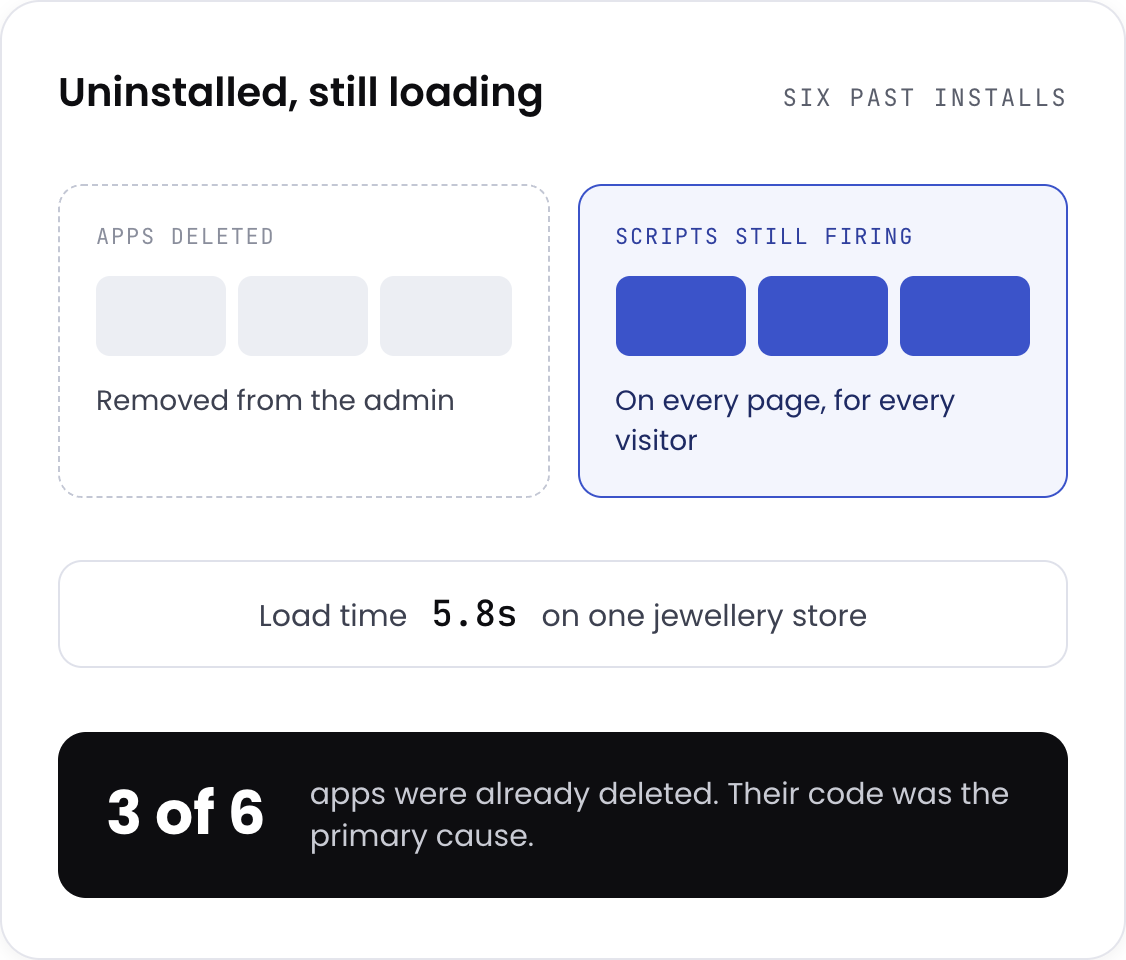
PageSpeed mobile 31. LCP 5.8s. GSC flagging “Poor” CWV across all collection pages. Mobile bounce rate 72%. Root cause: 3 inactive apps still injecting scripts via theme.liquid. Hero image served at 2.1MB uncompressed. No lazy loading. TTFB at 1.2s.

PageSpeed mobile31 → 78
LCP5.8s → 2.2s
CLS0.43 → 0.04
Bounce rate72% → 51%
GSC CWV status“Poor” → “Good”
Key insight: Remnant code from uninstalled apps - not live apps - was the primary LCP killer.
Medical Supply Ecommerce
INP + CLS Fix
Shopify Plus · 5,000+ SKUs · 6 weeks

INP 890ms (poor threshold >500ms). CLS 0.28. Severe layout instability on mobile during filter interaction. JavaScript filter library blocking main thread for 620ms per interaction. Ad banners rendering without reserved dimensions.

INP890ms → 140ms
CLS0.28 → 0.06
Mobile engagement rate+34%
Product page conversion+18%
Key insight: INP on filter-heavy Shopify Plus stores requires thread-level JS optimization, not just script deferral.
Fashion & Apparel
Full Core Web Vitals Overhaul
Shopify · Mid-size fashion brand, UK · 5 weeks

LCP 4.2s, INP 620ms, CLS 0.19. PageSpeed mobile 24. Google Ads quality score hurt by slow landing pages. 1.8MB unoptimized product images. 11 apps loaded synchronously. CDN misconfigured for UK + EU delivery.

LCP4.2s → 1.9s
INP620ms → 168ms
PageSpeed mobile24 → 81
Organic impressions+40% (60 days)
Key insight: Synchronous app load order - not app count - determines INP severity.
Why us

Why Choose Webrex Studio for Shopify Speed Optimization

Shopify-Only Framework
The Shopify Speed Stack is built for Shopify’s architecture. No recycled WordPress fixes. No generic “minify JS” advice with no Shopify context.
Technical SEO Integration
Speed fixes mapped to GSC Core Web Vitals field data outcomes, not just Lighthouse lab scores. Real-user data drives prioritization.
Implementation, Not Recommendations
We implement every fix. No audit-only packages that leave you with a PDF and no path forward.
Shopify Plus Capable
50+ SKU stores to 5,000+ SKU Shopify Plus. Scales with catalog size and app complexity. See our Shopify Plus case studies for full scope.
Before/After Documentation
Documented score changes across all CWV metrics and PageSpeed tools. No vague claims. Side-by-side comparison report delivered with every engagement.
No Design Risk
All optimizations are non-destructive to visual layout. Design stays identical. Performance transforms. Once your site loads fast, Conversion Rate Optimization captures the gains.
Root causes

10 Shopify-Specific Issues Destroying Your Core Web Vitals

Generic page speed advice doesn’t apply to Shopify. These are the platform-specific problems we diagnose and fix on every engagement - none of them appear in WordPress guides.

01
LCP
App Remnant Scripts in theme.liquid
Uninstalling a Shopify app does not remove its code. Scripts injected into theme.liquid persist after deletion and load on every page. A store with 6 past installs may have 3–4 dead script tags firing on every request - adding render-blocking weight with zero functional benefit. The single most common LCP killer we find during audits.
Fix: Remove all inactive app code from theme.liquid and theme.js
02
LCP
Unoptimized Hero Images Above the Fold
Shopify’s CDN supports WebP and AVIF conversion via the image_url filter, but most themes default to full-resolution JPEG or PNG hero images. A 2MB hero image without compression is the most direct cause of a high LCP score. Adding fetchpriority="high" and correct preload hints - which Shopify doesn’t apply automatically - cuts LCP by 0.5–1.2s alone.
Fix: WebP/AVIF conversion + preload + fetchpriority="high" on hero
03
LCP TTFB
Liquid Render Blocking at Theme Level
Inefficient Liquid - duplicate product.metafields calls, nested loops over large collections, unoptimized for loops in section files - slows TTFB at the Shopify infrastructure level. Unlike WordPress, Liquid output can’t be externally cached. Optimizing the Liquid layer directly reduces TTFB by 200–600ms on complex stores.
Fix: Audit and refactor slow Liquid loops, remove duplicate API calls
04
INP CLS
Shopify Plus Checkout Performance
Third-party scripts added to checkout.liquid (loyalty apps, post-purchase upsell, trust badge widgets) directly inflate INP and CLS on the most conversion-critical pages. Google Ads Quality Score considers landing page CWV - a slow checkout degrades ROAS independently of ad creative quality.
Fix: Shopify Plus only - audit and sequence checkout.liquid scripts
05
INP LCP
Review App Script Weight
Shopify review apps (Judge.me, Okendo, Stamped, Yotpo) load custom CSS, widget JS, and API polling requests. Served synchronously, a single review app adds 400–900ms to INP. The fix isn’t removal - it’s load sequencing: defer until after the critical rendering path completes, so reviews appear without blocking the page.
Fix: Defer review app JS post-critical-render; lazy-load widget on scroll
06
LCP FCP
Theme Section Render Order
Sections placed above the hero - announcement bars, header app injections, cookie consent banners - that load external resources block the critical rendering path for everything below. Reordering section render priority and deferring non-critical section assets resolves this without changing the visual design at all.
Fix: Defer banner + header app assets; reorder section resource loading
07
CLS
Mobile CLS from Dynamic Filters
Collection page filter sidebars and drawers injected by app scripts (Boost Commerce, SearchPie, Instant Search+) cause layout shifts of 0.15–0.35 when loaded asynchronously without reserved DOM dimensions. On mobile this creates severe visual instability exactly when users are about to tap a product. Reserving layout space and using skeleton UI patterns eliminates filter-driven CLS.
Fix: Reserve filter container dimensions; skeleton placeholder before load
08
CLS LCP
Font Loading FOUT and Layout Instability
Flash of Unstyled Text (FOUT) occurs when web fonts load after initial render, causing text reflow and CLS. In Shopify themes, Google Fonts loaded via <link rel="stylesheet"> in <head> block rendering entirely. Self-hosting fonts via Shopify’s CDN with font-display: swap and preload hints eliminates FOUT and removes render-blocking font requests.
Fix: Self-host fonts via Shopify CDN; add font-display: swap + preload
09
INP
INP from Cart Drawer Interactions
Shopify’s AJAX cart triggers a chain of JS events: inventory check, cart API call, DOM update, upsell render. On stores with cart upsell apps (ReConvert, Candy Rack, Monster Cart), this blocks the main thread for 400–800ms per interaction - producing poor INP on the product page, the most critical page for purchase intent. Async cart handling and thread decongestion reduces this to under 200ms.
Fix: Async cart API handling; defer upsell render after cart open animation
10
All metrics
Shopify Speed Score ≠ Real CWV Field Data
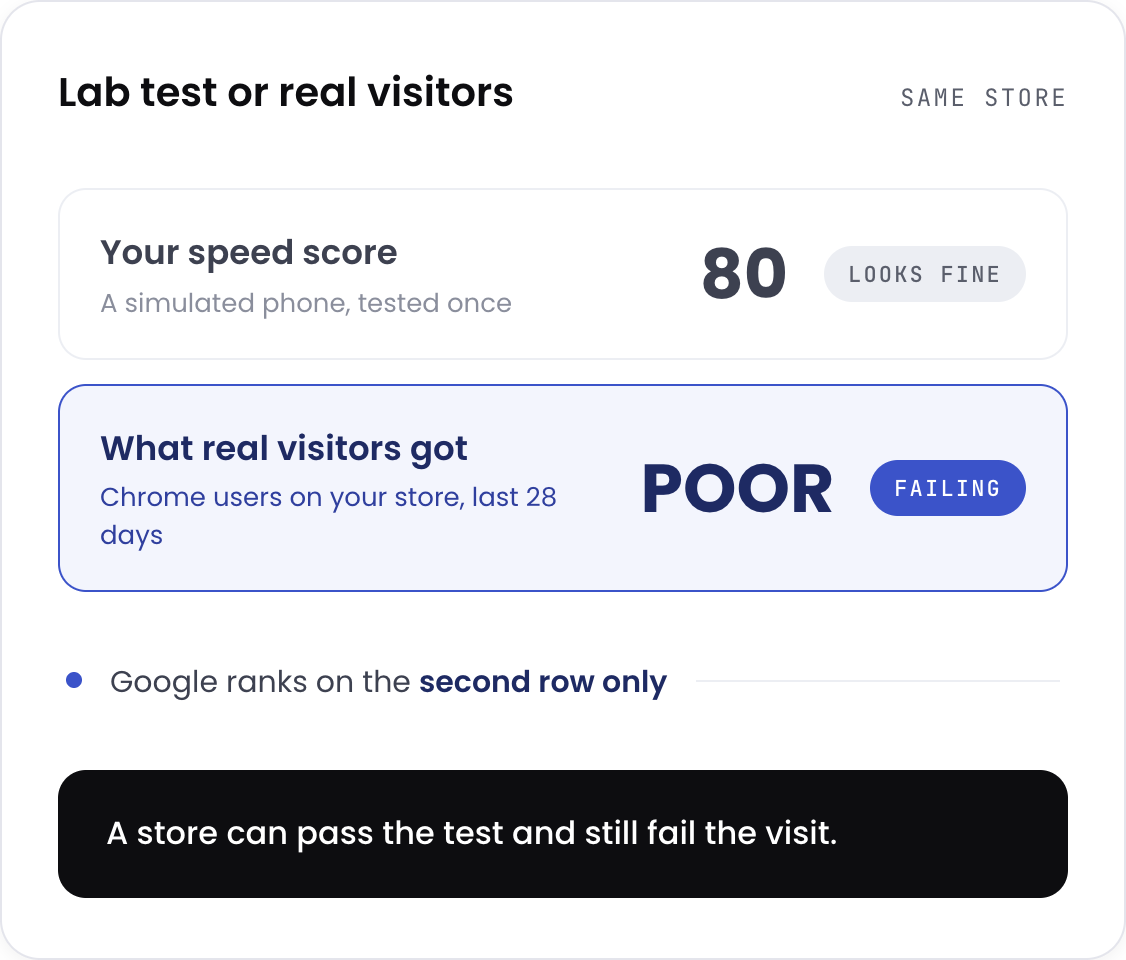
Shopify’s built-in Speed Score is a Lighthouse lab test from a single location on a simulated device. Google’s ranking signal uses CrUX field data - real user measurements aggregated over 28 days. A store can score 80 on Shopify’s tool while Google Search Console shows “Poor” CWV. Optimizing for lab scores without validating against field data produces no ranking benefit.
Fix: Optimize for CrUX field data via GSC; not just Shopify’s lab tool
FAQ

Shopify Core Web Vitals Optimization - Common Questions

Most engagements run 4–6 weeks. Phase 1 (Audit) is Days 1–3. Phase 2 (Strategy) is Days 3–5. Phase 3 (Implementation) is Weeks 2–4. Phase 4 (Validation + Reporting) is Weeks 4–5. Shopify Plus stores with checkout.liquid optimization or very large app ecosystems run 5–7 weeks. We provide a specific timeline estimate after the initial audit, not before.
No. Every optimization we implement is non-destructive to visual layout. Image optimization preserves visual fidelity. JavaScript deferral is sequenced so functionality remains intact. CSS changes are additive, not replacement. We run full visual regression checks after each implementation layer. If a change would affect design or functionality, we flag it in the Strategy phase before implementation begins.
Shopify's built-in Speed Score is a Lighthouse lab test run from a single location on a simulated mobile device. It's a useful benchmark but not what Google uses for ranking. Google's Core Web Vitals ranking signal comes from CrUX (Chrome User Experience Report) - real user measurements from actual Chrome browsers, aggregated over 28 days. A store can score 80+ on Shopify's tool but still be flagged as 'Poor' in Google Search Console's CWV report. We optimize for field data outcomes, not lab scores.
Not always. The issue is usually how apps load, not whether they're installed. Most app scripts can be correctly sequenced - deferred until after the critical rendering path - so they don't affect LCP or INP. The exception is truly redundant apps and, critically, remnant code from apps you've already uninstalled. Dead script tags from past app installs are one of the most common LCP killers we find. Those are removed entirely.
Yes. Shopify Plus merchants with checkout.liquid access can have checkout performance included in the engagement. Checkout CWV matters for two reasons: (1) Google Ads Quality Score considers the CWV of landing pages in your ad campaigns, which can include checkout; (2) INP during checkout interactions directly affects conversion rate. We audit and optimize checkout.liquid as a separate phase for Plus engagements.
Google's 'Good' thresholds: LCP ≤ 2.5s, INP ≤ 200ms, CLS ≤ 0.1. These are the thresholds that trigger positive ranking signals in Google Search. For LCP, we typically achieve 1.8–2.3s on well-structured Shopify themes. For INP, 100–180ms is achievable on most stores. CLS ≤ 0.05 is the practical target we aim for (well inside the 'Good' threshold) to maintain margin as content changes.
Yes - Dawn, Prestige, Impulse, Turbo, Pipeline, and fully custom themes. Custom themes built by agencies sometimes have unique performance constraints (non-standard section architectures, proprietary JS frameworks, custom Liquid patterns) that require theme-specific diagnostic approaches. We catalogue the theme structure during the audit phase before determining the implementation approach.
Core Web Vitals are a confirmed Google Search ranking factor via the Page Experience signal. Stores with 'Poor' CWV across key page types (home, collection, product, checkout) are at a ranking disadvantage for competitive keywords, especially on mobile. The effect is most pronounced for stores targeting high-competition head terms where other ranking signals are roughly equal. CWV improvements also reduce bounce rate, which further compounds SEO performance through engagement signals.
Full Lighthouse run (mobile + desktop), PageSpeed Insights lab + field data, GTmetrix waterfall analysis, CrUX field data from Google Search Console, TTFB measurement by page type, complete app script inventory (every injected script tagged to its source), image bottleneck identification (uncompressed assets, missing lazy loading, wrong format), and a prioritized fix list with projected metric shifts per fix. The report is a working document, not a PDF to file away.
Each engagement concludes with a Maintenance Checklist - a protocol for evaluating new app installs before they go live, image upload standards, and quarterly CWV monitoring checkpoints. We also set up real-user monitoring via Google Search Console's CWV report during the validation phase. Extended retainer arrangements are available for Shopify Plus brands that install apps regularly or run frequent theme updates.
Free Shopify Speed Audit

Your Shopify Store Has a Speed Problem.
We’ll Find Exactly What It Is.

We run your site through PageSpeed Insights, Lighthouse, CrUX, and GTmetrix, identify every render-blocking script, image bottleneck, and Shopify-specific issue, then deliver a prioritized fix list with projected metric shifts. No pitch call. No templates. Shopify-specific diagnosis only.

70%
Avg load time reduction
4–6
Weeks to “Good” CWV
50+
Shopify stores optimized
Book Free Speed Audit
No credit card. No commitment. Shopify stores only.
Audit delivered in 48 hours
Shopify-specific, not WordPress advice
Implementation included, not just a report