












Blogs Free Strategy Call
Conversion Rate Optimization

Shopify Conversion Rate Optimization That Fixes the Pages That Earn

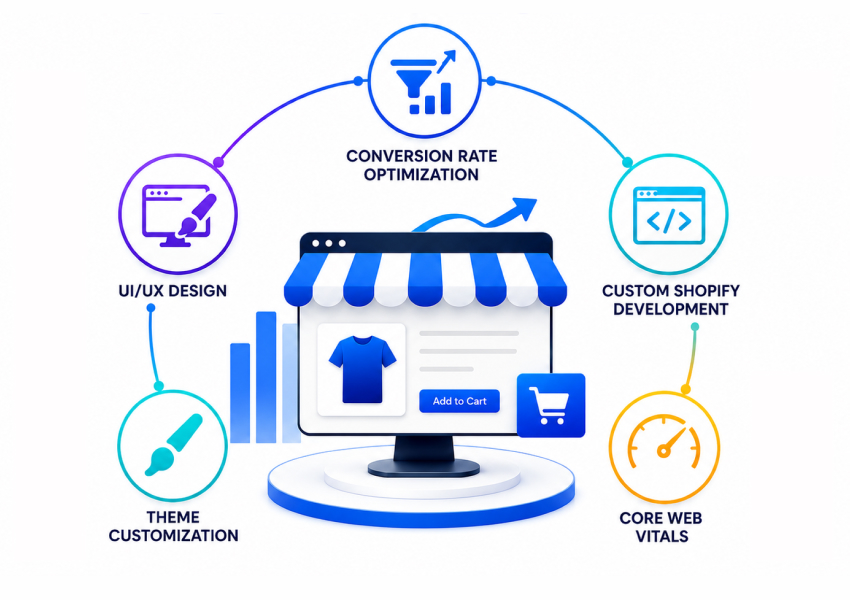
Our conversion rate optimization services work on your top four to ten revenue pages, using behavioural data and A/B testing. Not a full site redesign that takes six months and proves nothing.

Conversion rate optimization results across a small stack of high-revenue Shopify pages
Trusted by Shopify brands
Not a redesign

What is ecommerce CRO, and how is it different?

Conversion rate optimization is the work of getting more of the people already on your store to buy. No extra traffic, no extra ad spend. The same visitors, converting better.

What makes Shopify conversion optimization its own discipline is where the friction actually sits. It is rarely the whole store. It is a review block buried below the fold, a mobile checkout button that renders off-screen, a shipping calculator that demands a postcode before it will show anything. These are theme-level problems with theme-level fixes, usually concentrated on a handful of pages.

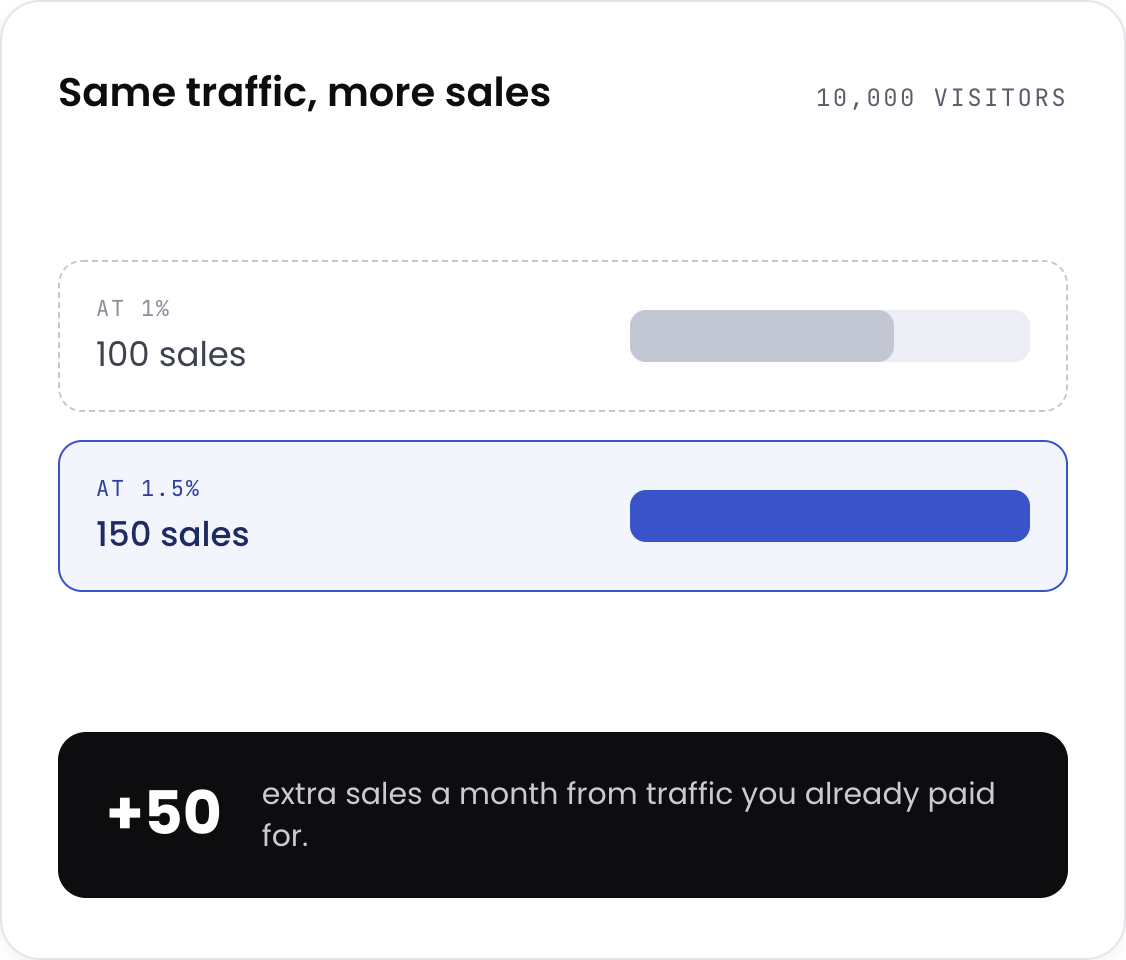
Move a store from 1% to 1.5% on 10,000 monthly visitors, and that is 50 extra sales a month from traffic you already paid for.

Where conversion friction actually sits on a Shopify store, concentrated on a handful of pages
The four pillars

Every engagement covers four pillars

Our CRO services run all four, and each has a named outcome you can check against.

01/04

Find the pages that matter

Rank every page by traffic multiplied by revenue, score friction by severity, lock a stack of four to ten.

What changes You stop spreading effort across pages that were never going to move the number.
02/04

Watch real behaviour

Heatmaps, session recordings, scroll depth and rage clicks across the stack, top three friction points named per page.

What changes You see why people leave, with evidence, instead of guessing.
03/04

Remove the friction

Reviews and trust signals repositioned, objections answered on the page, mobile layout and checkout fixed.

What changes The reasons people hesitated stop being there.
04/04

Prove it with testing

Every change runs as an A/B test to statistical significance before rollout; winners scaled to similar pages.

What changes You know which changes earned money, not which ones looked better.

Every engagement includes a monthly report showing what was tested, what won, and what is next.

Common mistake

Most stores redesign the whole site

The money is on four pages.

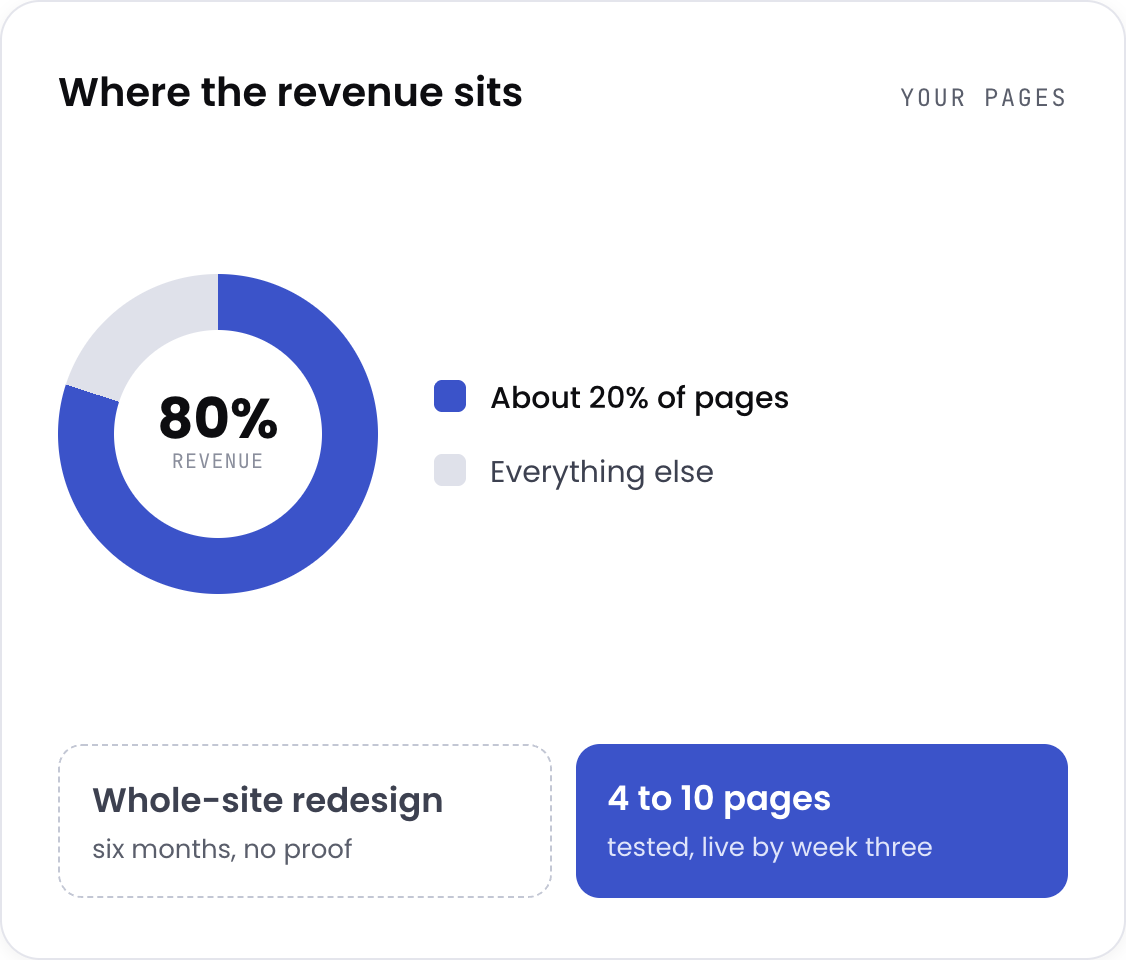
A full redesign takes six months, costs a fortune, changes a thousand things at once, and teaches you nothing, because you cannot tell which change did what. Meanwhile, roughly 80% of a store's revenue comes from about 20% of its pages.

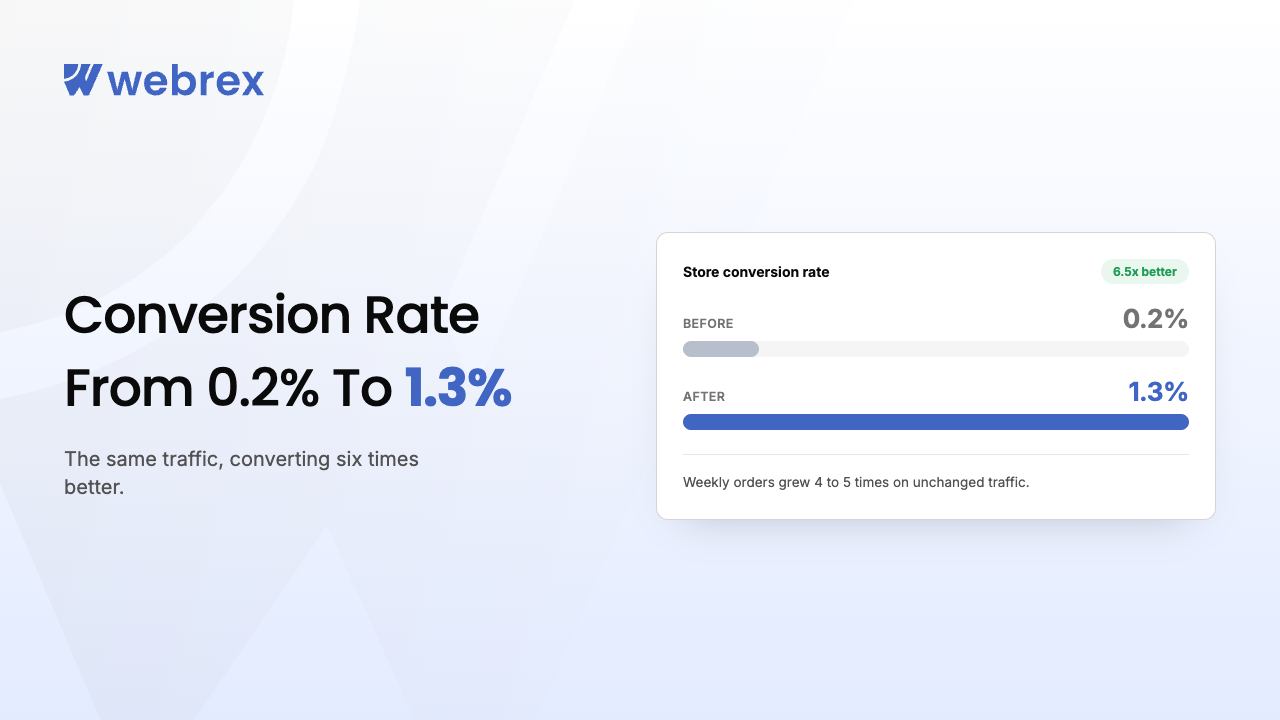
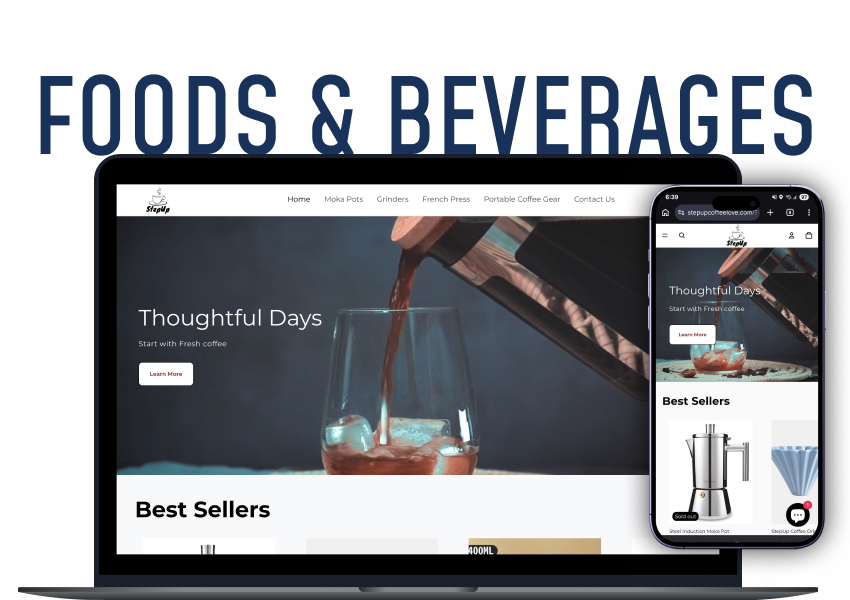
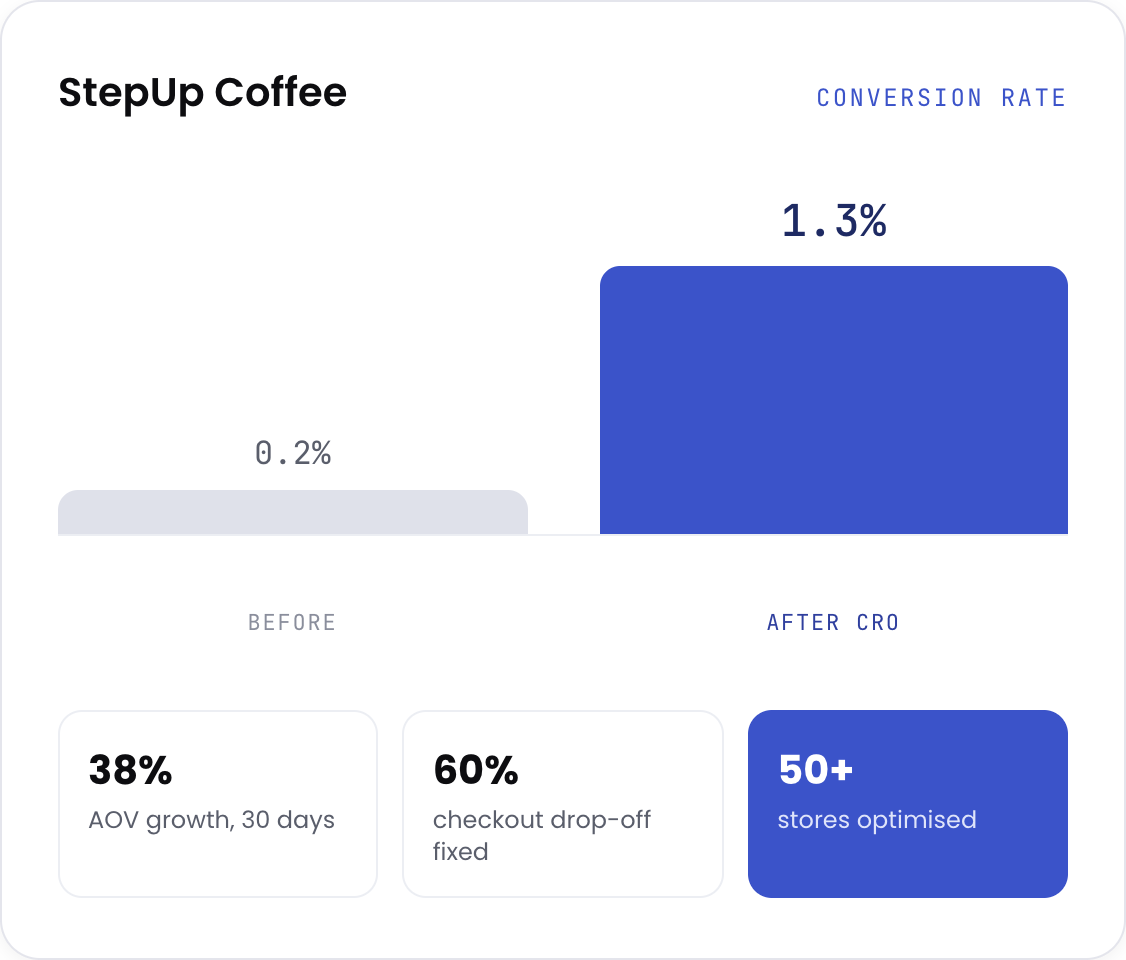
StepUp Coffee went from 0.2% to 1.3% conversion. Weekly orders went from roughly 1 to 4 or 5. There was no redesign. The store had no tracking or attribution structure at all, so nobody could see where buyers were dropping. Once that was visible, the fixes were obvious and small.

What most stores do versus what actually moves conversion rate
Our process

The Webrex Growth Framework

1
Phase 01

Discover

Rank pages by traffic and revenue, deploy heatmaps and session recordings, score friction per page. You get the stack and the evidence in week one.

2
Phase 02

Decide

A conversion hypothesis for every friction point, ordered by expected revenue impact. You see the test queue before anything is built.

3
Phase 03

Implement

Variants built and deployed directly in your Shopify store, tracking verified. Optimised pages live by week three.

4
Phase 04

Validate

Every variant runs to statistical significance. Winners roll out across similar pages; losers get documented and iterated. The stack expands monthly.

Proof, not promises

Real stores, real numbers

Fit check

Is this a fit?

Good fit if you

  • Run a Shopify or Shopify Plus store with at least 3,000 monthly visitors to the pages we would work on
  • Already get traffic and know it is not converting the way it should
  • Want changes built and shipped, not a slide deck of recommendations
  • Can wait four to six weeks for a test to reach significance rather than judging it on day two

Not a fit if you

  • Have very low traffic, where a test can never reach significance. Direct fixes still help, but you will not get proof
  • Want a brand redesign. That is our UI/UX Design service, not this one
  • Know your tracking is broken. Fix that first with Conversion & Analytics, because we cannot measure a lift on numbers that were never right
  • Need results this week. The testing is the point, and testing takes time

If you are in the second list, say so on the call. We will tell you what we would do instead, even if it is not us.

Straight answers

Common questions

01What is a conversion rate?
The percentage of visitors who do the thing you want. On a store, that means buying. If 1,000 people visit and 15 buy, your conversion rate is 1.5%. Shopify calculates it for you under Analytics, though it counts sessions rather than people, so a customer who visits three times before buying shows up as three sessions and one sale.
02What is conversion rate optimization?
Getting more of your existing visitors to buy, rather than buying more visitors. It works by finding where people hesitate or leave, removing that friction, and testing the change to confirm it actually helped. On ecommerce, it usually means product pages, collection pages, and checkout, because that is where the money is decided.
03How to increase conversion rate on a website?
Find the pages that carry your revenue, then find where people stop on them. Watch session recordings before you change anything, because the thing costing you sales is rarely the thing you assumed. The reliable ways to boost conversion rate on an ecommerce site are consistent: move reviews above the fold, answer objections on the page rather than in a policy link, put shipping cost near the buy button, and fix the mobile checkout, which is usually where the sharpest drop sits. Then change one thing at a time and measure it. Changing five things at once tells you nothing about which one worked.
04What is a good conversion rate on Shopify?
Most Shopify stores sit between 1% and 2%. Above 3% is strong. But the benchmark that matters is your own last quarter, because conversion rate varies enormously by category, price point, and traffic source. A store selling £500 furniture and one selling £15 candles should not be compared.
05How do I increase conversion rate on Shopify?
Start where the traffic already is. Move reviews above the fold, answer the top five objections on the page itself, put shipping and returns near the buy button rather than in the footer, and check what your mobile checkout actually looks like on a phone. Then test one change at a time so you know which one worked. Most stores have three to five fixes worth 15 to 40%.
06How long before we see results?
Optimised pages are live by week three. First validated results at four to six weeks, once tests reach statistical significance. Higher traffic reaches significance faster.
07Do you redesign the whole store?
No. We work on the four to ten pages carrying your revenue. Faster results, cleaner data, and you can see what each change did.
08What traffic do I need for this to work?
Around 3,000 monthly visitors to the pages in the stack, so A/B tests can reach significance. Below that, we can still remove obvious friction, but you will not get statistical proof it worked.
09Do you need access to our store?
Yes. Shopify admin with theme write access, your analytics, and your review platform. All handled through a secure Shopify collaborator invite.
10Will CRO affect our SEO?
Positively. Pages that convert better tend to hold attention longer, which helps rather than hurts. The two compound.
Free Strategy Call

Ready to Grow Your Store?

Proven SEO, performance & CRO strategies to scale your Shopify brand.

+1 (787) 468-5765