











Client: Vastranand | Industry: Fashion & Apparel | Service: Website Speed Optimization | Platform: Shopify | Timeline: 2 June – 1 July 2026 (under 30 days)
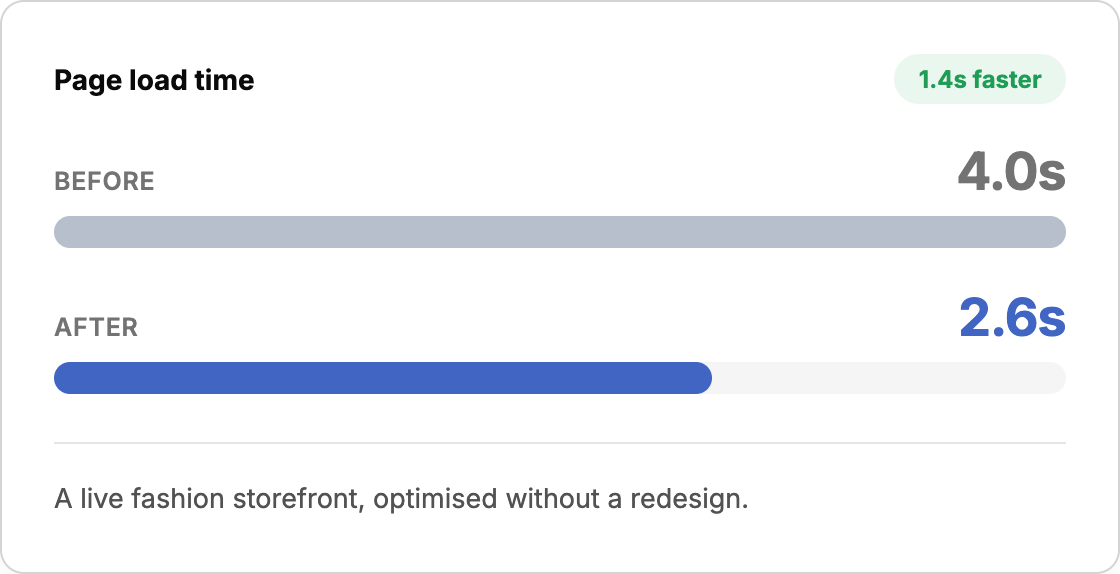
In under a month, we made Vastranand's Shopify store a lot faster, without a redesign or a single paid speed app. The main part of the page used to take about 4 seconds to load. We got it down to 2.6 seconds, enough to pull the store into Google's "good" zone.
Loading time cut from 4.0s to 2.6s (~35% faster). Google rating moved from "Needs work" to "Good." Zero redesign. Zero new apps. Under 30 days.
The Snapshot
| What we looked at | Before | After |
|---|---|---|
| Page load time | 4.0 seconds | 2.6 seconds |
| Google speed rating | Needs work | Good |
| How long it took us | — | Under 30 days |
| Redesign needed | — | None |
| New apps installed | — | Zero |
The Problem: A Great Store That Made People Wait
Vastranand's store had plenty of effort put into it. The design looked sharp, the products were well presented, and shopping through it felt smooth. But it had a quiet problem the owner couldn't see: it was slow to load.
Here's something most store owners don't realize. Google keeps a stopwatch on your site. It measures how long it takes for the largest element on the screen, usually the main banner image at the top, to appear. For this store, that number was stuck at around 4 seconds. Anything that slow gets a "needs improvement" flag, which sits just one step away from "poor."
Four seconds doesn't sound like much when you say it out loud. But online, it's an eternity. Most people won't wait. Every extra second staring at a half-loaded page is another reason to give up and leave, and a slow store quietly loses sales it never even knew it had. It can also hold you back in Google search, because Google prefers to send people to fast pages.
The owner came to us with one clear rule: Make it faster, but don't change how the store looks and don't remove anything that works. That's exactly what we set out to do.
What Was Actually Slowing It Down
Before touching anything, we looked under the hood to find the real cause. A few things stood out.
- Everything was trying to load at once: The design code, the scripts, and the images all rushed to load at the same moment and fought for the same space, so nothing loaded quickly. It was like everyone squeezing through one door at once.
- The main banner loaded late: The big image at the top, the first thing anyone sees, wasn't treated as important. So visitors sat looking at space while smaller, less important things loaded first.
- The apps were adding weight: Every app the store used quietly added a bit of extra baggage to each visit. One or two is fine. But stacked together, they added up and dragged the whole page down.
- The text arrived late too: The custom fonts were being fetched too slowly, adding one more small delay before the page felt finished.
None of this was Shopify's fault. It was the normal build-up of theme code, apps, and old habits that almost every growing store collects over time without noticing.
What We Did (No New Apps, No Redesign)
Most people try to fix speed by installing yet another speed app. That usually backfires, because it just adds more weight. We went the other way and cleaned up the store's own foundation.
Five steps:
- We found the real bottleneck: We tracked exactly what was loading, in what order, and pinpointed the one thing making shoppers wait the longest.
- We let the important things load first: We told the non-urgent code to wait its turn, so what a shopper actually sees appears right away instead of getting stuck behind background tasks.
- We put the main banner at the front of the line: We resized it properly and told the browser to load it first, so the top of the page appears almost instantly.
- We trimmed the theme: We cleared out leftover and unnecessary code, so the store had less to chew through on every single visit.
- We watched it for weeks: We tracked the speed day by day to make sure the improvement was real and lasting, not a one-time lucky reading.
The Results
Here's what changed, in plain numbers:
- Loading time: 4.0 seconds → 2.6 seconds
- Roughly 35% faster
- Google rating: "Needs work" → "Good"
- Time it took: under one month
- New apps added: zero
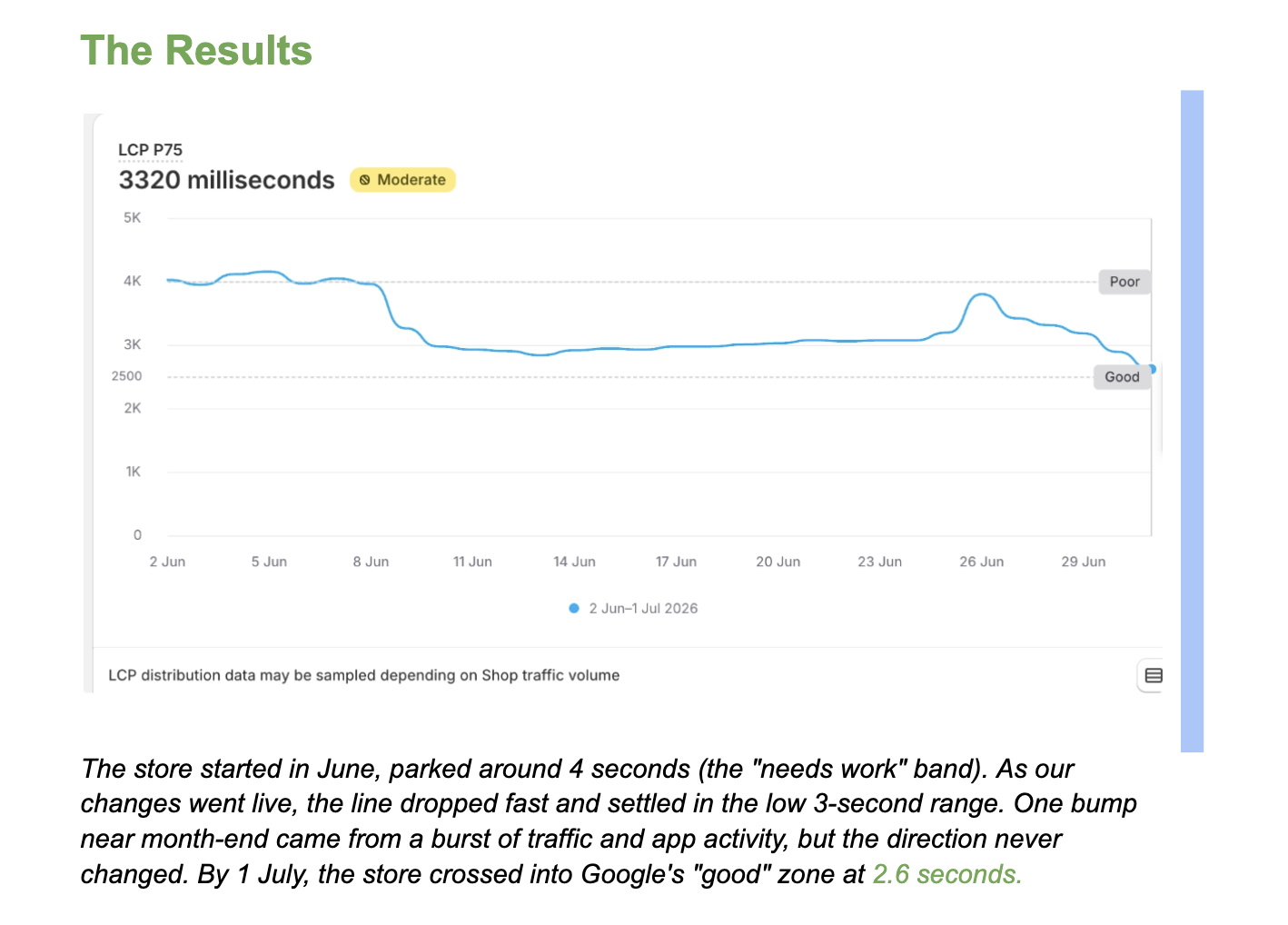
The store started in June, parked around 4 seconds (the "needs work" band). As our changes went live, the line dropped fast and settled in the low 3-second range. One bump near month-end came from a burst of traffic and app activity, but the direction never changed. By 1 July, the store crossed into Google's "good" zone at 2.6 seconds.
Why It Actually Worked
It really comes down to one thing: How fast can the browser show a visitor the main part of the page? When the code is all fighting for space and the big image loads late, people just sit there waiting. Clear that jam, load the stuff that matters first, and the page shows up quick.
And this wasn't some temporary trick. Caching apps and quick fixes can make a store look fast for a day or two, then it slips right back. We fixed the actual foundation, so every visitor gets the faster experience, not just whoever happens to catch it on a good day.
The Takeaway for Store Owners
If your store feels slow, the culprit usually isn't Shopify. It's the theme, the apps, and the order things load. The good news is that all three can be fixed without a redesign.
You don't have to rebuild your store to make it fast. You need someone to find what's dragging it down and clear the path. For Vastranand, that took less than a month, and now every shopper who lands on it gets a quicker, smoother experience from the very first second.