















Explore how Hero Life Care achieved $23K in Shopify revenue gains — see the case study

See how we turned raw product photos into 50% higher-converting images — view case study

Shopify Theme Development Agency

Build Themes That
Rank, Convert
& Scale

Webrex Studio builds Shopify themes with Liquid-first architecture — server-side canonicals, filter URL control, and Core Web Vitals optimisation engineered in from the start.

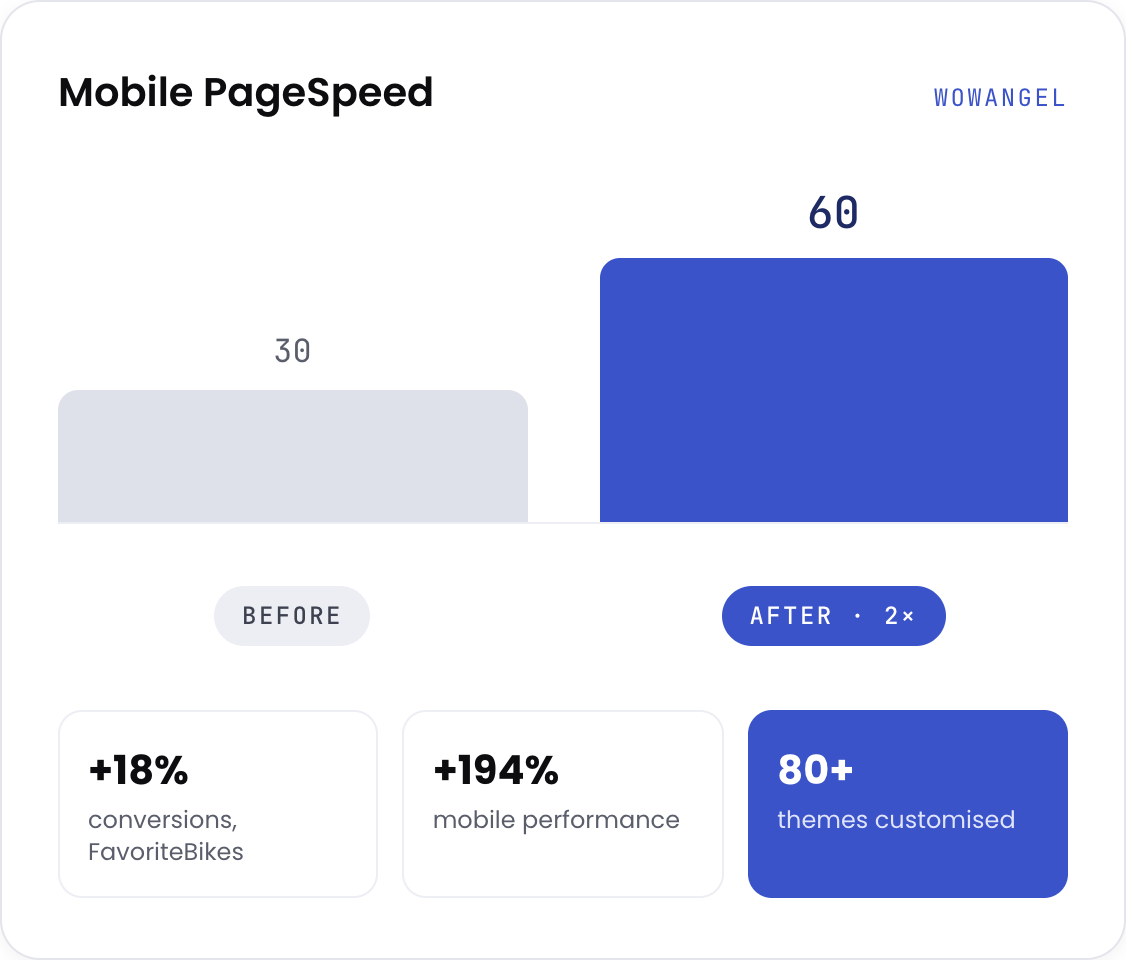
80+ Stores Customised
£4.2M+ Revenue Impact
34% Avg CWV Gain
100% Server-Side Liquid

Shopify Theme Development Done Right Is Architectural, Not Cosmetic

Most Shopify stores run on out-of-box themes that silently block organic growth. Generic layouts create duplicate content, slow load times, and filter URLs that spiral into crawl dead ends. Shopify theme development done right isn't cosmetic — it's architectural.

Theme structure determines what Google crawls, what converts, what loads first. Wrong Liquid implementation creates JS-dependent content Googlebot can't read. Wrong filter logic creates millions of junk URLs overnight. These aren't design problems — they're revenue problems.

Webrex Studio approaches every theme project from an SEO-and-conversion-first position. Customisations go server-side in Liquid — no JS injection, no render-blocking scripts. Filter URL canonicalisation is baked into build scope. Schema stays conflict-free with the Webrex AI SEO Optimizer app. Themes built here rank, convert, and scale.

SEO-Native

Server-side Liquid for all canonical, robots, and H1 signals. Never JS-injected.

Filter-Safe

3-rule indexing framework prevents junk URL proliferation from Day 1.

CWV-Optimised

LCP ≤ 2.5s as a hard build target. Validated with PageSpeed Insights field data.

Services

Our Shopify Theme Customization Services

High-performance Liquid development that prioritises search visibility and user experience — built server-side, every time.

Custom Liquid Development

Server-side Liquid only. No JS hacks, no render-blocking scripts, no Googlebot blind spots. Every content, navigation, and meta element rendered in Liquid.

Filter Navigation Architecture

SEO-safe filter page structure using the 3-rule indexing framework. Prevents junk URL proliferation at source. Multi-filter URLs canonicalised to base collection.

Dynamic H1 & Metadata Logic

Filter-value-composited H1s built via Liquid metafields. Context-aware title/description injection per collection, product, and filter state.

Core Web Vitals Optimisation

LCP ≤2.5s, FID <100ms, CLS <0.1 as hardcoded build targets. Aligned with our Shopify speed benchmarks.

Schema Injection Integration

Theme builds tested against Webrex AI SEO Optimizer app. Single-source schema architecture — zero duplicate Product or Service conflicts.

Shopify Plus Customisation

Checkout extensibility, B2B-gated sections, and custom metafield display. Tailored for complex catalogues and multi-market scaling.

The Webrex Way

The SEO-Native Theme Build Framework

Most Shopify theme agencies stop at visuals. Webrex goes deeper — into the Liquid architecture that actually determines rankings.

Server-Side Liquid = Guaranteed Crawlability

Every build starts with a technical crawl audit: mapping what the current theme serves to Googlebot vs. what users see. JS-rendered content, filter URL sprawl, duplicate metafields, schema conflicts — all diagnosed before one line of Liquid changes.

Implementation follows a strict server-side-first rule. Content, navigation, canonical signals, indexing directives — rendered in Liquid, not JavaScript. This matters because Googlebot's JS rendering queue is unreliable. Server-side Liquid = guaranteed crawlability, at any scale.

snippets/seo-canonical-robots.liquid
{%- comment -%}
  3-rule filter framework — Webrex Studio
{%- endcomment -%}

{% if paginate.items >= 5 %}
  <meta name="robots" content="index, follow">
  <link rel="canonical"
       href="{{ canonical_url }}">
{% else %}
  <meta name="robots" content="noindex, follow">
  <link rel="canonical"
       href="{{ collection.url }}">
{% endif %}
Build Target Zero JS · Guaranteed crawl
01

Crawl Layer

Robots.txt access preserved for all filter URL patterns. Multi-filter URLs stay crawlable so Googlebot reads noindex/canonical signals.

02

Indexing Layer

3-rule filter framework in Liquid. Prevents junk URL proliferation while ensuring priority filters are indexed — same system behind our technical SEO service.

03

Content Layer

Dynamic H1 composed from filter values + collection noun via Liquid metafields. Scalable — a core component of our on-page SEO workflow.

04

Schema Layer

Webrex AI SEO Optimizer handles JSON-LD. Theme code stripped of conflicting schema blocks for a single-source, conflict-free rule.

05

Performance Layer

CWV targets hardcoded. LCP hero image gets fetchpriority="high". All below-fold images lazy-loaded. Critical CSS inlined.

The Result?

Junk URLs eliminated, priority filter pages indexed, and GSC "Discovered – not indexed" queue cleared.

+340% Impressions
Workflow

Our Shopify Theme Customisation Process

A structured 4-phase approach to building high-performance, SEO-native Shopify themes.

1
Week 1

Phase 1: Discovery

  • Screaming Frog crawl + GSC coverage export
  • Identify JS-rendered content, filter URL count, CWV baselines
  • Schema conflict audit against installed apps
  • Map metafield structure for dynamic H1 requirements
Deliverable: Technical Audit Report
2
Week 1–2

Phase 2: Architecture

  • Filter URL framework design (3-rule logic)
  • Liquid snippet architecture map
  • Metafield schema for dynamic H1/meta
  • Schema injection plan (app vs. theme)
Deliverable: Implementation Blueprint
3
Week 2–5

Phase 3: Build

  • Server-side Liquid development
  • Filter canonicalisation + robots.txt integration
  • Dynamic H1 metafield setup + Liquid logic
  • CWV optimisation: image attributes, critical CSS
Deliverable: Staging theme + QA checklist
4
Week 5–6

Phase 4: Launch & Monitor

  • Pre-launch crawl validation (Screaming Frog)
  • GSC index coverage baseline
  • CWV field data monitoring (30-day window)
  • Liquid updates as collections scale
Deliverable: Live theme + 30-day Report
Why Us

Why Choose Webrex Studio for Shopify Theme Development

We combine deep technical Liquid expertise with a results-first SEO mindset.

Liquid-First Specialists

All implementation server-side. Zero reliance on JS for canonical tags, meta robots, or H1 composition. Tested and proven across 80+ stores.

SEO-Integrated by Default

Filter architecture, canonical logic, dynamic H1, and schema compatibility built into scope from Day 1 — not retrofitted after complaints.

Webrex AI SEO Compatible

Schema injection tested natively against our own app. Duplicate schema conflicts eliminated by design, not by luck.

International Standards

Webrex Studio operates from India serving UK, US, and international Shopify merchants. Shopify Partner expertise with direct implementation.

We Build, We Don't Advise

Audit, architecture, Liquid code, launch, monitoring — all in-house. Deliverables live in 5–6 weeks standard.

Technical Insights

What Actually Moves the Needle

Beyond visuals — these are the technical levers that drive SEO rankings and conversion performance in Shopify themes.

Filter URL Sprawl

Default Shopify tag combinations create exponential URL growth. 100 tags = millions of possible combinations. Must be handled at theme-level via Liquid, not app-side redirects which are too slow and leaky.

JS-Rendered Meta Tags

Apps injecting canonical/noindex via JavaScript risk Googlebot ignoring them. Server-side Liquid is the only reliable delivery method to ensure signals arrive before crawl.

Dynamic H1 at Scale

Static H1 tags = duplicate content across every filter page. Metafield-driven Liquid compositing ({filter value} {collection noun}) solves this without developer overhead per page.

Schema Source Conflicts

Shopify themes often ship with Product schema. If an SEO app is also installed, duplicate JSON-LD triggers GSC errors. Theme removal + single-app source = clean output.

paginate.items vs. collection.products_count

paginate.items returns accurate filtered product count. collection.products_count ignores active filters. Using the wrong variable creates incorrect noindex decisions on filter pages.

Core Web Vitals on Shopify

LCP is almost always the hero image. Theme-level fix: loading="eager" + fetchpriority="high" on above-fold images. Lazy load everything else, including collection grid images.

Shopify Plus Checkout Extensibility

Standard theme editor can't touch checkout. Plus merchants need Checkout UI Extensions built in Liquid/React via app blocks — handled as part of our Shopify Plus agency service.

Theme Migration Risks

Switching themes breaks heading hierarchy, schema, and filter logic. A full crawl audit before migration is non-negotiable to preserve rankings.

FAQ

Common Questions

Everything you need to know about our Shopify theme customisation services.

What's the difference between theme customisation and custom theme development?

Customisation modifies an existing Shopify theme (Dawn, Prestige, Impulse) via Liquid, CSS, and JS extensions. Custom development builds from a blank slate or bespoke framework. Customisation is faster, lower risk, and lower cost. We handle both.

Can you customise our theme without breaking current rankings?

Yes — with a proper pre-migration crawl audit. We map all canonical signals, H1s, meta robots, and schema before touching Liquid. Changes staged on dev theme, validated, then pushed live. GSC monitored for 30 days post-launch.

How does theme structure affect SEO?

Theme-level Liquid controls canonical tags, robots meta directives, H1 composition, and schema injection. Wrong implementation is the #1 cause of filter URL spam and duplicate content on Shopify. See our guide on structured data for Shopify for more schema conflict examples.

Do you work with Shopify Plus merchants?

Yes. Plus-specific scope includes checkout extensibility, B2B section gating, multi-market builds, and metafield-driven product data display for complex catalogues.

Will the customisation conflict with our installed apps?

We audit all installed apps pre-build. Known conflicts (schema apps, page builders, SEO apps) resolved before implementation begins. Native compatibility with Webrex AI SEO Optimizer guaranteed.

How long does Shopify theme customisation take?

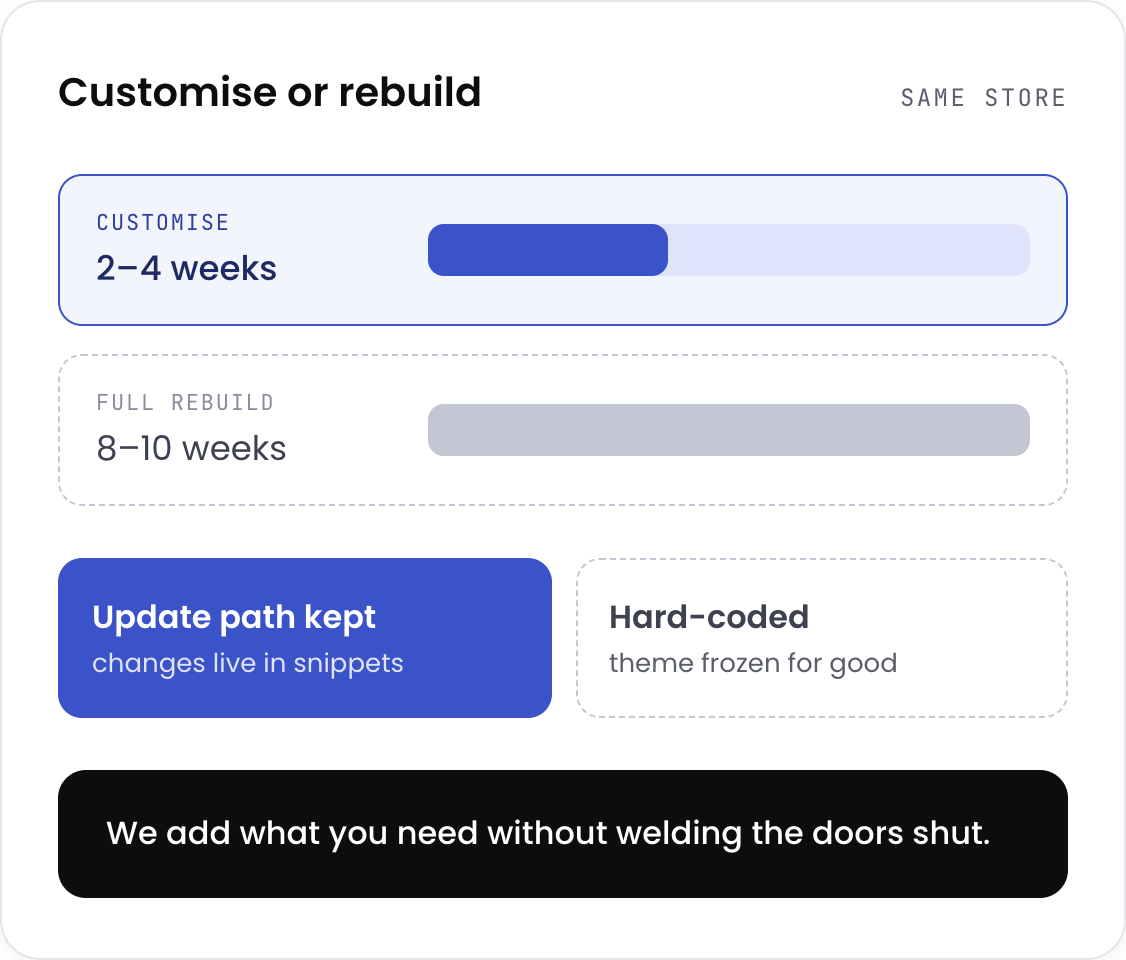
Standard customisation (Liquid, CSS, CWV): 2–4 weeks. Full SEO-native rebuild with filter architecture: 5–6 weeks. Shopify Plus builds: 6–10 weeks.

Can you improve our Core Web Vitals through the theme?

Yes. LCP, CLS, and FID are all influenced by theme-level code choices. We target LCP ≤2.5s and CLS <0.1 as standard build requirements — validated via PageSpeed Insights field data.

What Shopify themes do you work with?

Dawn, Prestige, Impulse, Debut, Kalles, Debutify, and any custom or third-party theme. Liquid is Liquid — we work with any base.
Start Your Transformation

Ready for an SEO-Native
Shopify Theme?

Theme structure either compounds or cancels every SEO and CRO effort. Stop leaving revenue on the table with generic layouts. Get a technical audit and build a theme that scales.

FREE
Initial Audit
100%
Liquid Focus
NO
JS Hacks
< 24H
Response Time