














Technical SEO Agency Specializing in Shopify Filter Page Optimization
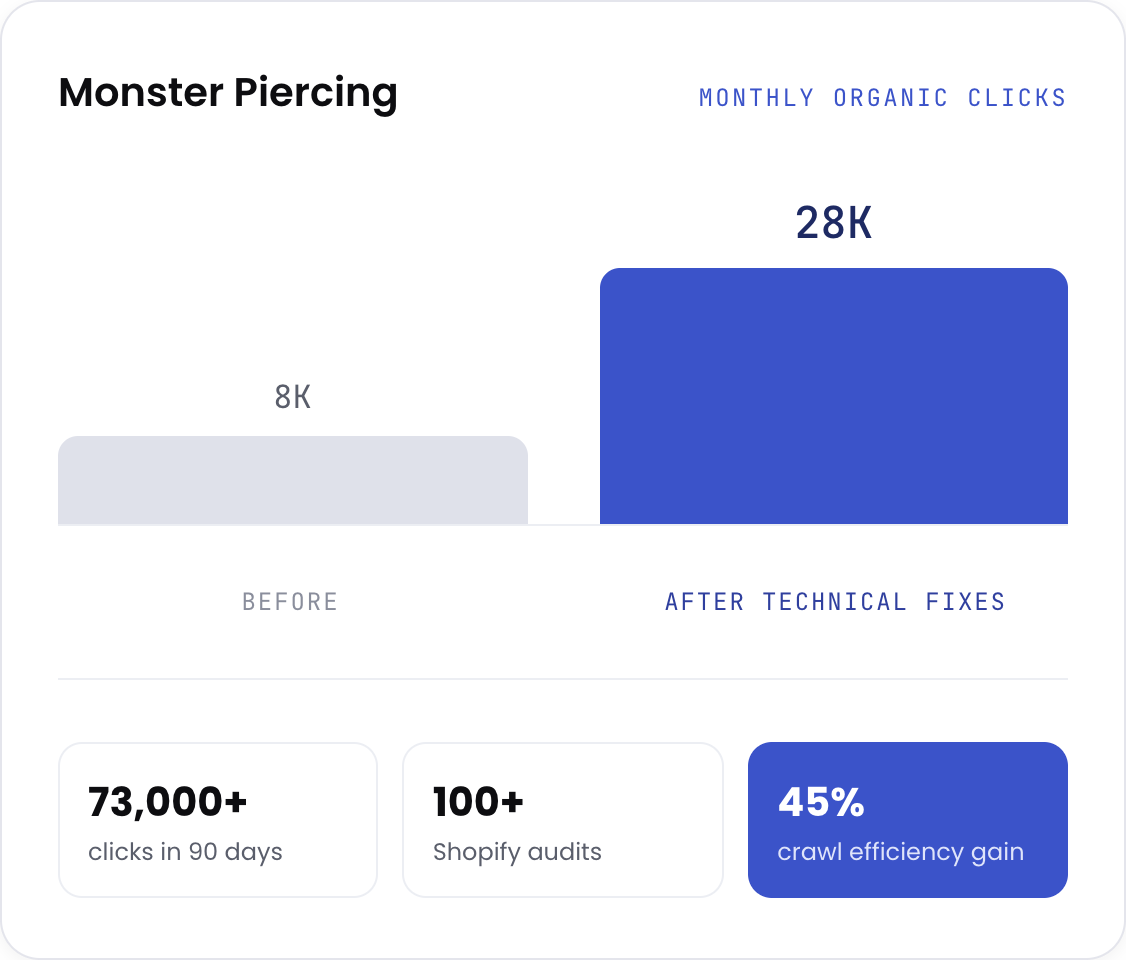
Shopify technical SEO consultants specializing in filter page indexing strategy. Strategic optimization of collection filters drives 3–5x more organic traffic than product pages alone. Average 45% crawl efficiency improvement.
Efficiency Gain
Completed
Errors Fixed
Optimization
Most Shopify stores focus technical SEO on product pages. Wrong. Filter pages drive 3–5x more traffic.
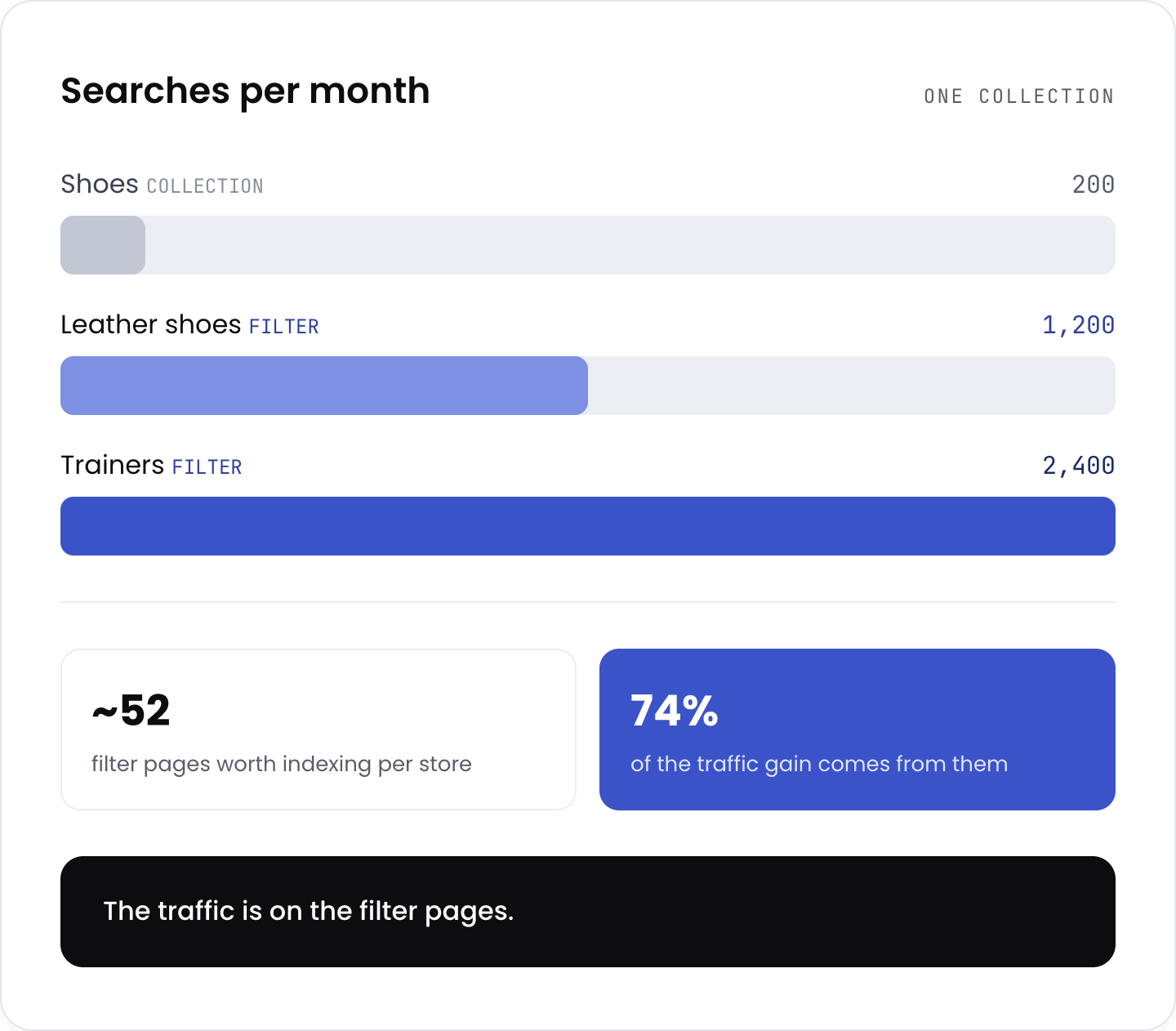
/collections/shoes = 200 searches.
/collections/shoes/material_leather = 1,200 searches.
A single collection generates 20–30 high-volume filter combinations.
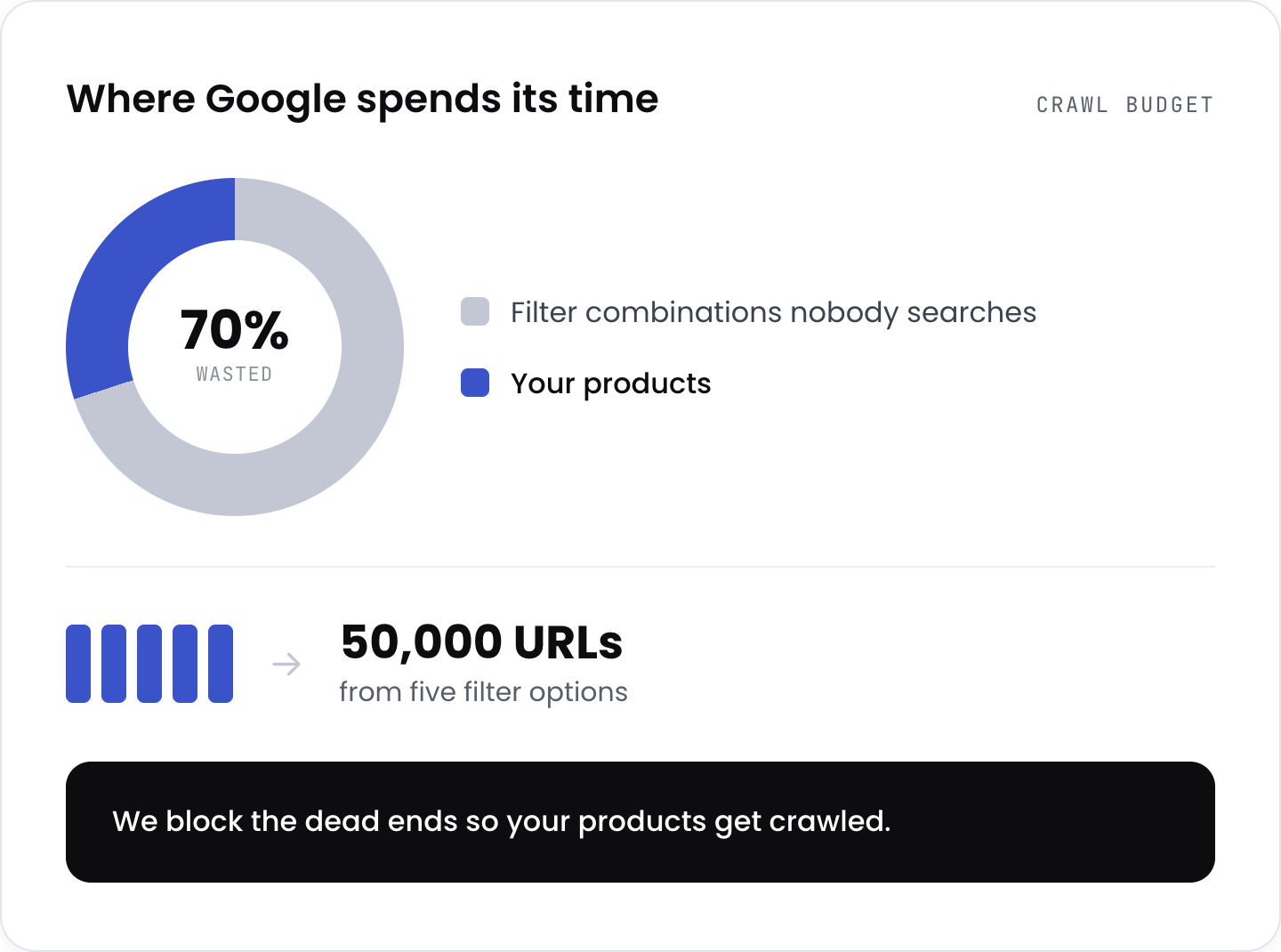
Default Shopify indexes all filters. The result: 50,000+ junk URLs, best filters buried, crawl wasted.
We specialize in Shopify filter indexing: identify high-traffic combinations via GSC + Ahrefs, implement a 3-rule framework, deploy dynamic H1s. Serving ecommerce brands across the UK, US, and internationally with specialized technical SEO services. 100+ Shopify audits completed. Average outcome: index 50–100 strategic filters, block 5,000–50,000 junk URLs, 156% traffic increase.
Our Technical SEO Services for Shopify
A complete technical SEO consultancy engagement, from filter strategy to ongoing monitoring.
Why Shopify Stores Waste 70% of Crawl Budget on Filter Pages
Filter over-indexing is the single biggest technical SEO issue on Shopify — and the most overlooked.
5 filter dimensions = 50,000+ URL combinations. Google indexes all by default.
Filter Over-Indexing in Practice
Reality: Base + 20–30 strategic filters = 80% of traffic. The remaining 49,970+ combos = <1% traffic, 70% of crawl budget wasted.
- Duplicate collection paths
- Variant URLs (?variant=...)
- Schema conflicts from apps
- Slow Core Web Vitals
- Redirect chains (3+ hops)
The 80/20: Filter over-indexing represents 70–80% of the technical SEO impact for a typical Shopify store. Fix that first.
The 3-Rule Filter Indexing Framework
A deterministic, server-rendered ruleset that decides what gets indexed — without JavaScript and without guesswork. Click a URL on the left to see how it’s classified.
Server-side Liquid detects single vs multi-filter via URL parsing, checks product count via paginate.items, and outputs dynamic robots + canonical tags.
{# snippets/seo-canonical-robots.liquid #} {# Decides robots + canonical based on URL filter structure #} {%- assign path = request.path -%} {%- assign filter_segment = path | split: '/' | last -%} {%- assign is_multi_filter = false -%} {%- if filter_segment contains '+' -%} {%- assign is_multi_filter = true -%} {%- endif -%} {%- if collection and collection.handle -%} {%- assign product_count = paginate.items | default: collection.products_count -%} {%- if is_multi_filter -%} {# Rule 3: multi-filter -> noindex, canonical to base #} <meta name="robots" content="noindex, follow"> <link rel="canonical" href="{{ shop.url }}{{ collection.url }}"> {%- elsif product_count < 5 -%} {# Rule 2: thin single-filter -> noindex, canonical to base #} <meta name="robots" content="noindex, follow"> <link rel="canonical" href="{{ shop.url }}{{ collection.url }}"> {%- else -%} {# Rule 1: strategic single-filter -> index with self canonical #} <meta name="robots" content="index, follow"> <link rel="canonical" href="{{ canonical_url }}"> {%- endif -%} {%- endif -%}
Premium Retailer: 13 → 111 Filter Pages
Traffic: 30–60 clicks → 1,539 conservative (4,616–7,693 with long-tail) by Month 12. Long-tail: 3–5 variations per page.
4 Weeks to Live Filters
- W1 GSC extraction + Ahrefs keyword research on filter values
- W2 Score filters, identify top 20–50 opportunities
- W3 Deploy Liquid snippet, dynamic H1s, internal linking
- W4 Monitor GSC, validate indexing, iterate
Our Technical SEO Audit & Implementation Process
From discovery to deployment to monitoring — four clear phases, every deliverable defined.
Screaming Frog crawl (500K URLs), GSC deep dive (filter URL analysis priority), Ahrefs keyword research on filter values, competitor filter analysis.
Map high-traffic filter combinations, implement the 3-rule framework, fix critical issues (noindex blocks, 5xx errors, missing canonicals).
Shopify: Liquid snippets, schema injection, image optimization, app conflicts, theme cleanup. Custom: developer handoff docs, code examples, testing checklist.
Monthly crawls, GSC weekly reports, Core Web Vitals tracking, schema validation.
Why Choose Our Shopify Technical SEO Consultants
Filter Page SEO Specialists
Pioneered the 3-rule filter indexing framework used by 50+ Shopify stores. Average 52 strategic filter pages indexed per store, 38K+ monthly visits from filters alone, 74% of total traffic gains.
Certified Technical SEO Experts
Shopify Plus Partner. Google Analytics, GSC, Screaming Frog certified. Deep integration expertise across Shopify admin, Core Web Vitals tools, and schema validators.
100+ Shopify Technical Audits
500-product stores to 50,000-product platforms. Average: 4,500 indexing errors, 127 high-traffic filter opportunities missed, 23 critical issues per audit.
We Implement, Not Just Recommend
Direct Liquid implementation for Shopify. Filter framework deployed Week 3. Results, not homework. Custom platforms get detailed developer handoff docs and code examples.
Technical SEO for Shopify Stores
Platform-specific issues we resolve directly in Liquid — no developer required.
01
Duplicate Collection Paths
/products/shirt, /collections/mens/products/shirt, /collections/sale/products/shirt = 3 URLs, identical content.
Dynamic canonical tags via Liquid → /products/[handle].
02
Variant URLs
/products/shirt?variant=12345 vs ?variant=67890 = separate URLs.
Canonical tags consolidate to base product. Proper schema for all variants.
03
Filter Over-Indexing
/collections/shoes?size=10&color=black creates infinite combos.
3-rule framework: (1) single-filter, 5+ products: index with dynamic H1; (2) single-filter, <5 products: noindex, canonical to base; (3) multi-filter (any “+”): always noindex, canonical to base.
04
App Conflicts
Multiple apps = duplicate Product schema.
Audit apps, disable conflicts, clean JSON-LD in theme.liquid.
05
Slow Apps
15–30 apps average. Each adds JavaScript.
Remove unused, replace with lighter alternatives, defer/async/lazy load.
06
Image Optimization
4MB image at 3000×3000px kills LCP.
Image parameters (?width=800&quality=80), WebP, lazy loading, responsive srcsets.
07
Pagination
No rel=“next”/rel=“prev” by default.
Add proper tags for Google page relationships.
Technical SEO Problems & Solutions
| Issue | Impact | Solution |
|---|---|---|
| Duplicate collection paths | Split rankings, diluted equity | Dynamic canonicals → /products/[handle] |
| Over-indexed filters | Wasted crawl, thin content | 3-rule noindex/canonical framework |
| Slow Core Web Vitals (LCP >2.5s) | Mobile penalty, −40% conversions | Image optimization, app cleanup, lazy load |
| Missing/conflicting schema | No rich snippets, lower CTR | Clean JSON-LD, app conflict resolution |
| Redirect chains (3+ hops) | Lost equity, slow crawling | Direct 301s, broken cleanup |
| XML sitemap bloat (50K+ URLs) | Google ignores, misses products | Clean sitemap, priority pages only |
| Crawl budget waste | Products crawled monthly not daily | Robots.txt, internal link restructure |
| Broken internal links | Lost equity, poor UX | Site-wide audit + fix |
| Mobile usability errors | Mobile penalty | Responsive fixes, viewport config |
| Hreflang errors | Wrong country versions rank | Proper hreflang, language structure |
Technical SEO FAQs
01
Why prioritize filter pages over product pages for Shopify SEO?
Filter pages drive 3–5x more traffic than product pages. Example: /collections/shoes (200 searches/month) generates 20–30 filter combinations like /material_leather (1,200 searches), /type_trainers (2,400 searches). Strategic indexing of high-traffic single-filter pages while blocking junk multi-filter combinations = 70–80% of technical SEO impact for Shopify stores. Most stores index 50,000+ junk filter URLs and miss this entirely.
02
What is technical SEO and why does it matter for ecommerce?
Technical SEO optimizes infrastructure — crawlability, indexing, speed, structured data — so search engines find, understand, and rank content. Duplicate URLs, over-indexed filters, slow Core Web Vitals all impact rankings and revenue. Perfect descriptions won’t rank if Google indexes 10,000 duplicate filter URLs instead of 500 products.
03
How long does a technical SEO audit take?
1–2 weeks for audit + report. Implementation: 2–4 weeks on Shopify (we implement), 4–8 weeks on custom platforms (developer required). Results visible in GSC 2–4 weeks after fixes.
04
Do I need technical SEO if I’m on Shopify?
Yes. Shopify has built-in features but also platform-specific issues: duplicate URLs from collection paths, variant parameters, over-indexed filters, schema conflicts from apps. We specialize in Shopify and implement via Liquid directly.
05
What’s the difference between technical SEO and on-page SEO?
Technical SEO = infrastructure (crawling, indexing, speed, schema, canonicals). On-page SEO = content (keywords, meta tags, headers, links). Both are essential: technical ensures Google access, on-page ensures ranking for the right keywords.
06
How do I know if I have technical SEO issues?
Check GSC: Coverage report “discovered not indexed” (crawl waste), Core Web Vitals “poor/needs improvement” (speed), indexing errors. Run a free crawl or request our audit.
07
Can you implement fixes or just audit?
We implement directly on Shopify — Liquid, schema, image optimization, theme changes, no dev resources needed. For custom platforms we provide detailed developer handoff docs, code examples, and validation checklists. Results implemented, not PDFs.
08
What tools do you use for audits?
Screaming Frog (crawling), GSC (indexing + Core Web Vitals), Ahrefs Site Audit (health), PageSpeed Insights (performance), Schema Validator, and custom Python scripts. Manual inspection always — automated tools miss context.
09
What results can I expect?
Average: 45% crawl efficiency improvement, 156% organic traffic increase within 6 months, improved Core Web Vitals (LCP <2.5s). Most stores: 4,500+ indexing errors fixed. Rankings improve 2–4 weeks after implementation as Google re-crawls and re-indexes.
Get Your Free Technical SEO Audit
Find out exactly which technical issues are costing you rankings — and what to fix first. We’ll review your Shopify store’s crawl budget, indexing coverage, Core Web Vitals, and schema. No obligation. No generic checklist. A real audit of your real store.
No commitment. See what’s broken and what it costs in lost rankings.
Get Free Technical Audit