











699% ROAS in 80 Days: How Product Selection, Not Budget, Fixed This Medical Brand's Google Ads
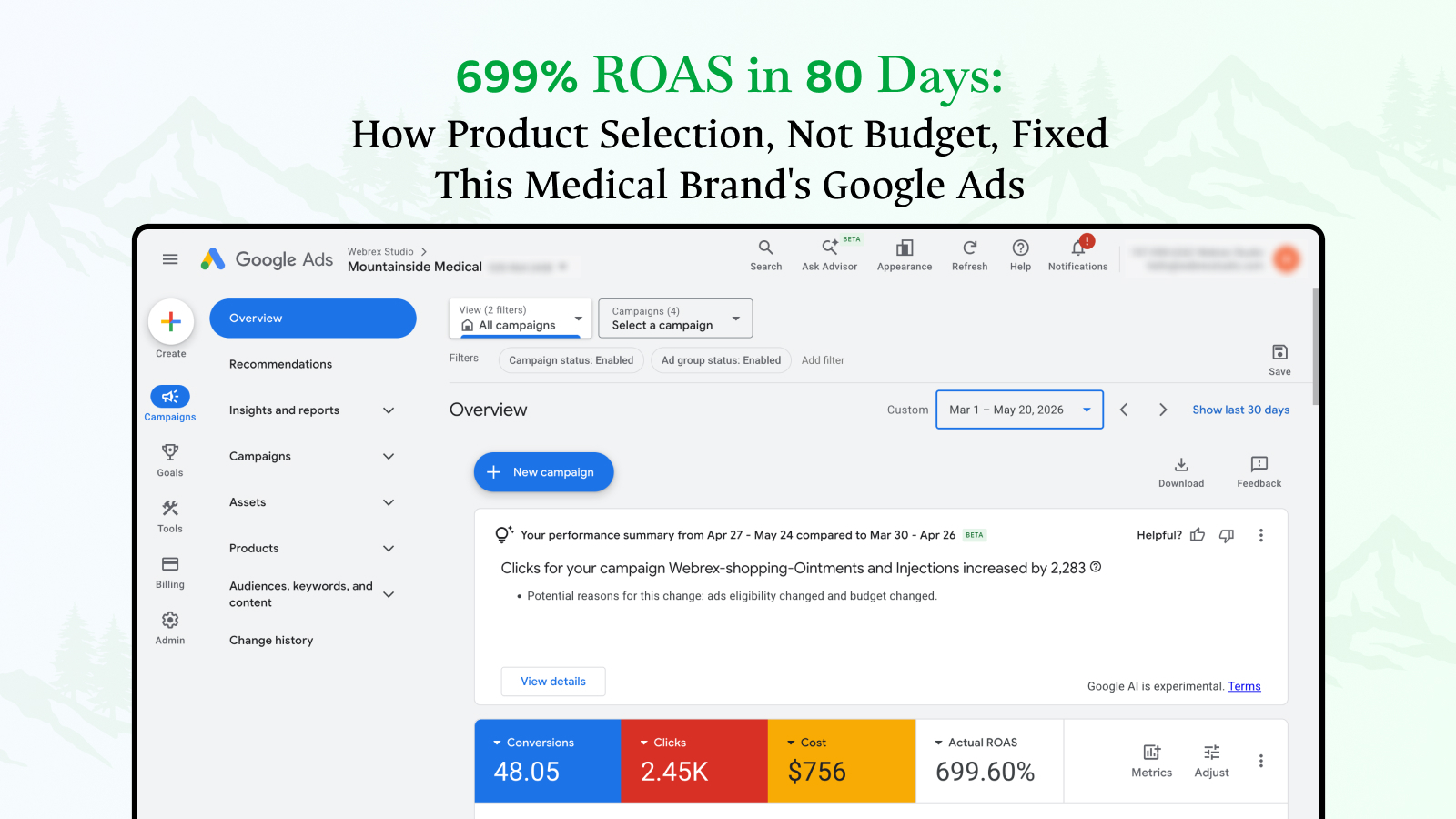
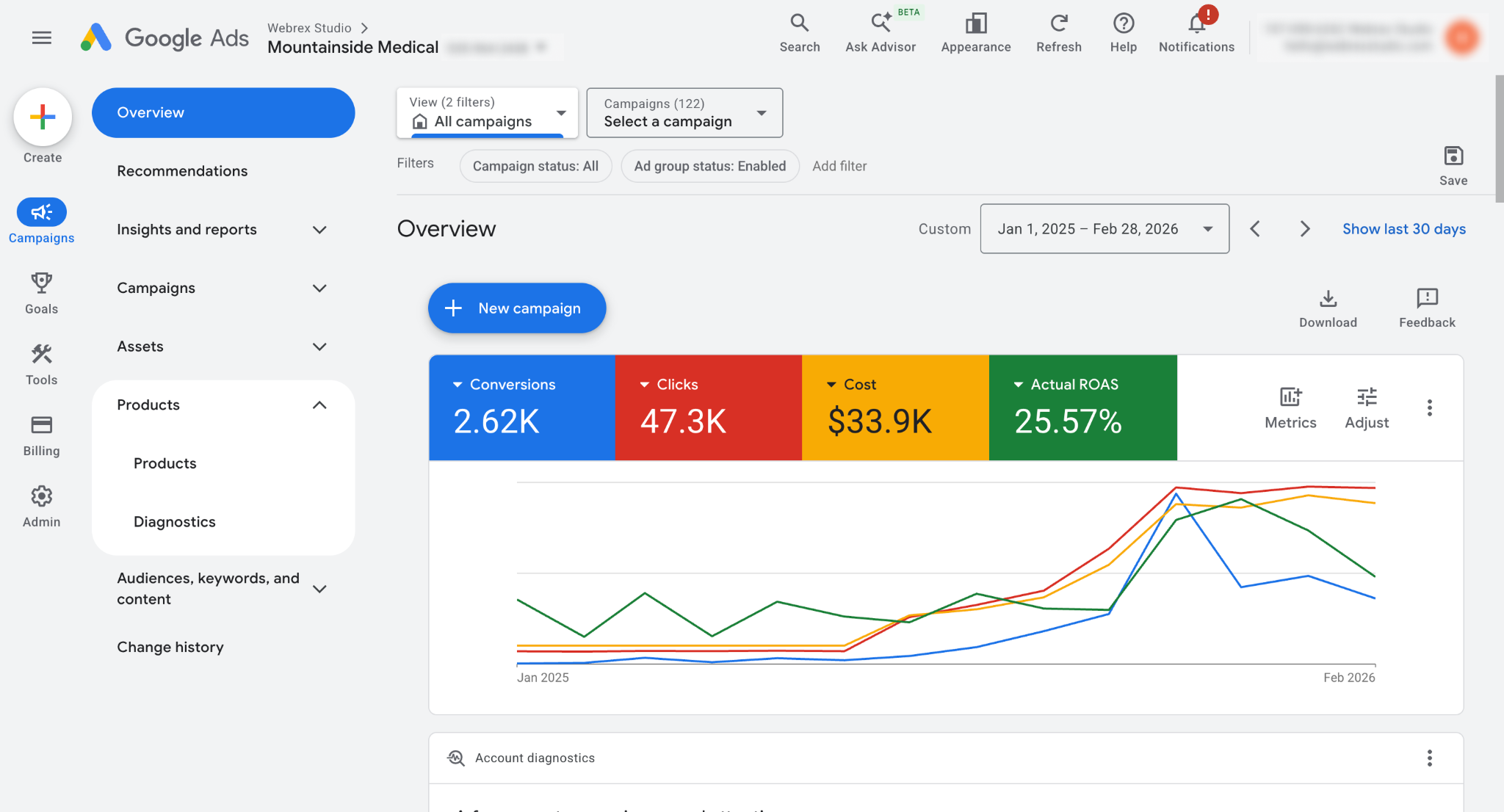
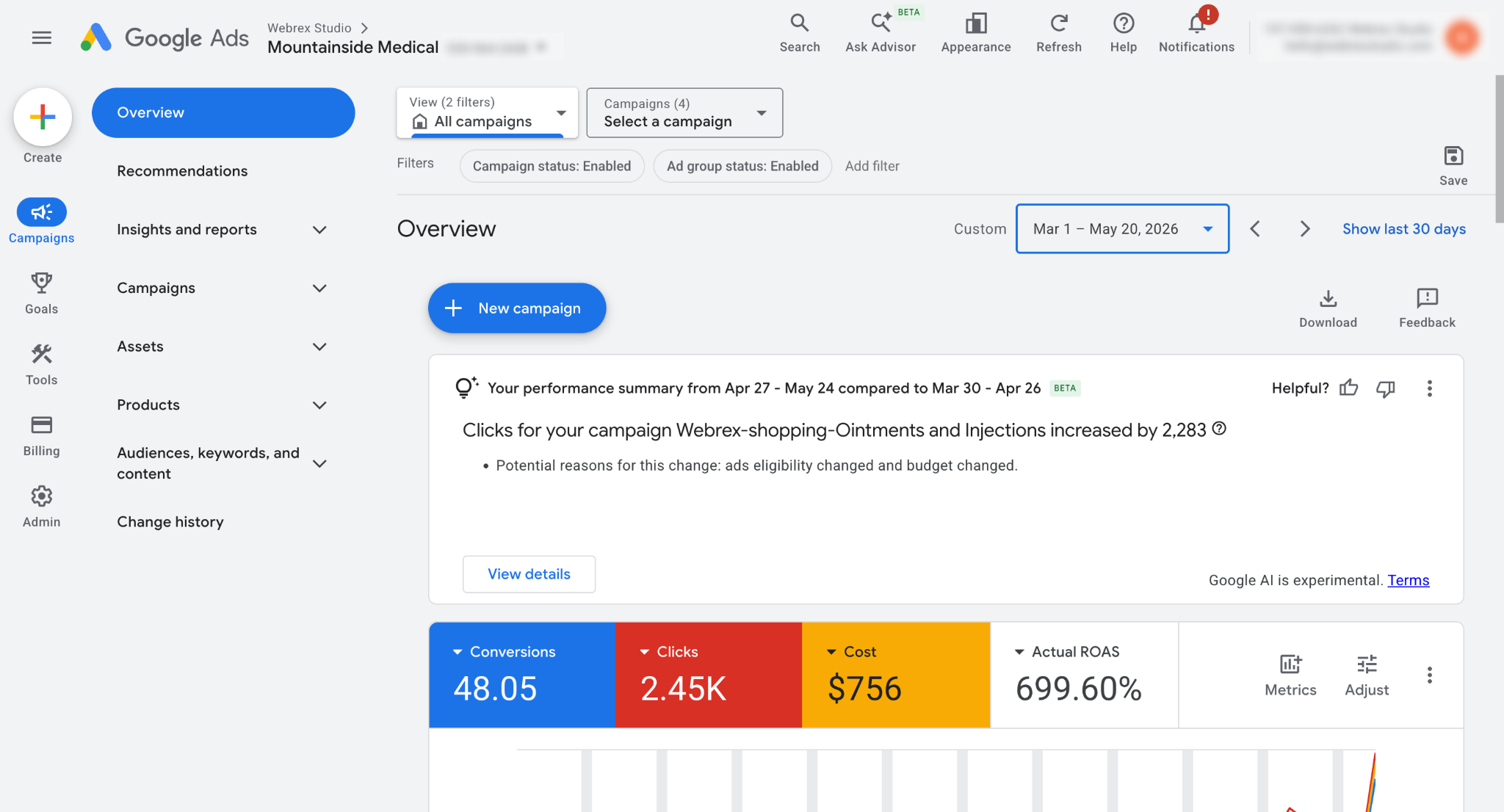
When the owner of Mountainside Medical handed us his Google Ads account, it had 122 campaigns and a 25.57% ROAS. He wasn't doing anything wrong; he was just doing everything without a system. No product selection logic, no campaign structure, no way to tell what was working. We spent 80 days fixing that. Today, the account runs 4 campaigns, spends $756 a month, and returns 699% ROAS. Here's exactly what we changed and why.
The Client
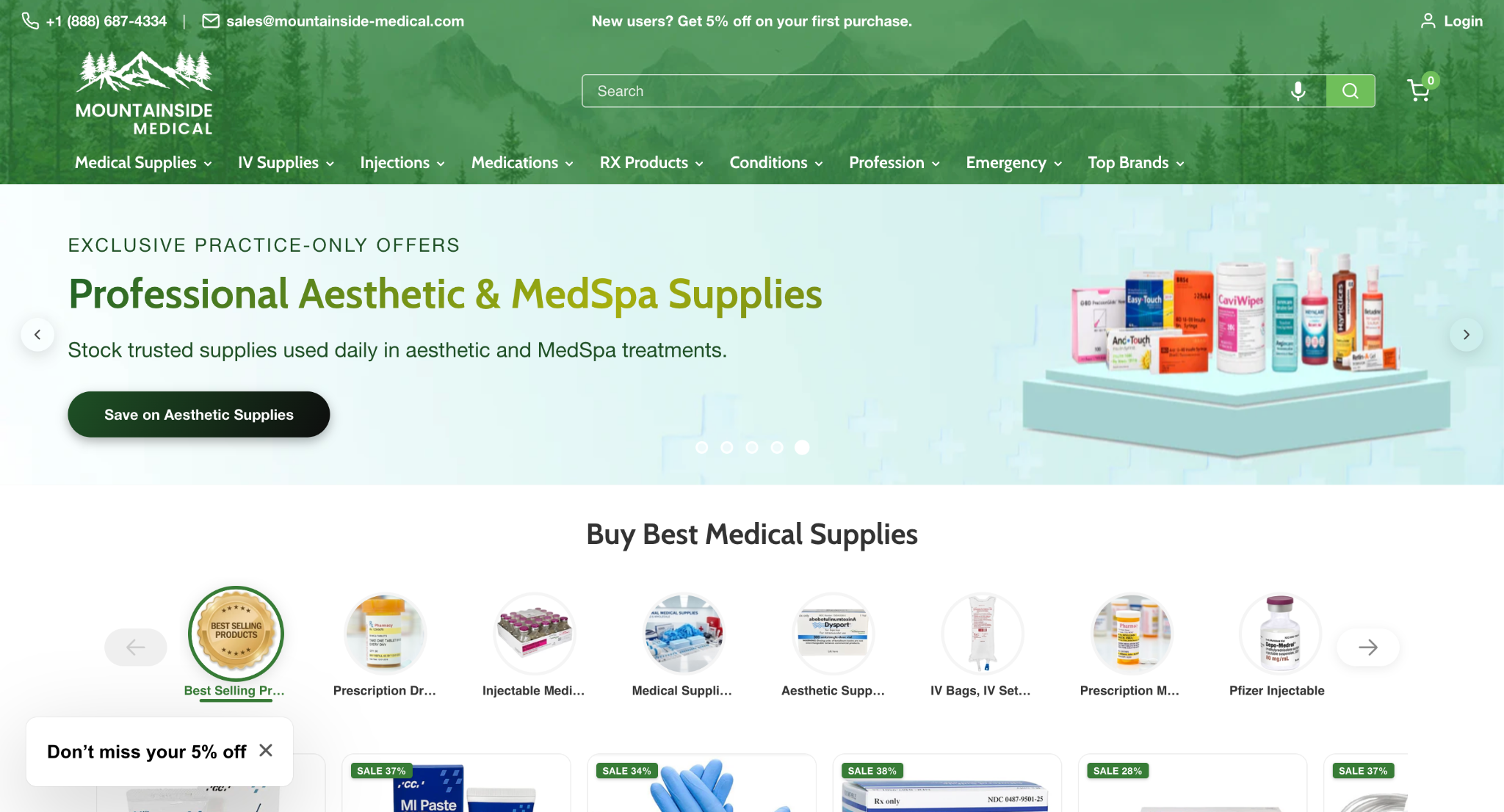
Mountainside Medical is a US-based online medical supplies and pharmaceutical distributor serving a wide range of buyers, from individual consumers and home care patients to doctors' offices, hospitals, EMS teams, and speciality clinics. Their Shopify store stocks thousands of SKUs spanning needles and syringes, IV supplies, injectable medications, wound care, respiratory equipment, diabetes supplies, prescription pharmaceuticals, and life-saving emergency medications from top brands including BD, Pfizer, Dynarex, and Fresenius Kabi. With free US shipping over $100, wholesale pricing, and a catalogue built to serve both everyday healthcare needs and complex clinical requirements, Mountainside Medical operates at the intersection of consumer accessibility and professional-grade medical supply.
Like most business owners running lean, he decided to manage Google Ads in-house. It made sense at the time — why pay an agency when you can learn the platform yourself? Over time, he built out 122 campaigns across the catalogue, kept them running, and watched the conversions come in. On the surface, the account looked active. The numbers told a different story.
At 25.57% ROAS, the account was returning roughly $8,600 in revenue against $33,900 in ad spend. The 2,620 conversions were real, but the products behind them were low-AOV, which created a structural ceiling that no amount of optimisation could fix. When the revenue per order cannot cover the cost of acquiring the customer, volume makes the problem worse, not better. The 122 campaigns compounded this further. Without clear segmentation logic, the budget was spread thin across the catalogue, signals were diluted, and there was no mechanism to identify what was actually working. The account was generating activity. It was not generating learning.
None of this reflects a lack of effort. Managing a business and running Google Ads simultaneously across a catalogue this broad is genuinely hard. But effort without the right framework produces exactly this outcome: numbers that look like progress until you do the maths.
What We Inherited
When Webrex took over, the account told a clear story.
The economics were broken at the product level. The campaigns were built around low average order value (AOV) products. Even if conversion volume was decent, the revenue per conversion could not absorb advertising costs. You cannot fix a 25% ROAS by optimising bids. The problem was upstream, in what was being sold.
Product titles were not written for how buyers actually search. Medical buyers search with specificity. They use brand names, dosage terms, gauge sizes, and application types. The existing titles were generic and missed most of this intent. A poorly written product title in Google Shopping means your ad appears in the wrong searches, attracts unqualified clicks, and burns budget.
No product reviews existed on the listings. In a category where trust is critical, and buyers are making decisions about health and body, reviews are not optional. Without them, click-through rates suffer, and conversion rates follow.
No campaign segmentation. 122 campaigns sounds like a lot of structure, but without a clear logic for how products are grouped and how budgets flow, it is just noise. Winning products cannot be identified, and the budget cannot be allocated to what actually works.
Phase 1: Foundation Before Spend — Merchant Center Cleanup
Before changing a single campaign, we went to the root. A Google Shopping account is only as good as its feed and its Merchant Center. We started there.
We rewrote product titles to match buyer search intent. For medical products, this means including brand names, product specifications, and clinical descriptors. A syringe listing, for example, becomes far more discoverable when the title includes needle gauge, barrel size, and brand rather than just "syringe."
We added negative keywords to cut out irrelevant search traffic that had been bleeding the budget. Medical product searches attract a wide range of intent, including informational queries, symptom lookups, and non-commercial searches. None of those should be eating ad spend.
This phase produced no visible ROAS improvement. The account looked the same from the outside. But it was the groundwork that made everything after it possible.
Phase 2: Building Trust — Product Review Setup
In healthcare and medical supplies, trust is the conversion mechanism. Before spending on driving traffic, we needed to ensure that when a buyer landed on a product page, there was something to convince them.
We set up product reviews on the listings. This required integrating the review feed correctly into the Merchant Centre, ensuring ratings appeared on Shopping ads, and seeding the pipeline for ongoing review collection.
The impact is not immediate. Reviews accumulate over time. But the infrastructure had to be in place before scaling spend, not after.
Phase 3: The Messy Middle — Campaigns, Failures, and What We Actually Learned
This is the part most agencies leave out of their case studies. In March 2026, we ran multiple campaign structures, and many of them did not work.
We followed a consistent methodology across every campaign: start at a $30/day budget with manual CPC set at $0.50. Monitor performance. Only campaigns that showed a genuine conversion signal received a budget increase to $50/day, with CPC raised to $1.00. Campaigns that failed to produce were identified early and killed. The budget only went where the data supported it.
Two major product pivots happened during this phase.
Pivot 1: RX to Non-RX. The initial campaigns included prescription-adjacent products. These created persistent issues with Google's policies around medical advertising. Approvals were inconsistent. Products got flagged. Campaigns stalled waiting on review. We made the decision to move entirely to non-RX products that any consumer could purchase without a prescription. This eliminated the policy friction and opened the inventory to a much broader buyer base.
Pivot 2: Bulk to Single-Unit. We assumed bulk-buying products would produce higher AOV and better returns. The data disagreed. Bulk medical supply buyers behave differently — longer consideration cycles, more price sensitivity, and different search intent. Single-unit products converted faster and at better margins for our campaign structure. We shifted focus there.
Neither of these decisions was obvious upfront. They came from running campaigns, reading the results, and being willing to change direction rather than defend the original strategy.
After working through these iterations, one campaign began to separate itself from the rest.
Phase 4: Finding the Winner — Ointments and Injections
The "Webrex-shopping-Ointments and Injections" campaign was the breakthrough. Non-RX ointments and injection supplies hit the right combination: high enough AOV, clear buyer intent, low policy risk, and review credibility that was now live and visible on listings. The titles matched how buyers were actually searching. The structure was clean. Once we had a proven formula, we used it as a blueprint — building out additional campaigns around similar product categories that showed the same signals. Same methodology, same disciplined budget approach, applied to a small set of validated winners.
The result is an account that today runs 4 active campaigns, all built on the same foundation. The 699% ROAS and 48 conversions over 80 days at $756 in spend is not the output of one lucky campaign. It is what happens when a winning approach gets replicated carefully rather than scaled recklessly.
One structural decision worth noting: 99% of products in the account are deliberately excluded from this campaign. This is not an oversight. It is precision. We identified which specific products drive profitable conversions and built the campaign around only those. Everything else is excluded. Fewer products, better control, better results.
Where We Are Now
The winning campaign is in active optimisation. The current focus is scaling spend while protecting ROAS, testing bid strategy adjustments, and identifying whether the product set can be expanded without diluting performance.
The account-level picture has shifted from 122 loosely organised campaigns burning $33,900 to a focused structure where a single campaign generates 699% ROAS at under $800/month in spend. The goal was never volume. It was building something that compounds.
What This Case Study Actually Shows
ROAS is a product selection problem before it is a bidding problem. If you are advertising low-margin or low-AOV products, no amount of campaign optimisation closes that gap. The fix has to happen upstream, in what you choose to advertise.
Medical advertising on Google requires a compliance layer most agencies skip. The RX vs. non-RX distinction, product approval workflows, and feed restrictions — these are not minor hurdles. Getting them wrong delays campaigns, wastes budget, and creates inconsistent results. Understanding the rules for this category is part of the job.
Starting small and scaling winners is not conservative. It is correct. Running 122 campaigns at once with no budget discipline produces noise. Running campaigns at $30/day, identifying signal, and only raising budget on proven performers produces data you can act on.
Transparency about the process builds better campaigns. There is no version of this case study where everything worked on the first attempt. The two major pivots, the failed campaigns, the policy learning — all of it was necessary. The result came from persistence and systematic elimination, not from a clever strategy executed perfectly.
Results Summary
| Metric | Before | Now (Winning Campaign) |
|---|---|---|
| ROAS | 25.57% | 699.60% |
| Monthly Ad Spend | ~$2,400+ avg | $283 avg |
| Conversions | High volume, low value | 48 high-value |
| Campaign structure | 122 campaigns, scattered | Focused, product-precise |
| Campaign status | Running but unprofitable | Limited by budget (ready to scale) |
View all Webrex case studies.
Frequently Asked Questions
What is a good ROAS for Google Shopping in the medical supply category? Industry benchmarks vary, but most medical e-commerce accounts target 400–600% ROAS to maintain profitability after product costs and ad spend. Reaching 655% with a tightly controlled product set puts Mountainside Medical above typical category performance.
Why only 48 conversions if the account used to generate thousands? The prior 2,620 conversions were generated from products with insufficient AOV to cover ad costs, resulting in 25% ROAS. 48 conversions from high-AOV products at 699% ROAS generate significantly more actual profit. Volume is not the goal. Margin is.
Can medical products be advertised on Google Shopping? Yes, with conditions. Non-prescription medical products can be advertised freely. Prescription-adjacent or regulated medical products face stricter review, policy restrictions, and potential disapprovals. Understanding which products qualify and how to structure feeds for compliant serving is essential in this category.
Why are 99% of products excluded from the winning campaign? Deliberate product exclusion is a performance strategy, not a limitation. By restricting the campaign to only the highest-converting products, the budget is concentrated where the conversion probability is highest. Adding more products dilutes that signal. When scaling, new products are tested in separate controlled campaigns rather than mixed into the winning one.
Work With Webrex
Webrex is a Shopify-focused e-commerce growth agency based in Ahmedabad, India, working with D2C and B2B brands across the US, UK, and Australia. Services include Google and Meta Ads, Shopify SEO, CRO, email marketing, and Shopify development.
If your Google Shopping account is spending without proportionate returns, the problem is likely not your bids.