



Schema Markup for AI Search
How to Get Your Shopify Store Cited by AI
What this guide walks you through
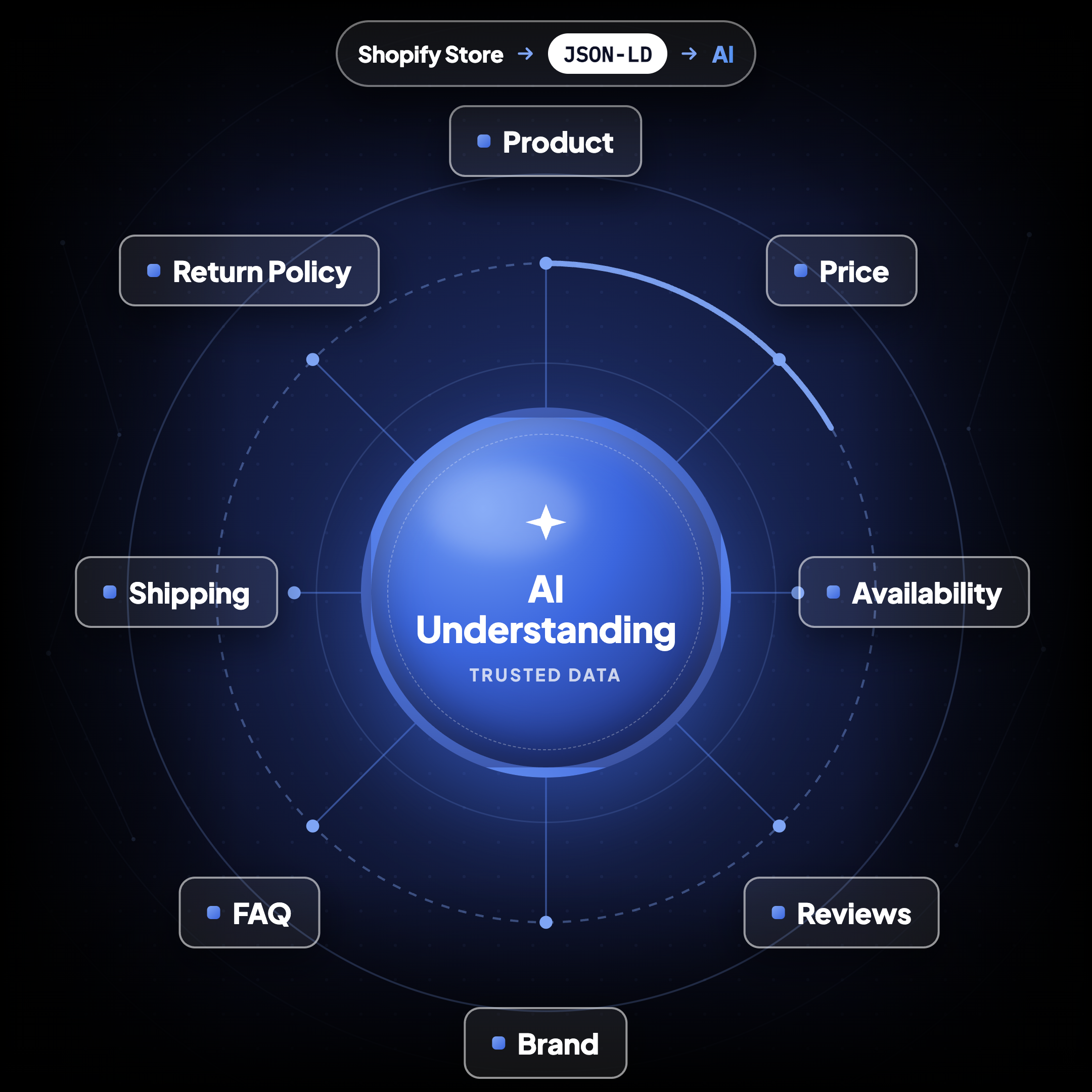
This guide explains what AI actually reads when it looks at your store, why structured data beats written content in an AI's eyes, why FAQ schema and clean question-and-answer content get quoted more often than polished prose, and what to do about it in your first month. No jargon, no scare tactics, and no claim that schema is magic. It is plumbing. Plumbing just happens to be the thing that decides whether the water arrives.
Why AI skips most Shopify stores
AI search engines do not browse. They process.
When Google AI Overviews, ChatGPT, or Perplexity encounters your store, it is not absorbing your product photography or your brand story. It is scanning for clear, consistent, machine-readable signals that say what you sell, what it costs, and whether you can be trusted as a source.
Without schema, that scan comes back thin. The engine sees a page with text and pictures. It has no reliable way to confirm what is being sold, at what price, in what currency, with what return window. That ambiguity is not a penalty. It is worse than a penalty, because there is nothing to appeal. Your store just gets passed over quietly.
With schema in place the same scan returns something entirely different. The engine reads: this is a product, the price is 34.00 USD and it matches the page, it holds 4.7 stars from 312 reviews, it ships in 3 to 5 business days, returns are accepted for 30 days. Every value is labeled and confirmed. The AI does not have to guess, so it does not have to look elsewhere.
That is the whole mechanism behind AI search visibility, and it starts with whether your structured data exists at all.
Why AI trusts structured content over written content
There is a reason engines do not just read your product copy and draw conclusions. Written copy is ambiguous by nature. "Premium quality" means nothing measurable. A price mentioned inside a paragraph might be six months stale. A glowing product story does not tell a machine whether the item is in stock right now.
Schema removes that ambiguity because every value arrives with a label attached. Not "here is some text" but "this is the price, in this currency, valid until this date." Not "customers love this" but "aggregate rating 4.7, review count 312." A labeled fact can be extracted. An unlabeled sentence has to be interpreted, and interpretation is exactly what an AI engine tries to avoid when it is deciding who to quote.
There is a second layer to this. Content that is organized, specific, and written to answer direct questions performs better in AI citation behavior than long unstructured prose. When your pages already answer what it costs, how long shipping takes, and what happens if it does not fit, they match the shape of the answer the AI is trying to build. Schema is how that shape gets communicated to the machine.
The takeaway: AI does not reward the best-written store. It rewards the least ambiguous one.
Schema versus writing more content, honestly
Content marketing works. A genuinely useful buying guide earns links, builds topical depth, and gives an AI engine more surface to read. If you have thin category pages and no blog, writing is a real fix and you should do it.
Here is where it falls short. Publishing more prose adds volume, not certainty. Ten thousand more words about sensitive skin still do not tell an engine that this bottle costs 34 dollars and ships Tuesday. You can be the most thorough writer in your niche and still lose the citation to a competitor with a plainer page and a complete Product block.
They are not rivals. Content gives the engine something worth quoting. Schema gives it the confidence to quote you. Doing only one is the common mistake.
Why FAQ schema is the piece that gets you quoted
Think about how people actually use AI search. They do not type keywords. They ask a full question. "Is this olive oil cold pressed." "What is the return window." "Does this ship to Canada."
Now think about how an AI builds its reply. It gathers answers to that question from across the web and stitches the clearest one into its response, with a credit to the source. So the content that gets cited is the content already shaped as a direct answer to a real question.
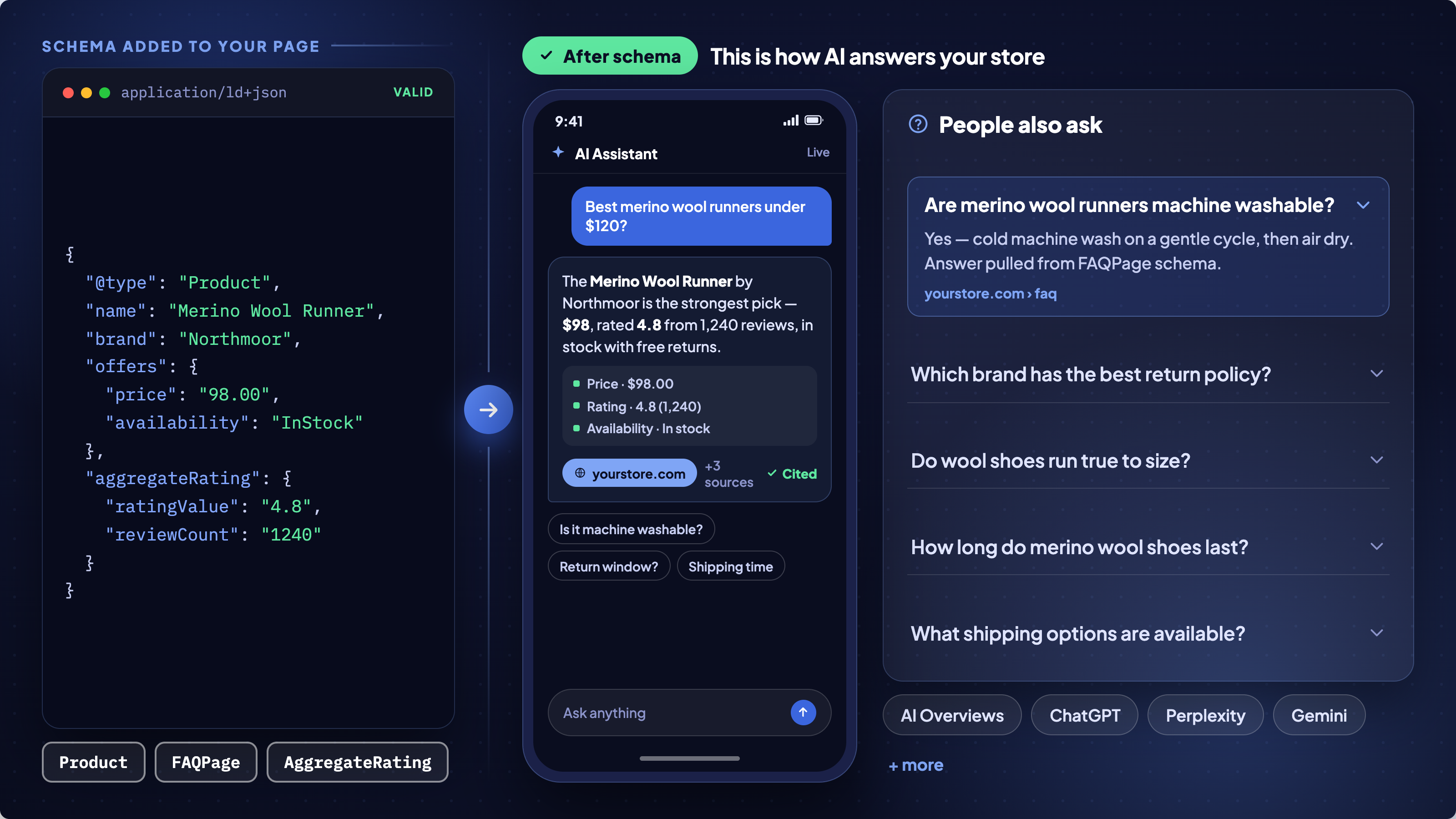
That is exactly what FAQ schema does. It structures part of your page as explicit question-and-answer pairs: a question and its accepted answer, labeled so a machine can lift them cleanly. Where a paragraph forces the engine to hunt for the answer inside your writing, FAQ schema hands it over pre-packaged. You are giving the AI the answer in the same shape it is trying to produce, which is the closest thing there is to writing your own citation.
What actually gets read
Not every schema type matters for a store. These are the ones that carry weight:
- Product. Name, price, currency, availability, identifiers. The block that makes price and stock visible to both Google and AI engines.
- Review and AggregateRating. Your star rating and review count. This turns a plain blue link into a listing with stars, and lets an AI say "rated 4.7 by 312 buyers."
- Offer. Shipping time, shipping cost, return window. Often the deciding detail when an AI compares two stores selling the same thing.
- FAQPage. Question-and-answer pairs tied to a page. Be precise here: Google narrowed FAQ rich results for most sites. FAQ schema still matters, just for a different reason now. It is the cleanest format for an AI to lift an answer from, which is exactly what LLM search does.
- Organization and LocalBusiness. Who you are and how to reach you. The trust layer behind your brand name.
- BreadcrumbList, Article, Video, Recipe. Cheap structural wins. Fewer competitors bother with the last three, which is precisely why they work.
Your first 7 days
You can get the structured data on your store into real shape in weeks. Here is the order that adds the most AI visibility for the least effort, one stage at a time.
Day 1: find out where you stand. Take three pages, one product, one collection, and your homepage, and paste each URL into Google's Rich Results Test and the Schema.org validator. The rule is simple. If it shows clean blocks, AI can read that page. If it shows errors, blanks, or the same block twice, it cannot. That is your baseline.
Days 2 to 3: build the foundation (Product, Breadcrumb, Organization). This is the layer AI reads first. Put one clean Product block on every product page with the correct price, currency, stock, and product ID, and delete duplicates so each page tells a single story. Add Breadcrumb Schema so engines see how your store is organized, and Organization Schema so they know who the brand is. Get this right and an AI can already state what you sell, for how much, and that it is in stock.
Days 4 to 5: add the trust layer (Reviews, Offer, LocalBusiness). These are the facts an AI uses to choose between two stores. Connect your reviews app so your star rating and review count show up as AggregateRating. Add Offer details for shipping time, cost, and returns. If you have a physical shop, add LocalBusiness. Stars and shipping are often the exact detail an AI repeats in its answer.
Day 6: add the answer layer (FAQ schema). This is the step that gets you quoted. Add FAQ schema to your top products and pages, built from the real questions customers already ask you, with one short honest answer each. FAQ schema turns your content into clean question and answer pairs, which is the exact shape ChatGPT, Perplexity, and Google's AI Overviews reach for. If you publish blogs, add Article schema while you are here.
Day 7: check, clean, and lock it in. Retest the same pages from Day 1. The errors and blanks should now come back as clean Product, Review, and FAQ blocks. Fix anything still broken, clear out any last duplicates, and add Video or Recipe schema if your store uses them. The last move is making sure this stays accurate on its own as prices and stock change, because structured data only helps while it matches the page.
That covers every schema type that moves AI visibility, in the order that pays off fastest.
Where to go from here
None of this requires you to become technical. It requires the data layer under your store to be complete, accurate, and maintained as your catalog moves.
That maintenance is the hard part at scale. Doing it by hand across 800 product pages, keeping prices in sync, catching duplicate blocks from three different apps, and writing FAQ content for every product is not a weekend job.
Webrex: AI SEO Schema, JSON-LD was built for exactly this. It generates Product, Breadcrumb, Organization, FAQ, Video, and Recipe schema (10+ schemas across your store), pulling values from your live storefront so markup never drifts from the page. Its AEO layer uses AI to write FAQ schema from your real product content, so a food brand ends up with "is this oil cold pressed" and "what is the smoke point" structured and published automatically. It connects your review app for ratings, handles country-specific shipping and return schema, and runs duplicate and error detection so conflicting blocks get caught. All through theme app blocks, no code.
Install Webrex and see what your store is currently telling AI, free to start.
Article by

Install SEO Schema
Add SEO Schema & JSON‑LD to your Shopify store in one click. Try it free and start optimizing your conversions and average order value instantly.
Want this done for you?
Webrex runs SEO, CRO & Ads as a comprehensive 6-month growth roadmap. Let our certified Shopify experts set up the app and scale your store.