





Schema Markup Pros and Cons
What Every Website Owner Should Know in 2026
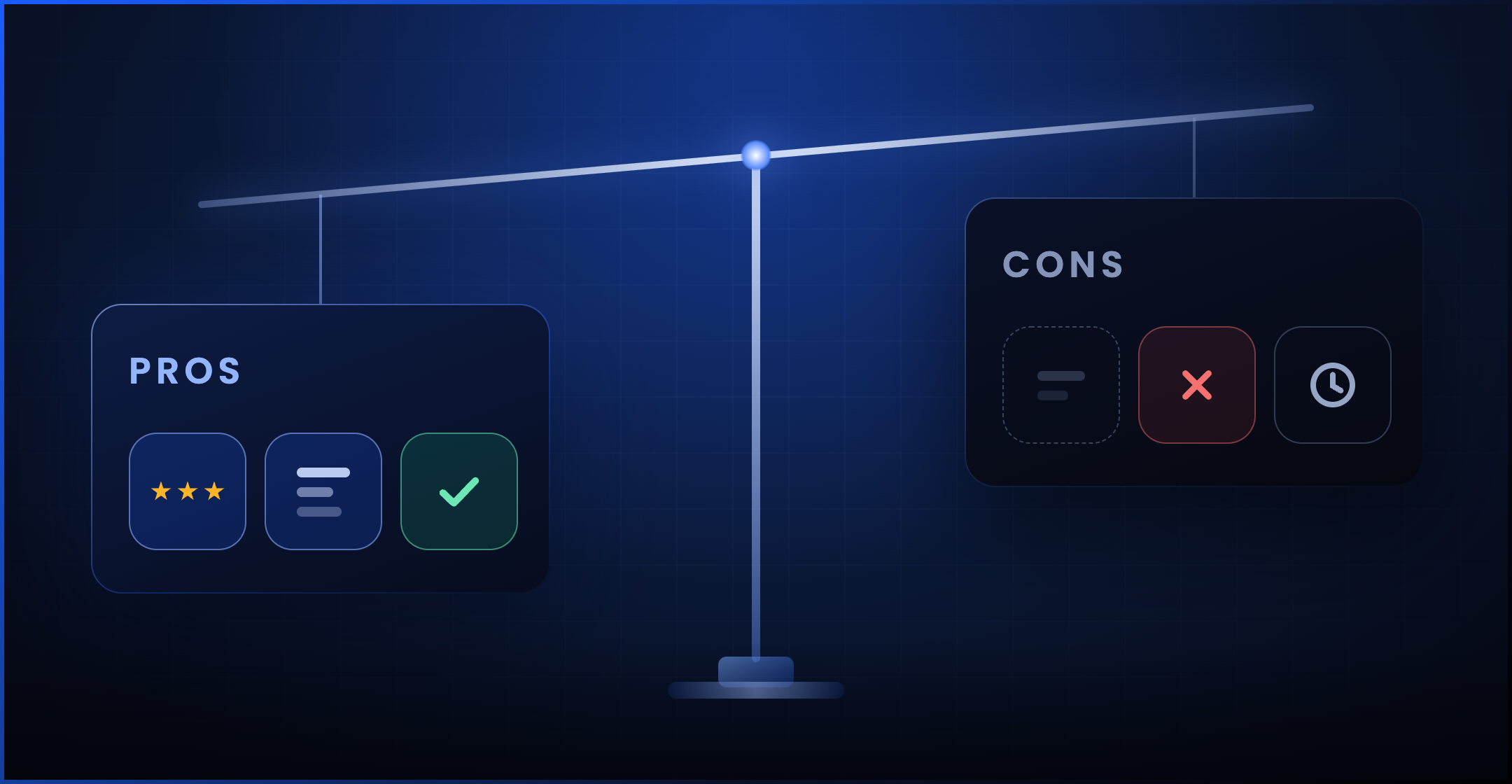
The honest breakdown of what schema does, what it does not, and whether it is worth your time.
Schema markup has been one of the most debated topics in SEO for years. Some say it is essential for rankings. Others say it makes no difference and is not worth the effort. Both groups are partly right, and partly wrong.
The problem is that most writing about schema markup argues one side without acknowledging the other. The result is that store owners either over-invest in it expecting magic, or ignore it entirely and miss a genuine advantage.
This article covers both sides honestly: what schema markup does well, where it falls short, and what that means for your website in 2026.
What Schema Markup Actually Does
Schema markup is structured data added to your website's pages as JSON-LD code. It does not change what visitors see on your page. What it does is give search engines a set of labeled, machine-readable facts about your content: what the page is about, what is being sold, what it costs, who the brand is, and how customers have rated the product.
Google uses this data in two ways. First, to decide whether your page qualifies for rich results, which are enhanced search listings that show star ratings, prices, availability, and FAQ answers directly below your title. Second, to build its understanding of your website as an entity: who you are, what you sell, and how you relate to other businesses and topics in its index.
That second use has become significantly more important in 2026, as AI search engines use structured data to decide which sources to cite in their generated answers.
The Pros of Schema Markup
Higher click-through rates before any ranking changes. One of schema's most consistent and measurable benefits is what it does to your search listings before a single ranking changes. Rich results, including product listings with star ratings, prices, and availability, get 20 to 30% higher click-through rates than plain blue links. Research from 2026 shows that pages with complete schema markup receive 58.3% more clicks and roughly 2.7 times more impressions than equivalent pages without it. The ranking stays the same. The listing just works harder.
Visibility in AI search and AI Overviews. This is where schema's value has expanded most significantly in 2026. AI search tools like Google AI Overviews, Perplexity, ChatGPT search, and Bing Copilot do not browse your page the way a person does. They extract labeled facts from structured data and use them to build answers. Pages with complete schema are cited 3.1 times more frequently in Google AI Overviews, according to data from Google I/O 2026. 25.11% of all Google searches now trigger an AI Overview. 35% of US consumers use AI tools at the product discovery stage. Schema is what gets your content into those answers.
FAQ schema feeds direct answers to AI engines. FAQ schema deserves its own mention because its value changed after Google retired FAQ rich results in May 2026. The visual rich result is gone from traditional search, but FAQ schema still structures your content as explicit question-and-answer pairs that AI tools can extract and quote directly. When someone asks Perplexity about your return policy or asks Google AI Overviews about your product specifications, the answer that surfaces is the one already formatted as a clean Q&A. FAQ schema is how you write your own citation in AI-generated responses.
Entity recognition and brand trust. Organization schema, Website schema, and LocalBusiness schema tell Google not just what your pages say but who your business is. This contributes to Knowledge Graph entries, E-E-A-T evaluation, and how your brand is described when AI engines reference it by name. A business with clean entity schema is treated as a known, verified source. A business without it is just another anonymous domain.
A competitive advantage most sites have not taken. Despite schema's clear benefits, the majority of websites still have incomplete, incorrect, or missing structured data. For ecommerce stores specifically, common gaps include missing offer data, no return policy schema, and conflicts between theme-injected markup and third-party app markup. Closing those gaps while competitors leave them open is a low-effort advantage that compounds over time as search behavior continues shifting toward AI-generated answers.
The Cons of Schema Markup
Schema is not a direct ranking factor. Schema markup does not push your pages up the rankings. Google has confirmed it is not a direct ranking signal. A product page with perfect schema but thin content, weak relevance, or poor technical SEO will still rank poorly. Schema makes eligible pages more visible and more useful to search engines. It does not rescue pages that are not already doing the fundamentals well.
Rich results are never guaranteed. Correct schema makes your page eligible for rich results. It does not force them. Google decides whether to show a rich result based on content quality, policy compliance, relevance, and whether the enhanced format is useful for that specific query. You can implement flawless schema and still not see stars or prices in your listings. The eligibility is real; the display is Google's call.
Maintenance is an ongoing commitment. Schema that drifts from your live page does not just stop working. It can actively damage your credibility with Google. Product prices change. Stock status changes. Return policies get updated. If your schema shows a product at $29 when the page shows $39, or marks an out-of-stock item as available, Google treats that as a mismatch and may suppress your rich results or flag the schema as invalid in Search Console. Keeping structured data accurate at scale requires either regular manual audits or an automated solution.
Duplicate schema can backfire entirely. This is the most common and least visible problem on Shopify stores specifically. Shopify themes inject their own Product schema automatically. When a separate SEO app adds its own schema block to the same page, the result is two conflicting Product objects on the same URL. Google encounters competing signals, cannot determine which is correct, and ignores both. Duplicate schema does not simply fail to help. It actively prevents rich results from showing and registers as errors in Google Search Console.
Results take time and are not always visible. Even after schema is correctly implemented, Google needs to recrawl your pages before any changes appear in rich results or Search Console. That process can take days or weeks depending on your site's crawl frequency. For new domains or recently updated pages, the wait can be longer. Schema is not a tactic for immediate results.
What This Looks Like in Practice
For a store that sets up schema correctly and maintains it: Rich results appear with star ratings, prices, and in-stock status. AI Overviews and Perplexity cite FAQ content directly from product pages. Search Console shows growing valid product snippets and merchant listings with zero errors. Click-through rates improve without any change in rankings.
For a store with broken, duplicate, or missing schema: Listings appear as plain blue links with no rich results. Search Console flags errors and invalid items. AI engines scan the page, find conflicting or incomplete signals, and pull answers from a competitor instead. The store's product data exists, but it never reaches Google in a form it can use.
The difference is not in the product or the content. It is in whether the data layer is clean, complete, and maintained.
So Is Schema Markup Worth It?
The cons listed above are real. Schema requires setup, maintenance, and patience. It is not a ranking shortcut, and it does not guarantee anything.
But every con has a direct answer. Setup is a one-time cost. Maintenance is solved by automation. Duplicate conflicts are eliminated by the right tooling. And the wait for results is just how crawl cycles work, not a reason to skip schema entirely.
The pros, on the other hand, compound. Higher click-through rates improve traffic without changing rankings. AI search citations grow as more queries trigger AI Overviews. Entity recognition builds over time as Google confirms your brand across more signals.
Schema markup used to be optional because the only visible payoff was rich results, and not every store saw them. That calculation changed when AI search became a real discovery channel. The question is no longer whether schema is worth it. It is whether your competitors will have clean structured data before you do.
Where to Start
Start small. Pick one product page, run it through Google's Rich Results Test, and see what is missing. That single check will tell you more about your current schema health than any article can. From there, the path forward is straightforward: fix what is broken, fill what is missing, and keep it maintained. The stores that do this consistently are the ones that show up where others do not.
Article by

Install SEO Schema
Add SEO Schema & JSON‑LD to your Shopify store in one click. Try it free and start optimizing your conversions and average order value instantly.
Want this done for you?
Webrex runs SEO, CRO & Ads as a comprehensive 6-month growth roadmap. Let our certified Shopify experts set up the app and scale your store.