

The Underused Checkout Upsell
Shopify's most overlooked revenue surface — and where upsell revenue actually concentrates
By Webrex Studio — makers of WB: Frequently Bought Together
This post in 30 seconds
- What it is: A breakdown of where upsell revenue actually concentrates across live Shopify stores, by placement — product page, checkout, cart drawer, and post-purchase.
- The finding: Product page and checkout together do the heavy lifting. Many merchants leave checkout upsells switched off entirely, throwing away the second-best surface they have.
- Who this is for: Merchants who've set up a cart-drawer upsell and stopped there.
In this post
We run upsell, cross-sell, and spending-goal boosters across hundreds of live Shopify stores. That means we don't have to guess where upsells actually earn — we can look at what actually happened in the order data.
A note on honesty: the ranking below comes from a representative store in our merchant base, not an average across every store we run. We're saying that plainly rather than implying a bigger sample than we have.
Placement decides everything — and the winners aren't where most people start
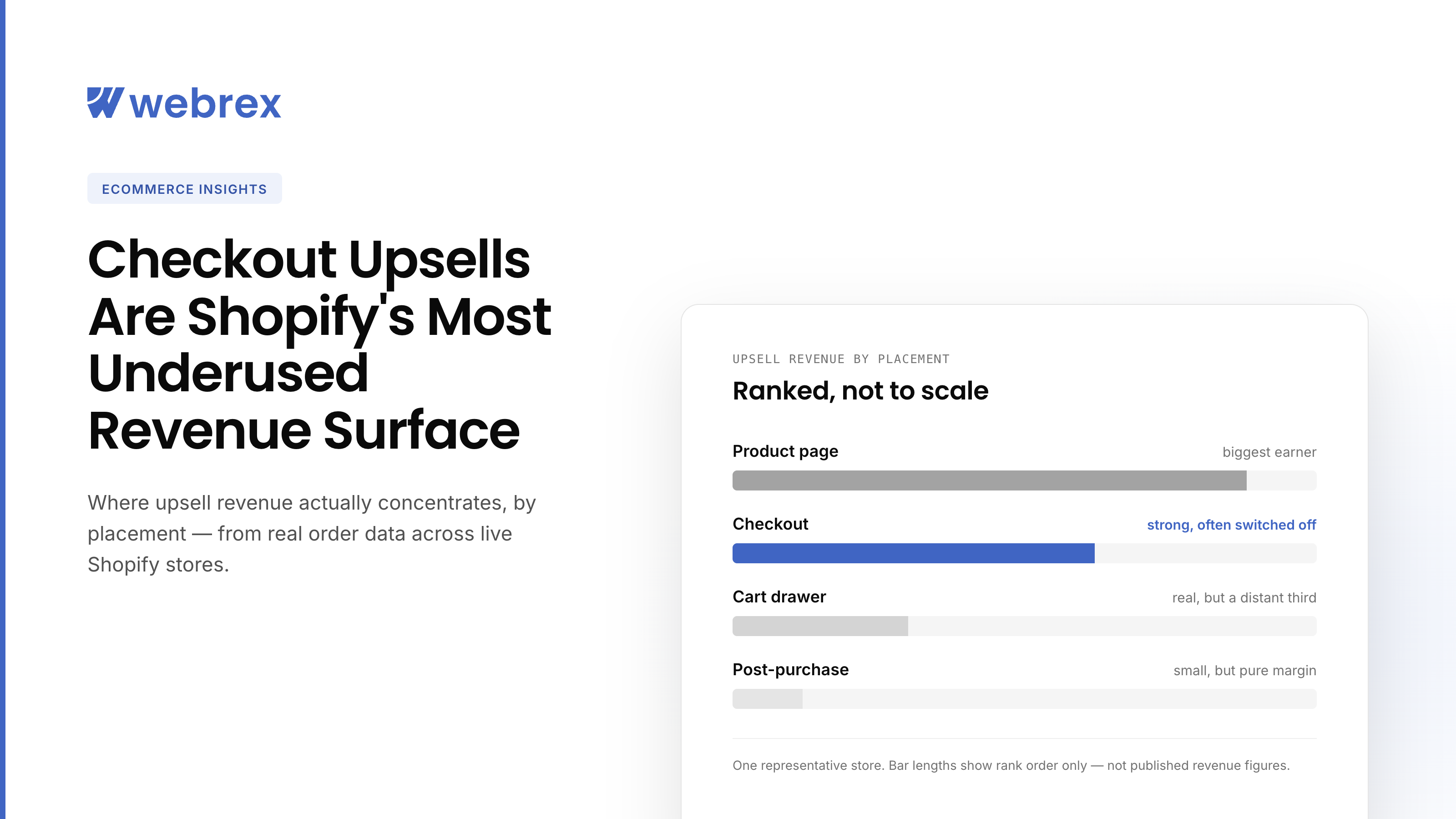
When we break upsell revenue down by where the offer appears, a clear order emerges on a representative store from our merchant base:
The takeaway isn't "only use the product page." It's that product page + checkout together do the heavy lifting, and many merchants leave checkout upsells switched off entirely — throwing away the second-best surface they have.
Why checkout specifically gets skipped: it feels riskier to merchants ("won't this slow down my checkout / hurt conversion?"), so a lot of stores default to a cart-drawer widget instead, since it feels lower-stakes to configure. The order data doesn't support that instinct — cart drawer is real, but it's a distant third, not the main event.
What to do
- Turn on product-page and checkout upsells first. Add cart/drawer after.
- Treat the cart drawer as a reminder, not your main engine.
- Don't pour all your effort into the cart drawer and skip checkout.
- If you're worried about checkout upsells slowing things down or hurting conversion, that's a fair concern to test on your own store — but don't skip the surface entirely on the assumption alone; the revenue data suggests it's worth the test.
Install WB: Frequently Bought Together free → — free plan covers up to 50 orders with no expiry; paid tiers start at $17/mo for stores doing up to 100 orders/month.
Frequently asked questions
Where should I place upsell offers first on Shopify?
Product page and checkout, based on where upsell revenue concentrates on a representative store in our data — cart drawer and post-purchase add more, but they're smaller surfaces.
Is a cart drawer upsell enough on its own?
No — in our data it's real but a distant third behind product page and checkout. A cart-drawer-only setup is leaving the two biggest surfaces unused.
Why do merchants skip checkout upsells?
Usually out of concern it'll slow down checkout or hurt conversion. That's worth testing on your own store, but the underlying revenue data suggests checkout is the second-strongest surface, not one to skip by default.
Install WB: Frequently Bought Together
Free to start, no expiry on the free tier's 50 orders. Install free →.
Related reading: The Free-Shipping Trap: why your threshold might be costing you money →
Written by Dhvanit.
Article by

Install Frequently Bought Together
Add WB: Frequently Bought Together to your Shopify store in one click. Try it free and start optimizing your conversions and average order value instantly.
Want this done for you?
Webrex runs SEO, CRO & Ads as a comprehensive 6-month growth roadmap. Let our certified Shopify experts set up the app and scale your store.