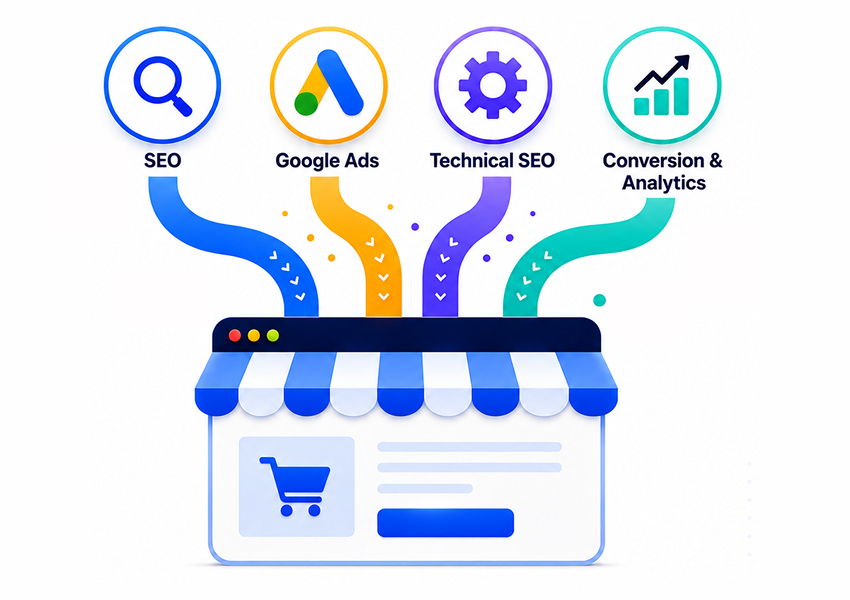
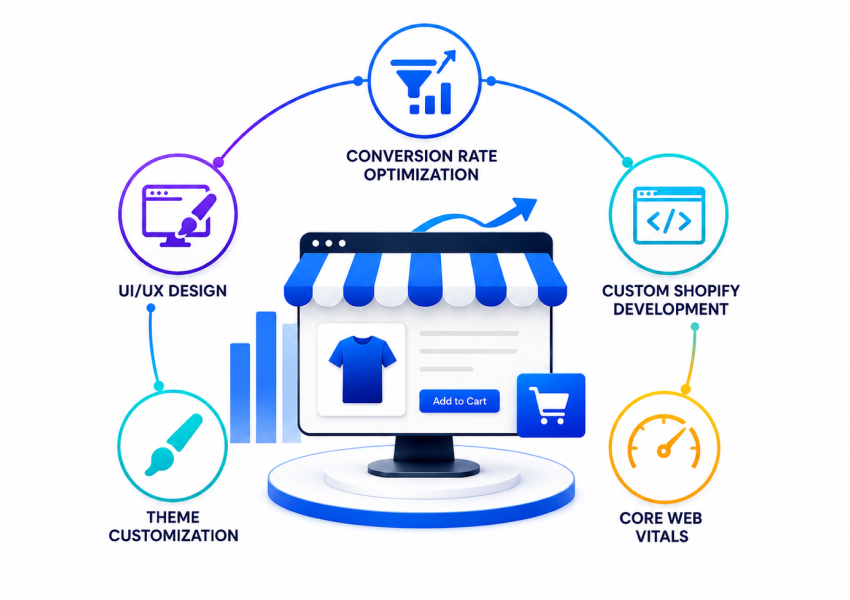


Shopify conversion rate optimization (CRO) is the work of getting a bigger share of your existing visitors to actually buy, instead of chasing more traffic. If 100 people land on your store and 1 buys, that is a 1% conversion rate. Push it to 2%, and you have doubled sales without spending a cent more on ads. This guide breaks down what a good rate looks like, how to increase it, and when it is worth bringing in help, in plain language with clear tables.
TL;DR
Traffic is expensive. Conversion rate optimization on Shopify makes the traffic you already have worth more. Know your number, fix the biggest leaks first (product pages, speed, checkout, trust), test one change at a time, and repeat. Most stores can lift their rate with a handful of focused fixes before they ever need to buy more ads.
In this guide
- What Shopify conversion rate optimization actually is
- What is a good conversion rate on Shopify
- The real cost of a low conversion rate
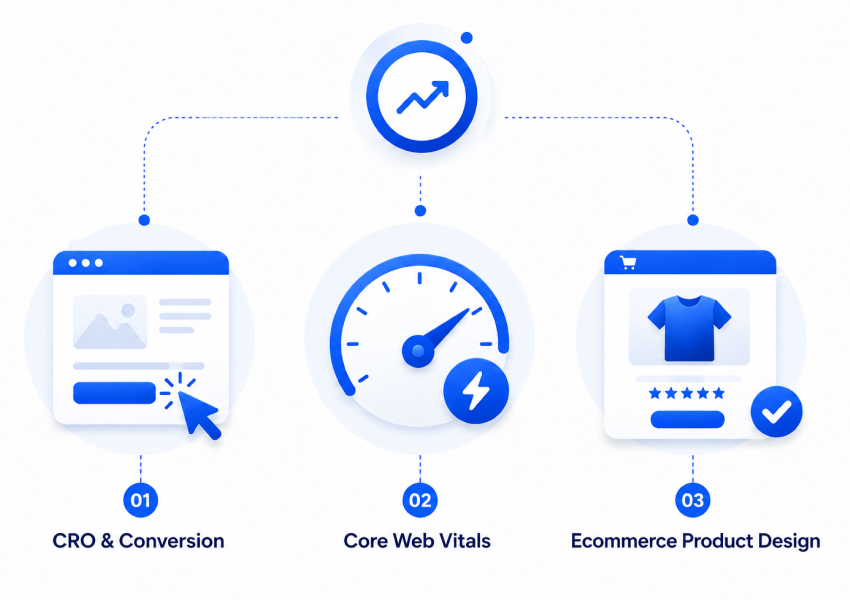
- How to increase conversion rate on Shopify
- Conversion rate optimisation for ecommerce: the testing loop
- A quick-win CRO checklist
- When to hire a Shopify CRO agency
- Frequently asked questions
This guide walks you through what CRO means, how to measure it, the fixes that move the needle, a simple testing process, and how to decide between doing it yourself or getting help, in plain words with no jargon.
What Shopify conversion rate optimization actually is
Conversion rate optimization on Shopify is the practice of improving your store so more of the people who visit take the action you want, usually a purchase.
In plain terms, it comes down to one formula:
- Conversion rate = (orders / visitors) x 100.
- 400 visitors, 8 orders = a 2% conversion rate.
CRO is not guesswork or a new theme every month. It is about:
- Finding the leaks: where people drop off before buying.
- Forming a reason why: a clear idea of what is blocking them.
- Testing a fix: one change, measured against the old version.
- Keeping what wins: and rolling it out.
The big shift in mindset: instead of asking "how do we get more traffic," Shopify conversion rate optimisation asks "how do we waste less of the traffic we already paid for."
The point: more traffic grows the top of the funnel. CRO grows the bottom. The second one is usually cheaper.
What is a good conversion rate on Shopify?
People always ask, so here is the honest answer on Shopify conversion rates: it depends on your industry, price point, and traffic source, but there are rough bands most stores fall into. Littledata's benchmark of 421 Shopify stores puts the median at 1.4%, with the top 10% above 3.4%.
Here is a simple way to read your own conversion rates on Shopify:
| Conversion rate | Where you stand | What it usually means |
|---|---|---|
| Under 1% | Below average | Real friction somewhere, worth a full audit |
| 1% to 2% | Around average | Typical for many Shopify stores, room to grow |
| 2% to 3.5% | Good | Solid product pages, trust and checkout |
| 3.5%+ | Great | Top tier, strong brand and tight funnel |
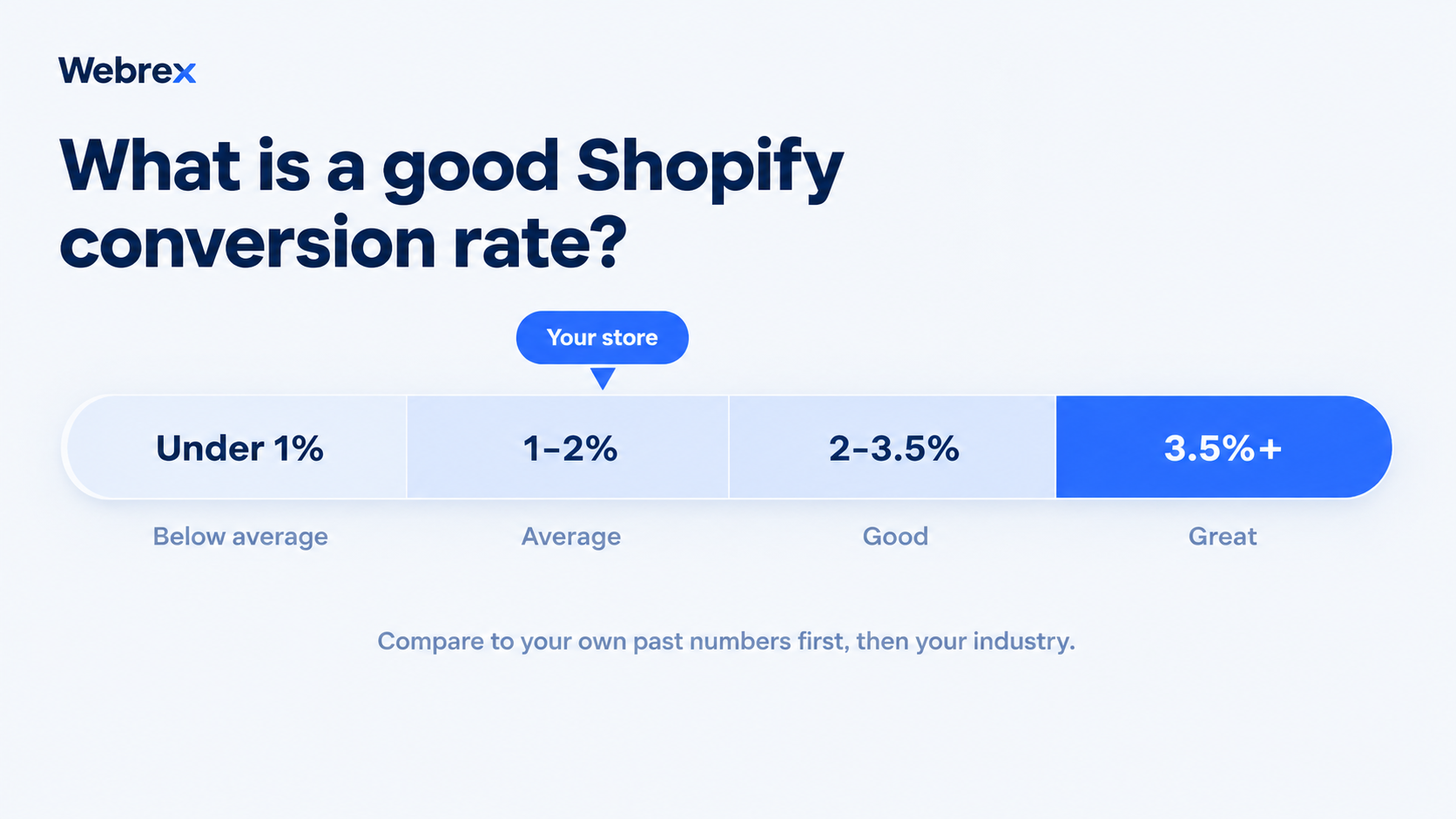
- Important: these are general bands, not a law. A high-ticket store converting at 0.8% can still be very healthy, while a cheap-impulse product may need 4%+ to work. Always compare against your own past numbers first, then your industry.
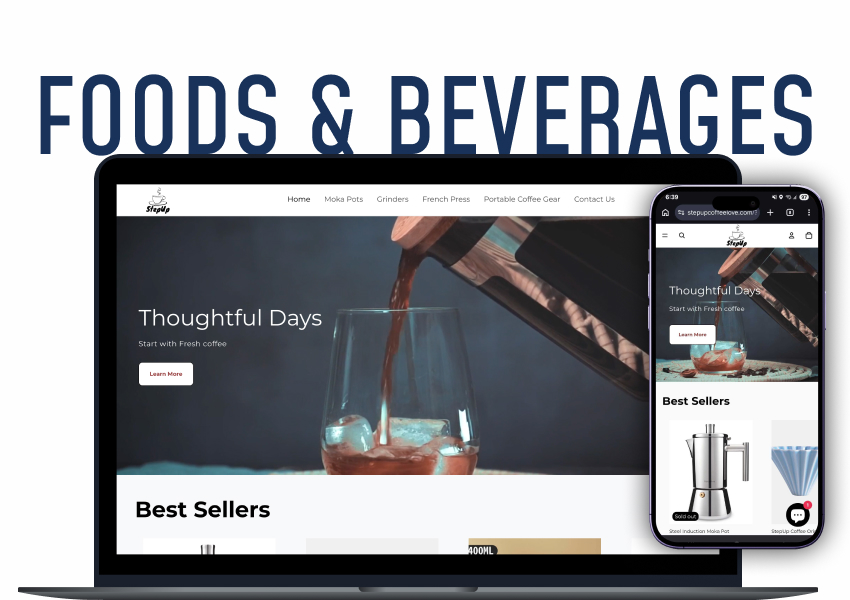
Beating your own baseline is what counts. StepUp Coffee went from 0.2% to 1.3% after we turned its 1,800-product catalog into a focused brand.
The takeaway: don't chase a single "ideal" number. Know your baseline, then beat it.
The real cost of a low conversion rate
This is the part that makes CRO click. A small lift in rate is the same as a big lift in traffic, but free.
Say your store gets 20,000 visitors a month with a $60 average order value:
| Conversion rate | Orders / month | Revenue / month |
|---|---|---|
| 1.0% | 200 | $12,000 |
| 1.5% | 300 | $18,000 |
| 2.0% | 400 | $24,000 |
| 2.5% | 500 | $30,000 |
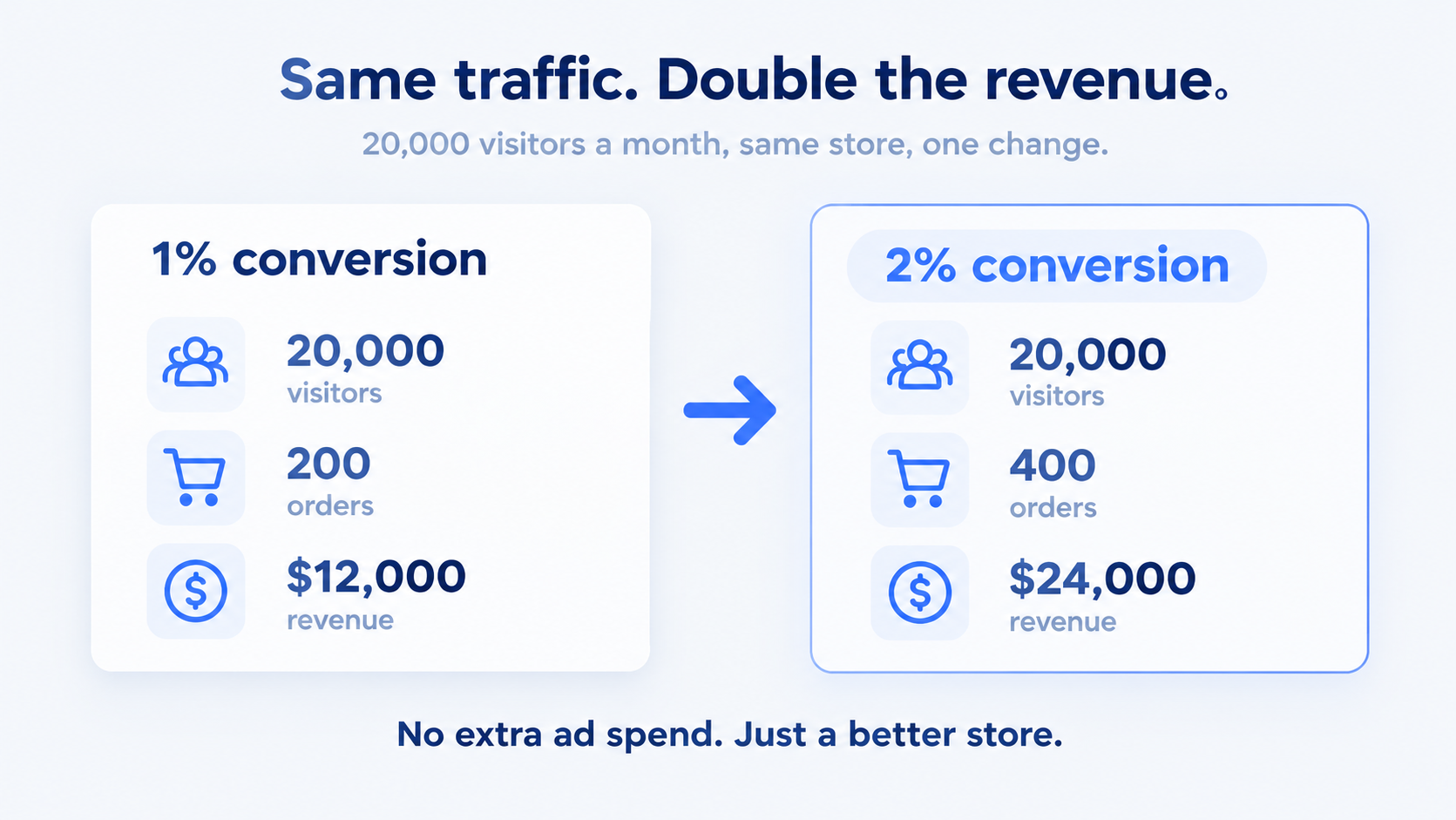
- Going from 1% to 2% doubles revenue on the exact same traffic.
- To match that with ads alone, you would have to double your spend.
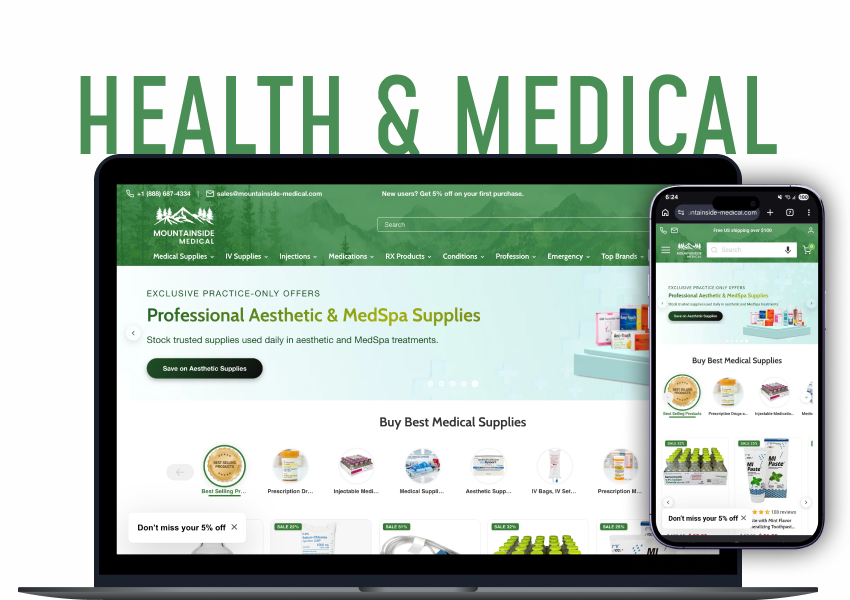
It holds up in practice too. In a checkout sprint for Mountainside Medical, checkout completion rose 13.8%, and the store got the same orders from 13% fewer sessions.
The point: this is why increasing your conversion rate on Shopify is often the highest-ROI work a store can do. The traffic is already paid for.
How to increase conversion rate on Shopify
Most people search "how to increase conversion rate on Shopify" hoping for one trick. It is really a handful of fixes, in order of impact. Here is where to increase conversion rate on your Shopify store first.
Fix your product pages first
The product page is where the buying decision happens, which is why product page design is the first place to look.
- Lead with clear, benefit-led titles and real photos (multiple angles, zoom, video).
- Put the key info above the fold: price, variants, delivery, add to cart.
- Answer objections right there: sizing, materials, returns, "is this right for me."
Speed up your store
Slow stores lose sales before the page even loads.
- Compress images and lazy-load below-the-fold content.
- Cut heavy apps and unused scripts.
- Aim to pass Core Web Vitals (Google's thresholds), especially on mobile.
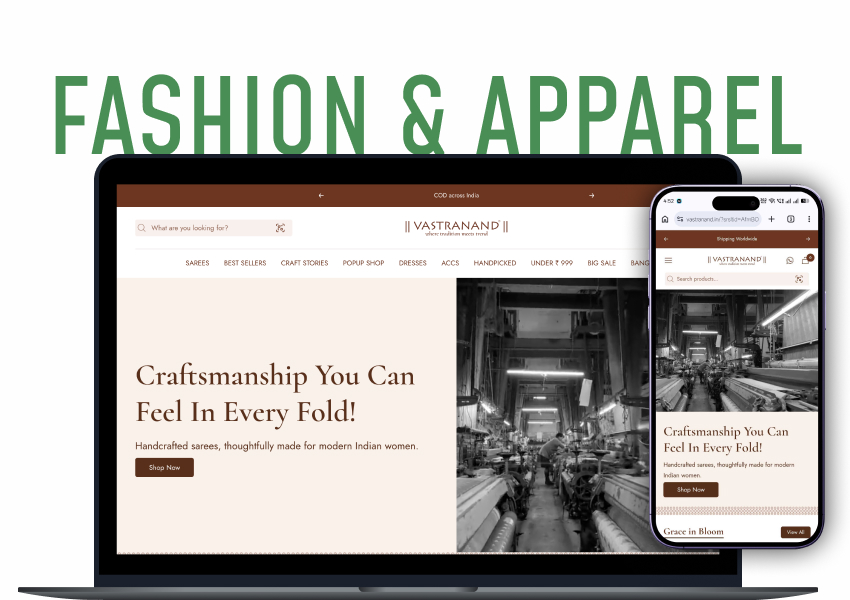
One store we worked with, Vastranand, went from a 4s to 2.6s load time.
Make checkout frictionless
Every extra step leaks buyers. Our guide to Shopify checkout settings shows where each of these lives.
- Offer guest checkout and express pay (Shop Pay, Apple Pay, Google Pay).
- Show shipping cost early, no nasty surprise at the end.
- Add a free-shipping progress nudge if you have a threshold.
Build trust everywhere
Cold visitors need reasons to believe you.
- Show reviews and ratings on product pages, not just a reviews tab.
- Add trust badges, clear returns, and real contact details.
- Use real customer photos, not only studio shots.
Win on mobile
A large share of Shopify traffic is mobile, so this is where a lot of sales are won or lost.
- Big tap targets, sticky add to cart, short forms.
- Test the whole journey on a real phone, not just desktop preview.
Use social proof and urgency honestly
- Low-stock and "X sold this week" work when they are true.
- Bundles and "frequently bought together" lift both conversion and order value.
The takeaway: to increase conversion rate on Shopify, fix the page where the decision happens, remove friction on the way to pay, and give cold visitors reasons to trust you.
Conversion rate optimisation for ecommerce: The testing loop
Good conversion rate optimisation for ecommerce is a loop, not a one-off. The same process works on any store.
- Measure: find where visitors drop off (analytics, heatmaps, session recordings).
- Hypothesise: write down why, in one sentence ("people bounce because shipping cost is hidden").
- Test: change one thing, run an A/B test, give it enough traffic.
- Learn: keep the winner, bin the loser, write down what you learned.
- Repeat: move to the next biggest leak.
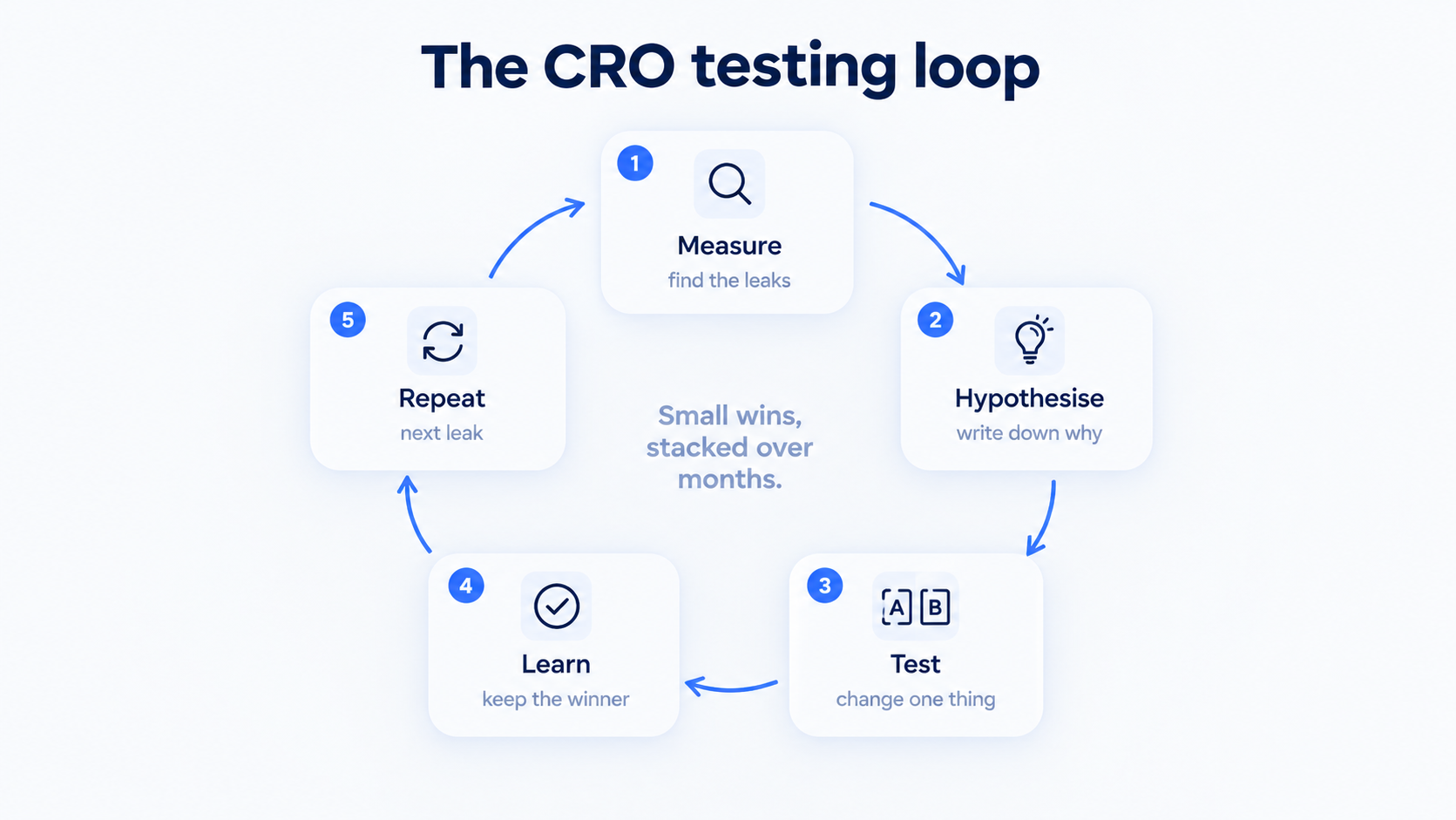
- One change at a time. If you change five things and the rate moves, you won't know which one did it.
- Enough data. Don't call a test after 30 visitors. Wait for a real sample.
The point: CRO compounds. Small, steady wins stacked over months beat one big redesign gamble.
A quick-win CRO checklist
If you want somewhere to start today, work down this list. It is roughly ordered by effort-to-impact.
| Area | Quick win | Why it lifts conversion |
|---|---|---|
| Product page | Add reviews above the fold | Trust at the decision point |
| Speed | Compress hero and product images | Fewer drop-offs on load |
| Checkout | Turn on express pay buttons | Fewer steps to buy |
| Shipping | Show cost or free-ship bar early | No end-of-checkout shock |
| Mobile | Add sticky add-to-cart | Easier to buy on a phone |
| Cart | Add "frequently bought together" | Higher conversion and AOV |
| Trust | Show returns policy clearly | Removes a key objection |
When to hire a Shopify CRO agency
You can do a lot of this yourself. But there is a point where Shopify conversion rate optimization services pay for themselves, usually when traffic is high enough that small percentage lifts mean real money, or when you don't have time to run tests properly.
A good Shopify conversion rate optimization agency will:
- Audit your funnel with data, not opinions.
- Prioritise fixes by likely impact, not guesswork.
- Run proper A/B tests so wins are real and repeatable.
- Report on revenue per visitor, not vanity metrics.
Signs it is time to bring in a Shopify conversion rate optimization agency in the USA or wherever your customers are:
- You are spending real money on ads but the store leaks most of it.
- You have tested a few things but can't tell what actually worked.
- Your rate has been flat for months.
When comparing the best Shopify conversion rate optimization agencies, look for ones that show you past test results and revenue lift, tie their work to your numbers, and start with an audit rather than a redesign pitch.
The takeaway: DIY the quick wins first. Bring in conversion rate optimization services for Shopify once the math says a 0.3% lift is worth more than their fee.
Frequently asked questions
How to increase conversion rate on Shopify?
Start with the biggest leaks, in order: product pages (clear photos, benefits, reviews above the fold), store speed (compress images, cut heavy apps), and checkout (guest checkout, express pay, shipping shown early). Then build trust with reviews and clear returns, and make sure the whole journey works on mobile. Change one thing at a time, measure it, and keep what wins.
What is a good conversion rate on Shopify?
Most Shopify stores land between 1% and 2%, which is around average. Anything from 2% to 3.5% is good, and 3.5%+ is great. But it depends heavily on your industry, price point, and traffic quality, so compare against your own past numbers first, then your industry benchmark.
How to improve conversion rate on Shopify?
Improving your Shopify conversion rate is a loop: measure where people drop off, write down why, test one fix, keep the winner, and move to the next leak. The highest-impact fixes are usually faster product pages, frictionless checkout, visible reviews, and a mobile-first layout.
How to increase Shopify store conversion rate without more traffic?
That is exactly what CRO is for. You make the visitors you already have worth more by removing friction and adding trust. A lift from 1% to 2% doubles orders on the same traffic, with no extra ad spend, which is why conversion rate optimization is often the cheapest growth lever a store has.
How to increase conversion rates on Shopify for a new store?
For a new store with little traffic, focus on the fundamentals rather than A/B tests (you won't have the data yet): clear product pages, fast load, simple checkout, honest reviews, and a clean mobile experience. Once you have steady traffic, start proper testing.
Do I need a Shopify conversion rate optimization agency, or can I do it myself?
Do the quick wins yourself first, they are mostly free. Consider an agency when your traffic is high enough that a small percentage lift means real revenue, when you can't tell which changes are working, or when your rate has been flat for months. A good agency starts with a data-led audit, not a redesign pitch.
Where to go from here
Shopify conversion rate optimization isn't a redesign or a lucky trick. It is a steady habit: know your number, fix the biggest leak, test one change, keep what wins, repeat. Done consistently, it turns the traffic you already pay for into more orders, which is the cheapest growth most stores will ever find.
If you want to know where your store is leaking today, book your free Shopify store audit, and we'll show you the highest-impact fixes first.