







SEO gets your store to show up in Google's list of blue links. GEO (Generative Engine Optimization) gets your store mentioned and cited inside AI answers, like ChatGPT, Gemini, and Google's AI Overviews. That's the whole GEO vs SEO difference in one line: SEO wins the search results page; GEO wins the AI answer. You don't pick one. In 2026, you need both, plus a third called AEO. This guide breaks down all three in plain words, with a clear table, so you know exactly what to work on.
TL;DR
SEO ranks you in search engines. GEO gets you cited inside AI-generated answers. AEO gets you picked as the direct answer (snippets, voice, "the answer" box). They overlap and feed each other, so the smart move in 2026 is to do all three, not choose. See the full SEO vs GEO vs AEO table below.
In this guide
- Why GEO vs SEO is suddenly a real question
- What is SEO
- What is GEO
- What is AEO
- SEO vs GEO vs AEO: The Difference
- SEO and GEO are not enemies
- Where GEO-marketing fits for a store
- Which one your store needs first
- Frequently asked questions
This guide walks you through what SEO, GEO, and AEO each mean, how they differ point by point, why they work together, and which one to start with, in plain language with no jargon.
Why GEO vs SEO is suddenly a real question
For 20 years, "getting found online" meant one thing: rank on Google. Then AI answers changed the front door.
- More people now ask ChatGPT, Gemini, Perplexity, or Google's AI Overview instead of scrolling a list of links.
- Those tools often give one answer and name a few brands, rather than ten blue links.
- If your store isn't in that answer, you're invisible to that shopper, even if you rank #1 the old way.
So SEO vs GEO stopped being a nerdy debate and became a real business question: how do you show up when the answer is written by an AI, not listed by a search engine?
The point: search didn't disappear. It split into two front doors: the results page and the AI answer. SEO owns one. GEO owns the other.
What is SEO
SEO (Search Engine Optimization) is getting your pages to rank in search engines like Google and Bing, so people click through to your site.
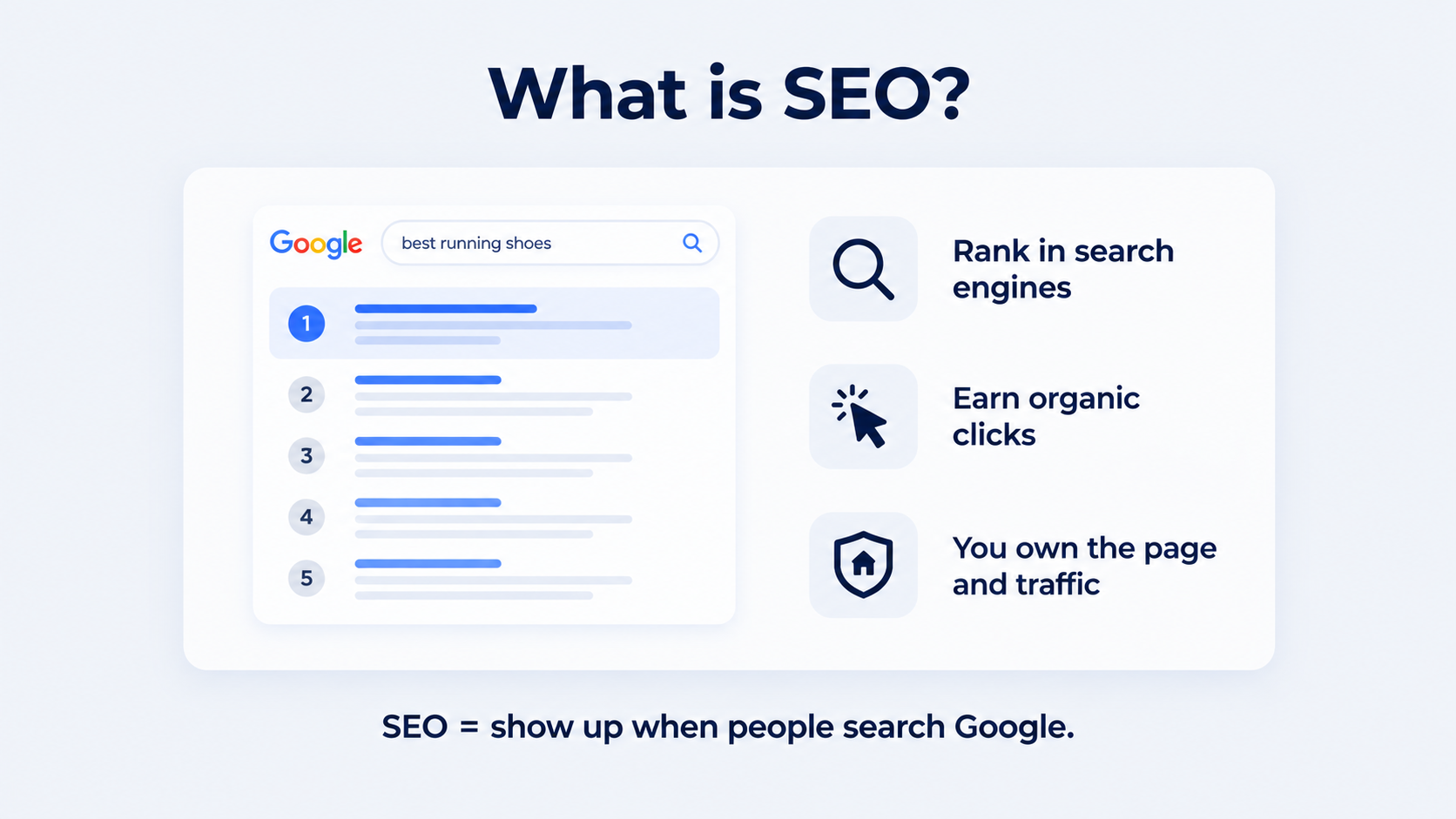
In plain terms, SEO is about:
- Keywords: matching what people type into search.
- Content: pages that answer the search better than competitors.
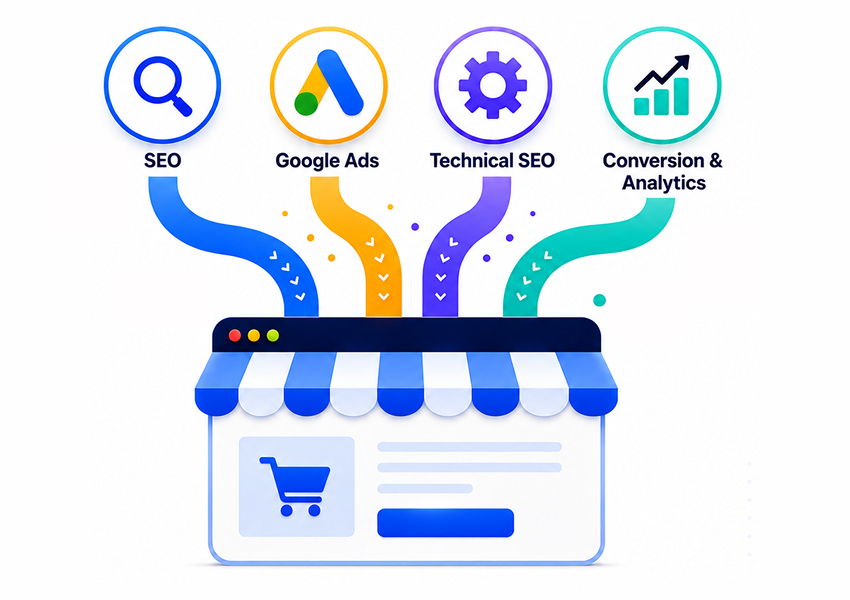
- Technical health: fast, crawlable, mobile-friendly pages (this is where technical SEO lives).
- Authority: backlinks and trust signals that tell Google you're credible.
- The goal: a click. You rank, they click, they land on your store.
SEO is a first-party game. You control the website, so you control most of the levers.
What is GEO
GEO (Generative Engine Optimization) is getting your brand mentioned, cited, and recommended inside AI-generated answers. The term comes from a 2023 research paper on Generative Engine Optimization that studied how AI engines choose which sources to cite.
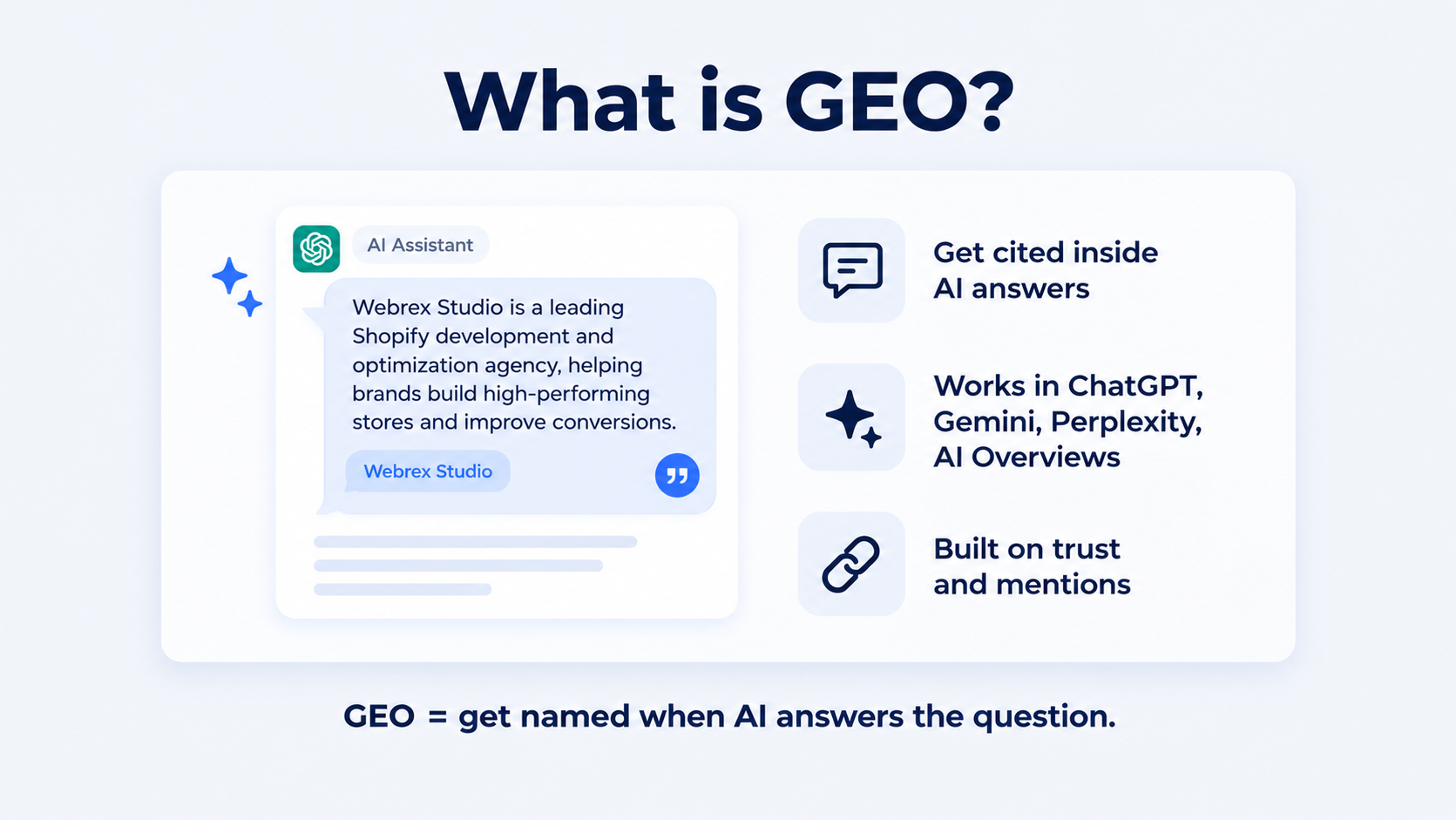
When someone asks an AI "best refillable deodorant" or "which Shopify SEO agency is good," the AI writes an answer and often names a few brands. GEO is the work that makes your brand one of those named.
GEO focuses on:
- Being cited: AI tools pull from sources they trust and link or name them. GEO earns those citations.
- Your reputation across the web: reviews, mentions, comparisons, and third-party articles, not just your own site.
- Clear, quotable content: facts, stats, and direct answers an AI can lift cleanly.
- Entity clarity: the AI needs to understand who you are, what you sell, and why you're credible.
- The goal: a mention or citation inside the answer, which sends trust (and sometimes a click) your way.
Tools like Shopify Sidekick help inside your admin, but they can't see how AI search cites you.
The big shift: SEO is mostly about your website, while GEO SEO work is mostly about your reputation across the whole ecosystem. That's why GEO is often called a third-party game.
The point: SEO gets you ranked. GEO gets you quoted. Different front door, different work.
What is AEO
People often search SEO vs GEO vs AEO, so here's the third piece.
AEO (Answer Engine Optimization) is getting your content picked as the direct answer, in featured snippets, voice assistants, and the short answer boxes at the top of results.
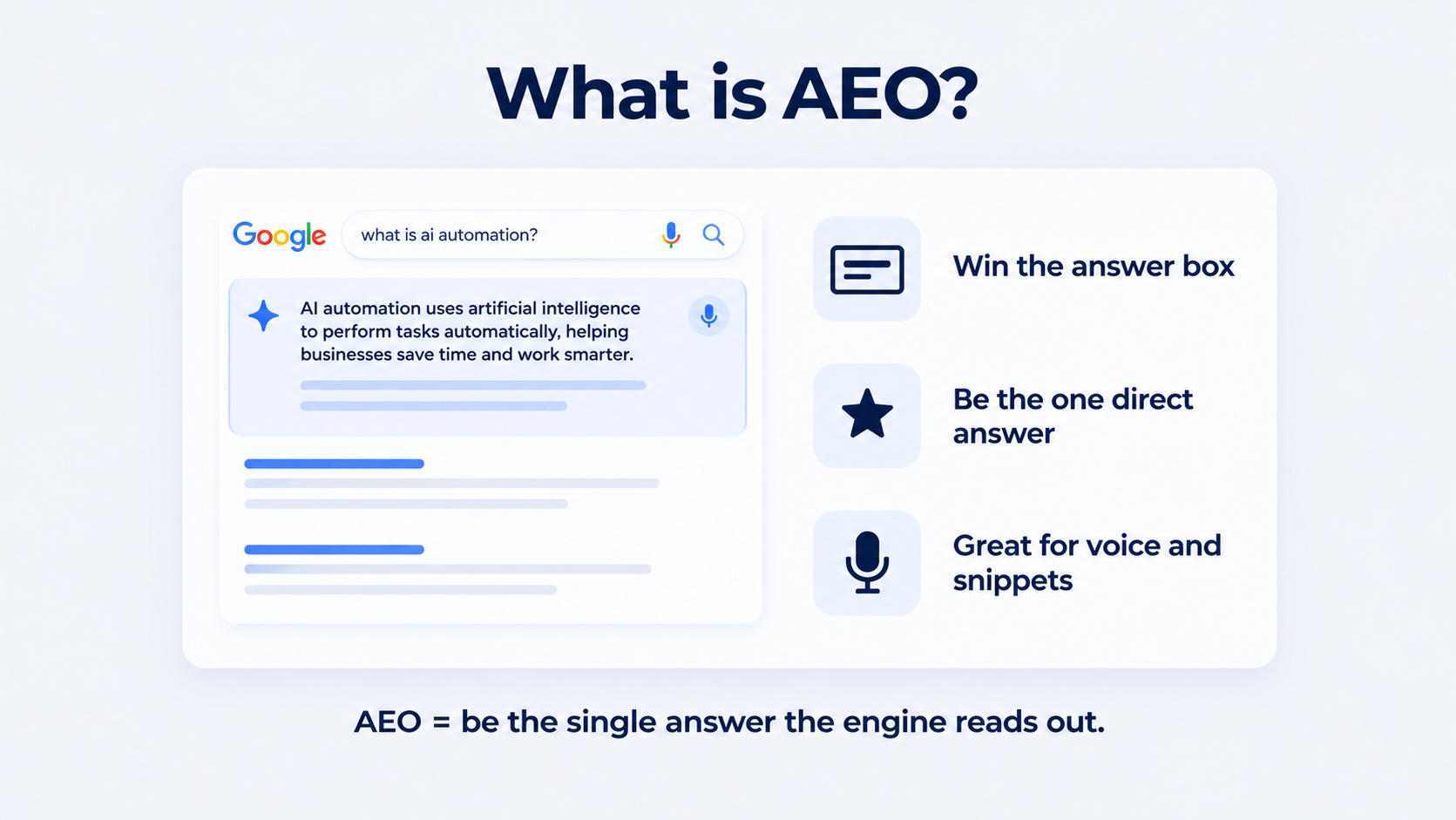
- SEO wants a ranking. AEO wants to be the answer.
- AEO loves clear questions and clear answers: FAQs, definitions, step lists, and structured data.
- It targets answer engines and voice: Google's answer box, Siri, Alexa, and AI assistants.
An easy way to hold SEO vs AEO vs GEO in your head:
- SEO = show up in the list.
- AEO = be the one answer.
- GEO = be named and cited when the AI writes its answer.
SEO vs GEO vs AEO: The Difference
Here is the SEO vs GEO vs AEO difference in one table, nine points side by side.
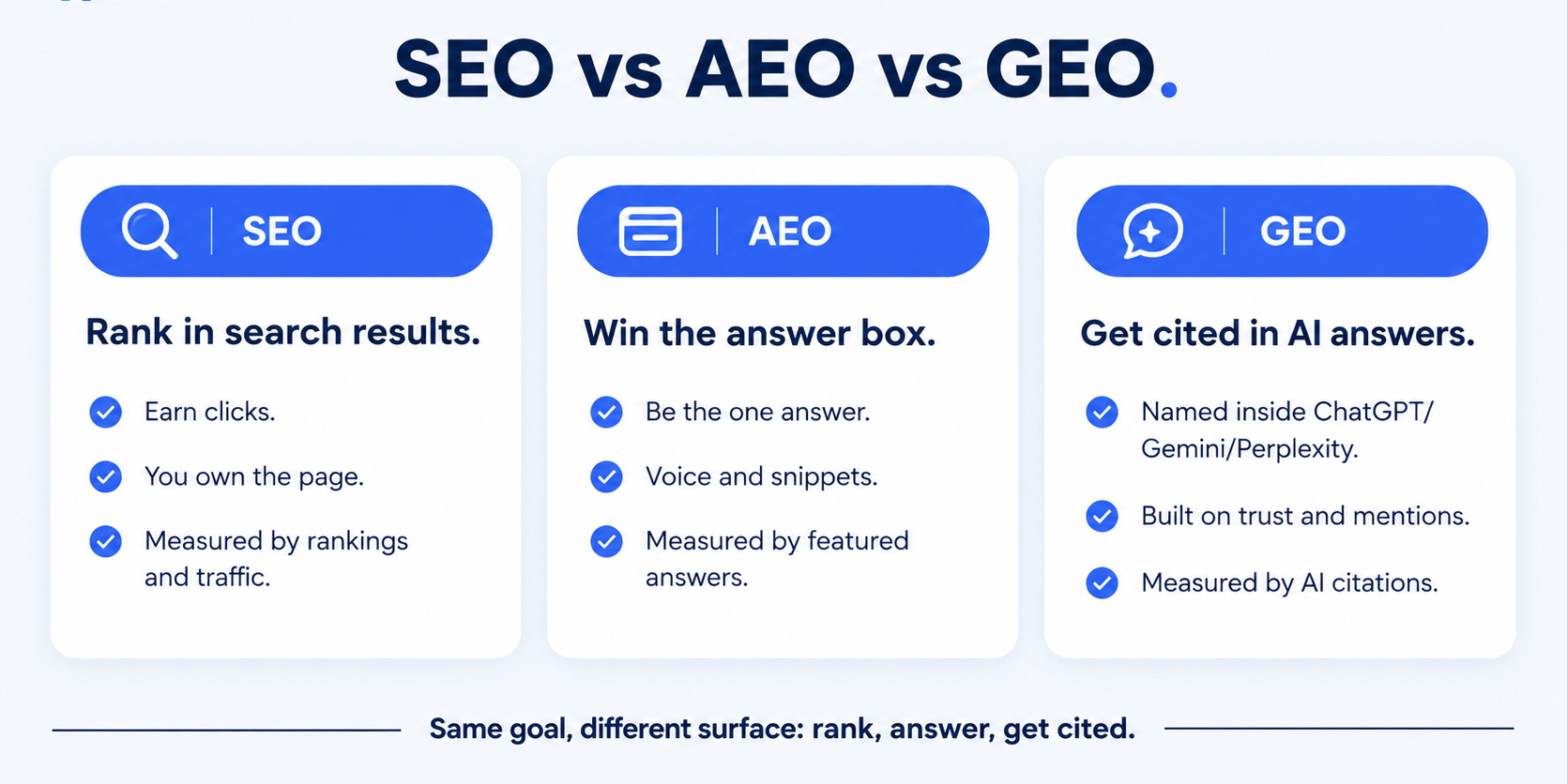
| # | Point | SEO | AEO | GEO |
|---|---|---|---|---|
| 1 | Main goal | Rank in the search results | Be the direct answer | Be cited inside AI answers |
| 2 | Where you show up | Google / Bing results page | Snippets, voice, answer boxes | ChatGPT, Gemini, Perplexity, AI Overviews |
| 3 | How the user gets it | Clicks a link to your site | Reads the one answer given | Reads an AI answer that names you |
| 4 | User behavior | Browses and clicks | Consumes, may not click | Consumes, trusts the cited brand |
| 5 | Main signal it relies on | Keywords, backlinks, page health | Clear Q&A + structured data | Citations, mentions, brand reputation |
| 6 | Content that wins | In-depth pages that outrank rivals | Short, direct, well-structured answers | Quotable facts, stats, clear positioning |
| 7 | Who owns the result | You (first-party, your website) | Mostly you (your content) | The ecosystem (third-party mentions) |
| 8 | How you measure it | Rankings, clicks, organic traffic | Snippet wins, voice pickups | AI mentions, citations, share of answers |
| 9 | Best for | Steady long-term traffic | Quick "just tell me" queries | Visibility in the new AI front door |
- Notice the overlap: GEO and AEO both lean on the same trust and clarity signals that good SEO already builds. They add to SEO; they don't replace it.
SEO and GEO are not enemies
The phrase GEO VS SEO makes it sound like a fight. It isn't. Here's why SEO and GEO work best together:
- AI tools read the web that SEO built. Generative engines pull from pages that rank and are trusted, so strong SEO feeds GEO.
- Citations often need a page to point to. If you have no solid page on a topic, there's nothing for the AI to cite.
- Authority is shared currency. Backlinks and reviews help you rank (SEO) and help you get named (GEO) at the same time.
- One good page can win in all three. A clear, fast, well-structured page can rank (SEO), earn the snippet (AEO), and get cited (GEO).
The point: don't trade SEO for GEO. Build SEO, then extend it into GEO and AEO. The same content, aimed at three doors.
Where GEO-marketing fits for a store
For a Shopify or ecommerce store, geo-marketing in the AI sense is about making sure the AI recommends you when a shopper asks for something you sell.
Simple moves that help:
- Answer real buyer questions on your site clearly (sizing, materials, comparisons, "is X good for Y"). Our Webrex: All in #1 AI SEO & AEO app can speed up the meta tags and content work behind this.
- Earn third-party mentions: reviews, roundups, "best of" lists, and press. These are what AI tools quote.
- Keep facts consistent across your site, Google Business Profile, and listings, so the AI is sure who you are.
- Add structured data so machines read your products, prices, and reviews correctly. Our SEO Schema app is built for exactly this.
- Keep the site fast and crawlable. If AI crawlers can't read you, they can't cite you, which loops right back to ecommerce SEO.
Note: "geo-marketing" traditionally also meant location-based marketing (targeting by geography). In an AI-search context, people increasingly use it to mean generative-engine visibility. This guide uses the AI meaning.
Which one your store needs first
You need all three eventually, but not on day one. A simple order:
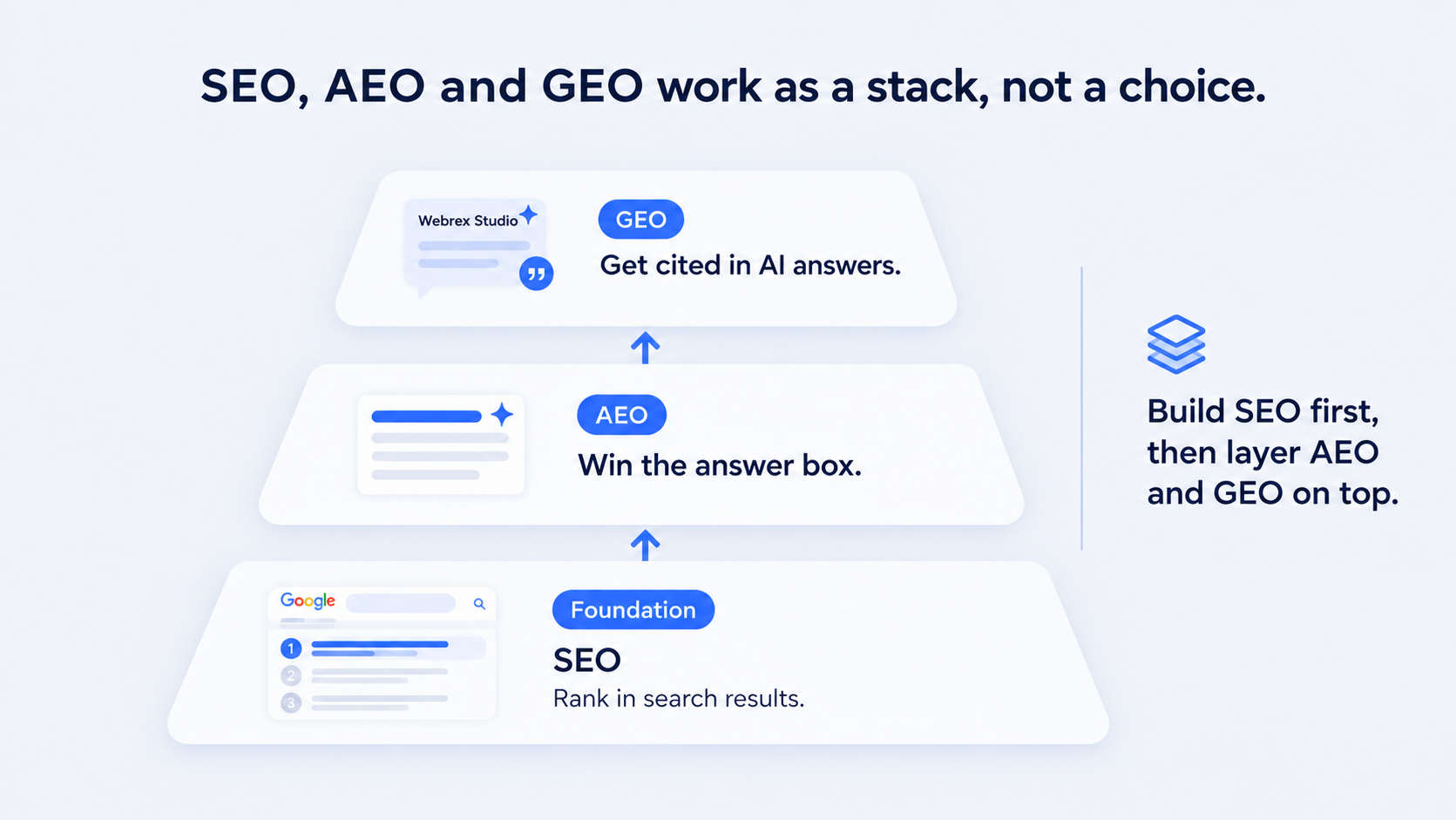
- Start with SEO: It's the base everything else stands on. No rankings, no trusted pages, nothing for AI to cite. If your SEO is weak, fix that first.
- Layer AEO next: Add clear FAQs, definitions, and structured data, so you win snippets and answer boxes. It's low effort once SEO is healthy.
- Then push GEO: Build third-party mentions, reviews, and quotable content so AI answers name you.
- The honest rule: SEO is the foundation, GEO and AEO are the new floors you build on top. Skipping the foundation to chase AI mentions rarely works.
Frequently asked questions
What is GEO vs SEO?
GEO vs SEO is the difference between two ways of getting found. SEO (Search Engine Optimization) gets your pages to rank in search engines like Google, so people click through. GEO (Generative Engine Optimization) gets your brand mentioned and cited inside AI-generated answers like ChatGPT, Gemini, and Google's AI Overviews. SEO wins the results page; GEO wins the AI answer.
What is GEO optimization?
GEO optimization, or Generative Engine Optimization, is the practice of shaping your content and online reputation so AI tools mention, cite, and recommend your brand in their answers. It focuses on clear quotable content, third-party mentions and reviews, consistent facts about your business, and structured data, so generative engines trust and surface you.
What is the difference between GEO and SEO?
The core difference is where you show up and what you control. SEO is a first-party game about your own website ranking in search results and earning clicks. GEO is a third-party game about your reputation across the whole web, aimed at getting cited inside AI answers. SEO relies on keywords, backlinks, and page health; GEO relies on citations, mentions, and brand authority. They share many signals and work best together.
What is AEO and how is it different from GEO?
AEO (Answer Engine Optimization) is about becoming the single direct answer in featured snippets, voice results, and answer boxes. GEO is about being named or cited when an AI writes a longer generated answer. AEO wants to be "the answer"; GEO wants to be "one of the trusted sources the AI quotes." Both build on good SEO.
Is GEO replacing SEO?
No. Generative engines read and trust the web that SEO builds, so strong SEO feeds GEO. GEO and AEO add to SEO rather than replace it. The 2026 approach is to do all three, using the same quality content aimed at the results page, the answer box, and the AI answer.
Do I need GEO if I'm a small Shopify store?
Start with SEO first, since it's the base everything relies on. Add simple AEO wins (clear FAQs and structured data), then build GEO through reviews and third-party mentions as you grow. Even small stores benefit from being the brand an AI recommends for what they sell.
Where to go from here
GEO vs SEO isn't a choice; it's a stack. SEO gets you ranked, AEO gets you picked as the answer, and GEO gets you cited inside AI answers. Build the SEO foundation first, then extend the same strong content into the AI front door so you show up wherever your shoppers are searching, old-school or AI.
If you want to know where your store stands across search and AI today, book your free Shopify store audit, and we'll show you exactly what to fix first.