


A Shopify abandoned cart email is the single highest-return message in your Shopify email marketing toolkit. Someone picked your product, added it to the cart, and left before paying. They were one step from buying. At $50k a month and up, those lost carts aren't a rounding error; they are thousands of dollars walking out every week. This guide shows you the exact flow we build for stores at that level: the timing, the copy, and how to run it across both email and WhatsApp so fewer of those carts slip away.
TL;DR
A Shopify abandoned cart email flow works best as a short, well-timed sequence, not a single email. Fire the first reminder within an hour, follow up at 24 hours, and close with a final nudge at 48 to 72 hours. Add WhatsApp as a second channel for opted-in customers and recovery climbs again, because messages get seen in minutes, not hours. The goal is not to spam; it is to remove the small friction that stopped the sale. Build it once, maintain it, and it recovers revenue on autopilot.
In this guide
- What is a Shopify abandoned cart email
- Why abandoned carts cost Shopify stores more at $50k+ a month
- The abandoned cart email Shopify flow and timing
- Adding WhatsApp to your Shopify abandoned cart recovery
- How to set up Shopify abandoned cart email automation
- What to write in each abandoned cart email Shopify sends
- Mistakes that kill your Shopify abandoned cart recovery
- Frequently asked questions
This guide walks you through what an abandoned cart flow is, why it matters more as you scale, the exact timing and copy that works, and how to run email and WhatsApp together, in plain language with no fluff.
What is a Shopify abandoned cart email
A Shopify abandoned cart email is an automated message sent to a shopper who added products to their cart or started checkout but did not complete the purchase. Shopify captures the email at checkout, and your email tool triggers a message a set time later, reminding them to come back and finish.
In plain terms, abandoned carts Shopify tracks are simply:
- Carts with intent: The shopper wanted the product enough to add it. This is warm traffic, not cold.
- Checkouts that stalled: Something small got in the way: a price shock at shipping, a distraction, a payment doubt, a second thought.
- Recoverable revenue: A large share of these people will still buy if you give them a timely, low-friction reason to return.
The point: An abandoned cart is not a lost customer; it is a paused one. The job of the flow is to un-pause them before they forget.
Why abandoned carts cost Shopify stores more at $50k+ a month
Most stores lose roughly 7 out of every 10 carts. That abandonment rate is normal. What changes as you scale is the size of the leak. Here is the simple math on why Shopify abandoned cart emails matter so much once you cross $50k a month.
| Your store | Monthly carts started | Abandoned (~70%) | Recovered at 10% | Extra monthly revenue (at $80 AOV) |
|---|---|---|---|---|
| Smaller | 1,000 | 700 | 70 orders | ~$5,600 |
| $50k+ a month | 3,000 | 2,100 | 210 orders | ~$16,800 |
In our own client work, expanding from a single reminder to a full 3-step sequence helped lift abandoned checkout revenue from $7,465 to $19,142—a 156% increase without spending a dollar more on acquisition.
- The leak scales with you. The more traffic and spend you push, the more carts you abandon, and the more a flow is worth.
- It is the cheapest revenue you have. You already paid to acquire this visitor. Recovering them costs a fraction of a new sale and compounds alongside your conversion rate optimization work.
The takeaway: At $50k a month, a working Shopify abandoned cart flow is not a nice-to-have. It is often the fastest five figures of monthly revenue you can add without spending a cent more on ads.
The abandoned cart email Shopify flow and timing
One email is not a flow. The stores that recover the most use a short sequence, each message with a different job. Here is the abandoned cart email Shopify sequence we build at this level.
| Step | Timing after abandonment | Job of the message |
|---|---|---|
| Email 1 | 1 hour | Simple reminder. "You left something behind." No discount yet. |
| Email 2 | 24 hours | Handle the objection. Trust, shipping, returns, reviews, product value. |
| Email 3 | 48 to 72 hours | Final nudge. Light urgency or a small incentive if your margin allows. |
- Start fast. The first hour is when intent is highest. Wait a day and most of that heat is gone.
- Do not lead with a discount. Train shoppers to abandon on purpose, and you shrink your own margin. Save any offer for the last message, if at all.
- Three is usually enough. More than three emails and you annoy more people than you recover.
The point: The timing is the strategy. A great email sent 12 hours too late loses to an average email sent in the first hour.
Adding WhatsApp to your Shopify abandoned cart recovery
Email works, but inboxes are crowded, and many messages are never opened. For opted-in customers, WhatsApp is a powerful second channel for Shopify abandoned cart recovery, because messages are usually read within minutes.
Here is how we layer the two channels together without overwhelming the shopper.
| Channel | Timing | What it does |
|---|---|---|
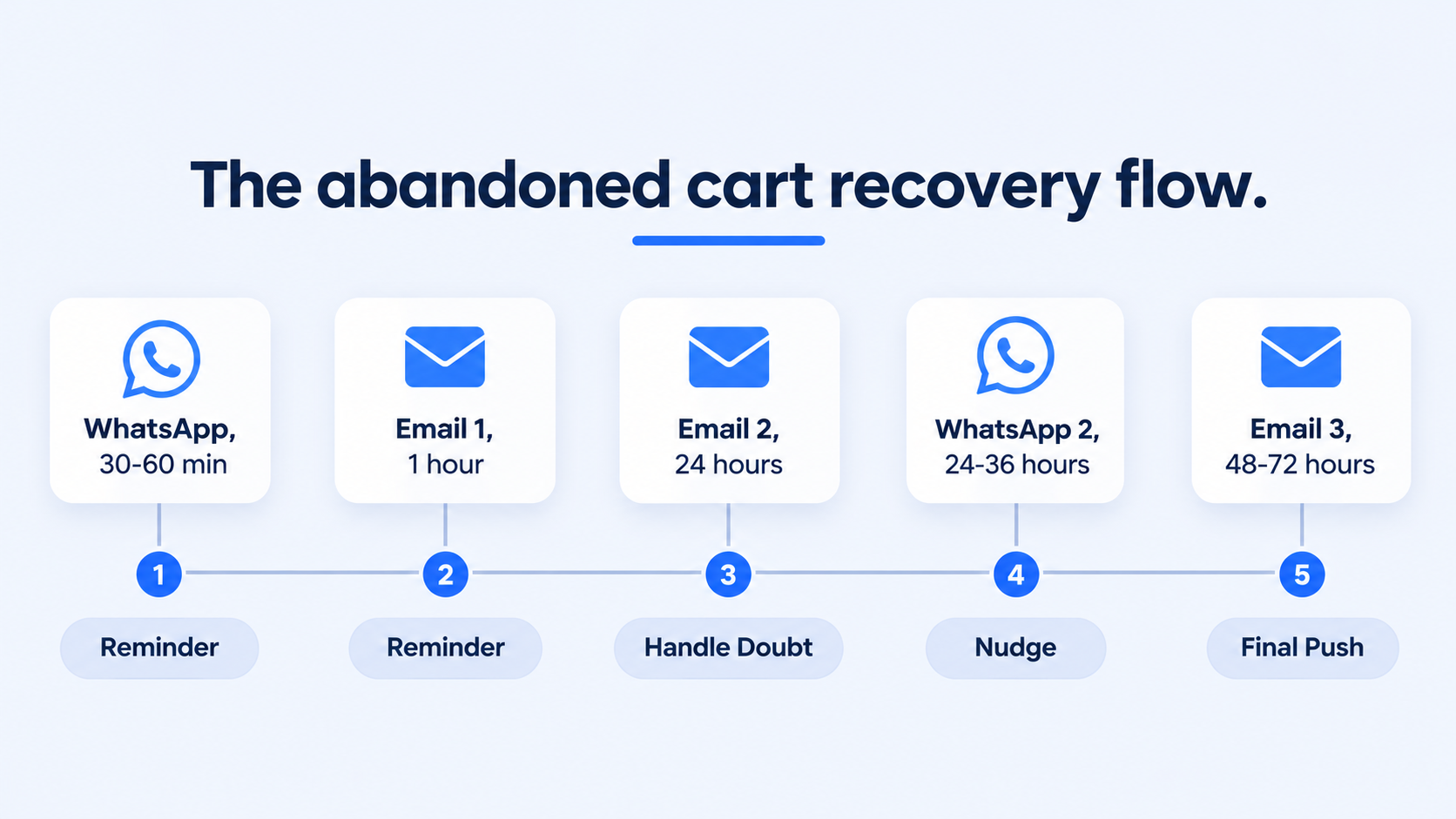
| WhatsApp 1 | 30 to 60 minutes | A short, friendly nudge with the product and a checkout link. |
| Email 1 | 1 hour | The reminder email, in case WhatsApp was missed or not opted in. |
| Email 2 | 24 hours | Objection-handling email. |
| WhatsApp 2 | 24 to 36 hours | A quick "still thinking it over?" message, only if no reply. |
| Email 3 | 48 to 72 hours | Final email with light urgency or incentive. |
- Consent first: Only message customers who opted in to WhatsApp, strictly adhering to the WhatsApp Business Messaging Policy. Keep in mind that WhatsApp messages outside the standard 24-hour service window require an approved template, as abandoned cart reminders are classified as marketing messages.
- Keep WhatsApp short: One or two lines and a link. It is a tap-to-buy channel, not a newsletter.
- Stop on reply or purchase: The moment they buy or respond, the sequence should exit. Nothing kills trust like a reminder for something already bought.
The takeaway: Email reaches almost everyone; WhatsApp reaches them fast. Run both, space them sensibly, and you catch the carts a single channel would miss.
How to set up Shopify abandoned cart email automation
You can get a basic version live quickly, then layer in the rest. Here is how to build Shopify abandoned cart email automation the right way.
- Turn on cart tracking: Make sure your Shopify checkout and email tool (or dedicated abandoned cart recovery apps) are capturing abandoned checkouts and the shopper's email.
- Connect your email platform: Use your email marketing automation platform (or Shopify Email) to create an automation triggered by "checkout abandoned." Note that by default, Shopify's built-in automation only emails subscribed customers; make sure you review recipient rules if you plan to recover un-subscribed checkouts.
- Build the three-email sequence: Set the delays to 1 hour, 24 hours, and 48 to 72 hours, each with its own message and job.
- Add exit conditions: The flow must stop automatically when the shopper completes the purchase (using Shopify Flow's customer abandons checkout triggers and exit conditions), so no one gets reminded after buying.
- Layer in WhatsApp: For opted-in customers, add the two WhatsApp touches at 30 to 60 minutes and 24 to 36 hours.
- Personalise it: Pull in the exact products left behind, with images, name, and a one-click link straight back to the cart. You can also segment by cart value to trigger personalized offers or white-glove support for high-value orders.
- Test, measure, improve: Watch recovery rate, revenue per recipient, and unsubscribe rate, then adjust timing and copy.
The point: The setup is not the hard part. Getting the timing, copy, and exit rules right is what separates a flow that recovers 10% from one that recovers almost nothing.
What to write in each abandoned cart email Shopify sends
Every abandoned cart email Shopify delivers should carry a few non-negotiables. Get these right, and the copy mostly writes itself.
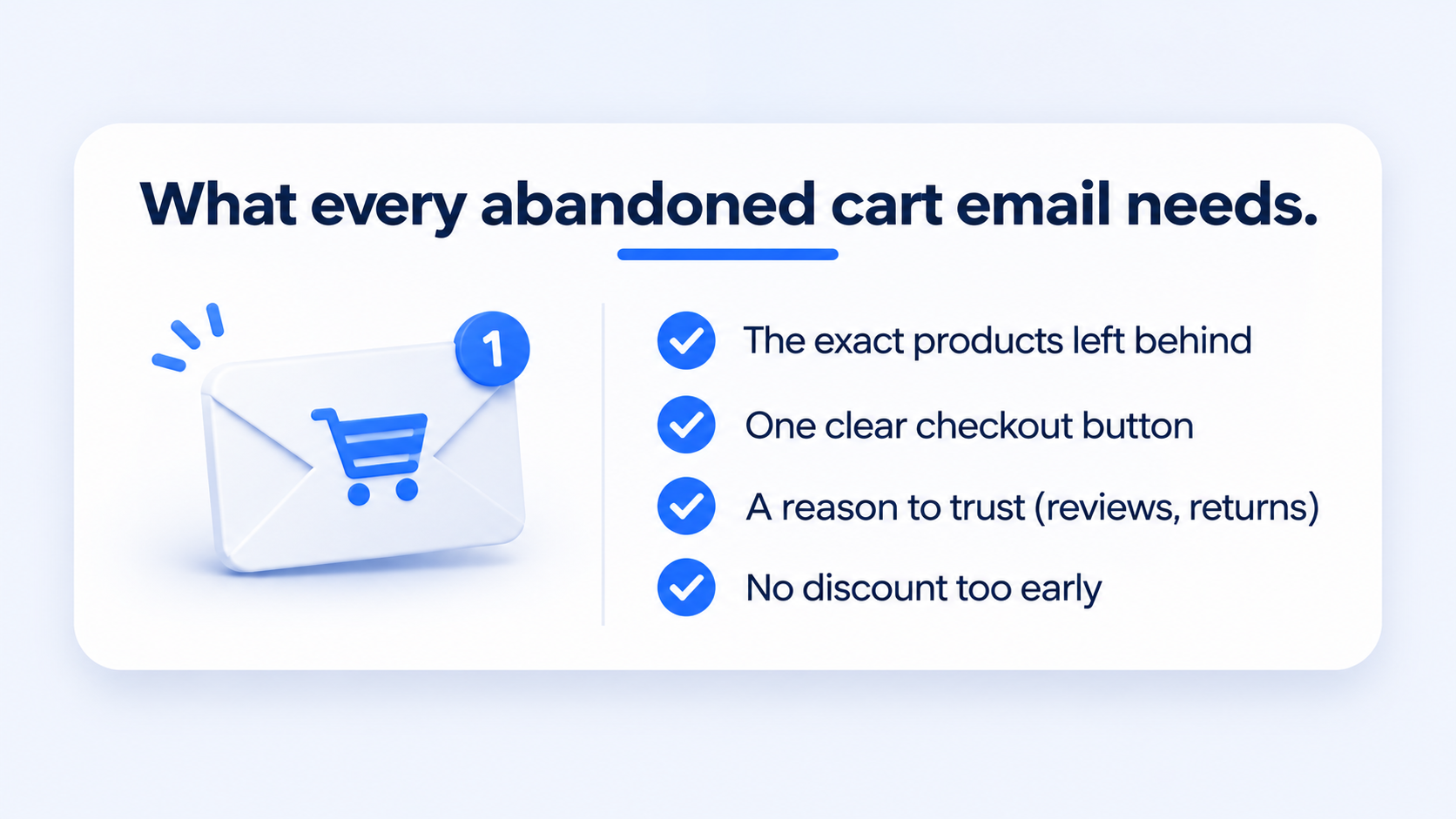
- The exact products they left: Image, name, and price. Remind them what they wanted.
- One clear button: "Complete your order," linked straight back to the filled cart. One action, no hunting.
- A reason to trust: Reviews, free returns, shipping info, or a guarantee. Most carts stall on doubt and checkout friction, not price.
- A human tone: Write like a helpful person, not a billing system. Short, warm, easy to scan.
- An incentive only at the end, only if needed: If your margin allows and the first two emails did not convert, a small offer in the final message can tip the fence-sitters.
The takeaway: The best Shopify abandoned cart emails remove friction and doubt. They do not beg, and they do not bribe too early.
Mistakes that kill your Shopify abandoned cart recovery
A flow can look live and still leak. These are the mistakes we see most on stores at $50k a month and up.
- Sending too late: A first email at 24 hours misses the hottest window entirely.
- Discounting immediately: Train buyers to abandon for a coupon, and you erode margin across the whole store. Hold back discounts to protect your margin until the final reminder.
- No exit condition: Reminding someone about a cart they already paid for destroys trust.
- Generic copy: No product image, no cart link, no personalisation. It reads like spam and performs like it.
- One channel only: Email alone leaves recoverable WhatsApp-reachable carts on the table.
- Set and forget: Timing and copy drift out of date. The flow needs eyes on it, not just a switch.
The point: Most abandoned cart flows underperform not because the idea is weak, but because the timing, personalisation, or exit rules are off. The details are the difference.
Frequently asked questions
How to set up abandoned cart email in Shopify?
Connect your email platform to Shopify, create an automation triggered by an abandoned checkout, and build a short sequence: a reminder at 1 hour, an objection-handling email at 24 hours, and a final nudge at 48 to 72 hours. Pull in the exact products left behind with a one-click link back to the cart, add an exit condition so the flow stops when the shopper buys, then test the timing and copy over time. For opted-in customers, add WhatsApp as a faster second channel.
How many abandoned cart emails should I send?
Three is the sweet spot for most stores. The first recovers the easy wins, the second handles doubt, and the third makes a final push with light urgency or a small incentive. More than three tends to annoy more shoppers than it recovers, so add touches only if the data shows they still convert.
Should abandoned cart emails include a discount?
Not at the start. Leading with a discount teaches shoppers to abandon carts on purpose, which quietly shrinks your margin. Lead with a reminder and a reason to trust. If your margin allows, hold any small incentive for the final message, and only for people the earlier emails did not convert.
Does WhatsApp work better than email for abandoned carts?
They work best together. WhatsApp messages are usually read within minutes, so they are great for a fast first nudge to opted-in customers. Email reaches almost everyone and carries more detail. Running both, spaced sensibly, recovers more carts than either channel alone.
What is a good abandoned cart recovery rate on Shopify?
Many stores recover somewhere around 5 to 15% of abandoned carts with a solid flow, though it varies by product, price, and audience. The exact number matters less than the trend: once the flow is live, focus on improving timing, copy, and personalisation to push the rate up over time.
Can I automate Shopify abandoned cart emails and forget about them?
You can automate the sending, but not the thinking. The flow needs occasional review: timing, copy, offers, and exit rules all drift. Treat it as a living asset you improve, not a switch you flip once, and it keeps earning.
Where to go from here
At $50k a month and above, a well-built Shopify abandoned cart email flow is some of the cheapest, fastest revenue in your whole store. The visitors are warm, the cost is near zero, and the only thing standing between you and the recovered sales is a sequence timed and written properly, ideally across both email and WhatsApp.
If you want that built and managed for you, book your free Shopify store audit, and we'll show you exactly how much revenue your abandoned carts are leaving on the table, and the flow to recover it.