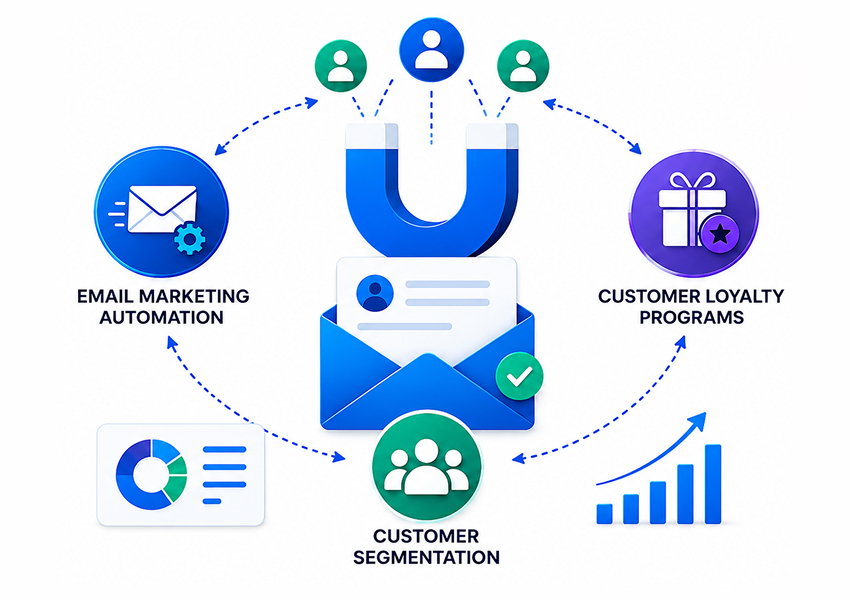


If you want more sales from your Shopify store without spending more on ads, email is where it comes from. And it comes down to 8 things: a welcome flow for new subscribers, an abandoned cart flow, a browse abandonment flow, a post-purchase flow, a winback flow for people who drifted away, splitting your list into segments, writing emails that sound like a person, and keeping a simple campaign calendar. The flows do most of the work. Klaviyo's 2026 benchmark data, drawn from more than 183,000 brands, shows automated flows are about 5.3% of sends but around 41% of email revenue. You set them up once, and they keep earning while you sleep.
In this guide
The 8 ways
- Set up a welcome flow first
- Rescue abandoned carts
- Catch browse abandonment
- Sell again after the sale
- Win back the people who drifted away
- Segment your list
- Write emails that sound like a person
- Send regular campaigns on a simple calendar
Also covered
- Why most Shopify stores leave money on the table
- Flows v/s campaigns, the one idea that makes email click
- The best email marketing apps for Shopify
- Will I annoy my list and lose subscribers?
- Common mistakes to avoid
- Your first 30 days
This guide walks through all 8, in the order a real store owner should actually do them. If you would rather hand the whole thing over, that is what our email marketing automation work does day to day. But first, a quick picture.
Think about the last coffee shop you loved. Not the chain on the main road. The small one on a side street where the owner remembered your order. You went back because it felt like they knew you. You told your friends. You never even looked at the price.
Now think about a shop where a stranger takes your order every single time and never says a word back. You buy, you leave, you forget it exists. Same coffee. Totally different relationship.
Your Shopify store is one of those two shops. Email is the thing that decides which one. Get it right, and your customers feel remembered, so they come back and spend more. Get it wrong, or skip it, and every visitor is a stranger who buys once and vanishes. No jargon and no scare tactics ahead, just the moves that make the biggest difference.
Why most Shopify stores leave money on the table
Here is how it usually happens. You launch. You are busy with products, ads, packing orders, and customer messages. Email feels like a "later" job, so you send the odd newsletter when you remember, and that is it.
Meanwhile, your list grows. People sign up at checkout, in a popup, from an offer. And then nothing reaches them. No welcome, no cart reminder, no note after they buy. The people most likely to buy again are sitting in a list, hearing silence.
The problem is not that you are lazy. It is that email marketing on Shopify feels optional when ads are running. But ads rent attention. Email owns it. You paid to get that person once, and email is how you sell to them a second, third, and fourth time for almost nothing.
If you have not covered the technical groundwork yet, our guide to email marketing fundamentals walks through authentication and deliverability, which is what decides whether any of the below actually reaches an inbox.
The one idea that makes email click
Most owners think email marketing means "send more newsletters." That is why they avoid it. The real shift is this. Email is two jobs, not one. Flows are automated emails that fire when someone does something, like joining your list or leaving a cart. Campaigns are the emails you write and send to everyone on a given day. Flows run forever once set up; campaigns are the fresh, timely sends, and most of your money comes from flows, which is the part almost everyone skips.
The takeaway: flows are the machine that runs while you sleep. Campaigns are you talking to the room today. Build the machine first, then talk to the room.
The 8 ways
1. Set up a welcome flow first
When someone joins your list, they are the warmest they will ever be. They just raised their hand. A welcome flow is a short series of automated emails that greets them and makes the first sale feel easy.
Welcome emails are the highest-opened emails you will ever send. Reported open rates for automated welcome emails run around 83%, though Klaviyo's own broader ecommerce benchmark puts the average closer to 51%, so treat 83% as the ceiling rather than the norm. Use email one to say thanks and set the tone, email two to share your story or bestsellers, and email three to nudge with a small first order incentive if you offer one. If you do only one thing after reading this, do this one.
2. Rescue abandoned carts
Most people who add to cart do not buy on the first visit. That is normal, as long as you follow up. An abandoned cart flow reminds a shopper about the items they left behind, usually starting 30 to 60 minutes after they leave.
These emails work because the person already wanted the product. According to Klaviyo's abandoned cart benchmark report, cart flows average a 50.5% open rate and a 3.33% placed-order rate, with the top 10% of stores reaching 7.69%. That makes them the single highest-earning flow per recipient of any you can run. Two or three spaced-out reminders beat a single email by a wide margin, because they catch people at different moments.
If you want to go deeper on this one flow, we compared the tools in our guide to Shopify abandoned cart recovery apps.
3. Catch browse abandonment
This is the quiet one most stores miss. Some shoppers view a product and leave without ever adding to cart, so no cart trigger fires and a cart flow never reaches them.
A browse abandonment flow emails someone who viewed a product but did not add it, showing them what caught their eye. It is softer than a cart email because intent is lower, so lead with the product and a helpful reason to come back rather than a hard discount.
4. Sell again after the sale
The sale is the start of the relationship, not the finish line. A post-purchase flow thanks the buyer, sets delivery expectations, and gently opens the door to the next order.
Use it to confirm the order in a warm human way, share how to use the product, ask for a review at the right moment, and later suggest a matching item. A happy first-time buyer is far cheaper to sell to than a cold stranger from an ad. This is where one-time buyers quietly become regulars.
5. Win back the people who drifted away
Every list has sleepers who bought once or signed up months ago and went quiet. You do not need to lose them. A winback flow reaches lapsed contacts with a "we miss you" message and a reason to return.
Set it to trigger after a stretch of no activity, say 60 or 90 days depending on how often people normally buy. Lead with a reminder of why they liked you, then add a clear offer if the silence continues. The ones who never engage again can be cleaned off your list, which actually helps your deliverability.
6. Segment your list so the right message reaches the right person
Sending the same email to everyone is the fastest way to bore your best customers and annoy your new ones. Segmentation means grouping your list so each group gets a message that fits them.
Start simple. Split by new subscribers v/s repeat buyers, by recently active v/s quiet, and by big spenders v/s one-time buyers. Segmented sends consistently outperform blasts, and even a basic split can raise your email revenue by 15 to 25% with no change to your products or ad spend. If you would rather have this built properly against your real order data, that is what our customer segmentation work does.
7. Write emails that sound like a person, not a billboard
Owners often think a real marketing email needs a big banner and a sale sticker. Often the opposite wins. Simple, plain text style emails frequently beat heavily designed ones because they feel like a note from a friend, not an ad.
Write as you talk. Use the person's first name. Keep one clear idea and one clear thing to click. A short, honest email that says "we just restocked the one you wanted, here it is" will usually outperform a glossy template that says nothing personal.
8. Send regular campaigns on a simple calendar
Flows do the automated heavy lifting, but you still need to show up. Campaigns are your planned sends, and a simple calendar keeps you consistent without burning out.
You do not need to email daily. A steady rhythm of one to a few sends a week is plenty for most stores. Mix it up so you are not always selling. Share a new arrival, a useful tip, a customer story, a restock, then an offer. Consistency is what keeps your list warm so that when you do run a sale, people are actually paying attention. For the highest-stakes stretch of the year, our Shopify Black Friday checklist covers send cadence and list warm-up in detail.
The best email marketing apps for Shopify
You cannot do any of the 8 things above without a tool to run them. The good news is you do not need a fancy one, and the Shopify email marketing apps worth your time are few. Here are the ones most store owners actually use.
-
Shopify Email: This is the native option built right into your admin. If you are brand new and want to learn how to use Shopify email marketing without paying extra, start here. It handles basic campaigns and simple automations, and it is free up to a set number of emails a month. It is the easiest way to send your first Shopify email campaign. One store we worked with cut costs by migrating to it from Klaviyo without losing revenue.
-
Klaviyo: The most popular choice for serious email marketing Shopify stores rely on. It is built for exactly the flows and segmentation covered above, and it plugs straight into your store data. If you plan to grow, this is the tool most stores settle on. It costs more as your list grows, but the flows usually pay for it many times over.
-
Omnisend: A strong middle ground. Cheaper than Klaviyo for many stores, with email and SMS in one place and ready-made flow templates. A solid pick if Klaviyo feels like too much too soon.
So what is the best email marketing for Shopify for you? If you want free and simple, use Shopify Email. If you are ready to build the full flow and segment setup and want room to scale, choose Klaviyo. If you want most of that power at a lower starting cost, look at Omnisend. The tool matters far less than actually turning the flows on, so pick one and start.
The part nobody talks about: your list is the only asset you truly own
Your ad accounts can get restricted. Your social reach can drop overnight. Your rankings can slip after an update. All of that sits on land you rent.
Your email list is the one audience no platform can take from you. You own the addresses, and you decide when to reach them. That is why email quietly returns more per dollar than most paid ads. One store we fixed the flows for went from $47K to $101K in monthly email revenue without touching ad spend. Treat your list like the asset it is, and it becomes the most reliable revenue you have.
The fear that stops people: "I will annoy my list and everyone will unsubscribe"
This is the number one worry, and it keeps stores emailing too little rather than too much. Here is the honest answer.
-
A few unsubscribes are healthy, not a failure. People who leave were never going to buy. Every send gently sharpens your list down to people who actually want to hear from you, and a tighter list gets delivered better.
-
Value beats frequency. People do not unsubscribe because you emailed twice this week. They unsubscribe because both emails were boring or pushy. Send something useful and the complaints stay low. And flows like a cart reminder or a thank-you note rarely annoy anyone, because they match what the person just did.
Common mistakes to avoid
-
Sending campaigns but skipping flows: This is the big one. If you only blast newsletters and never set up a welcome or cart flow, you are leaving the most profitable email revenue on the table. Build the flows first.
-
Buying or scraping email lists: It wrecks your deliverability. Emails to people who never signed up get marked as spam, which then hurts the inbox placement of your real subscribers. Grow your list with honest signups only.
-
One long cart email instead of a short series: A single reminder catches one moment. Two or three spaced-out reminders catch people across different days, and consistently recover more orders.
-
Never clean the list: Keeping dead contacts to make the number look big lowers your open rates and can land you in spam. A smaller engaged list beats a big silent one.
Your first 30 days with Shopify email marketing
You do not need to build everything at once. Here is a doable order.
-
Week 1: Pick your tool and set up the welcome flow. Choose one of the apps above, then build a 2- to 3-email welcome series. This alone starts earning quickly.
-
Week 2: Turn on the abandoned cart flow. A short reminder series starting under an hour after someone leaves a full cart. This is your fastest win in real revenue.
-
Week 3: Add the post-purchase and browse abandonment flows. Thank your buyers, open the door to the next order, and catch the people who looked but did not add to cart.
-
Week 4: Do a basic segment split and send your first campaign. Separate new subscribers from repeat buyers, then send one useful, human email. Now you have flows running and campaigns going, which is a complete program.
After 30 days, you can add a winback flow and a light weekly calendar. A mature setup, built one small step at a time.
Where to go from here
You do not need to be a marketer to make Shopify email marketing work. You need the flows set up in the right order, a list you grew honestly, and emails that sound like a person. Do that and email becomes the calm, reliable channel that keeps paying you long after the ad budget runs out.
If you would rather have someone set the flows up for you, that is what our email marketing automation work does. And if you want a second set of eyes on your store first, book a free strategy call and see exactly which flows and fixes would move your revenue the most.