
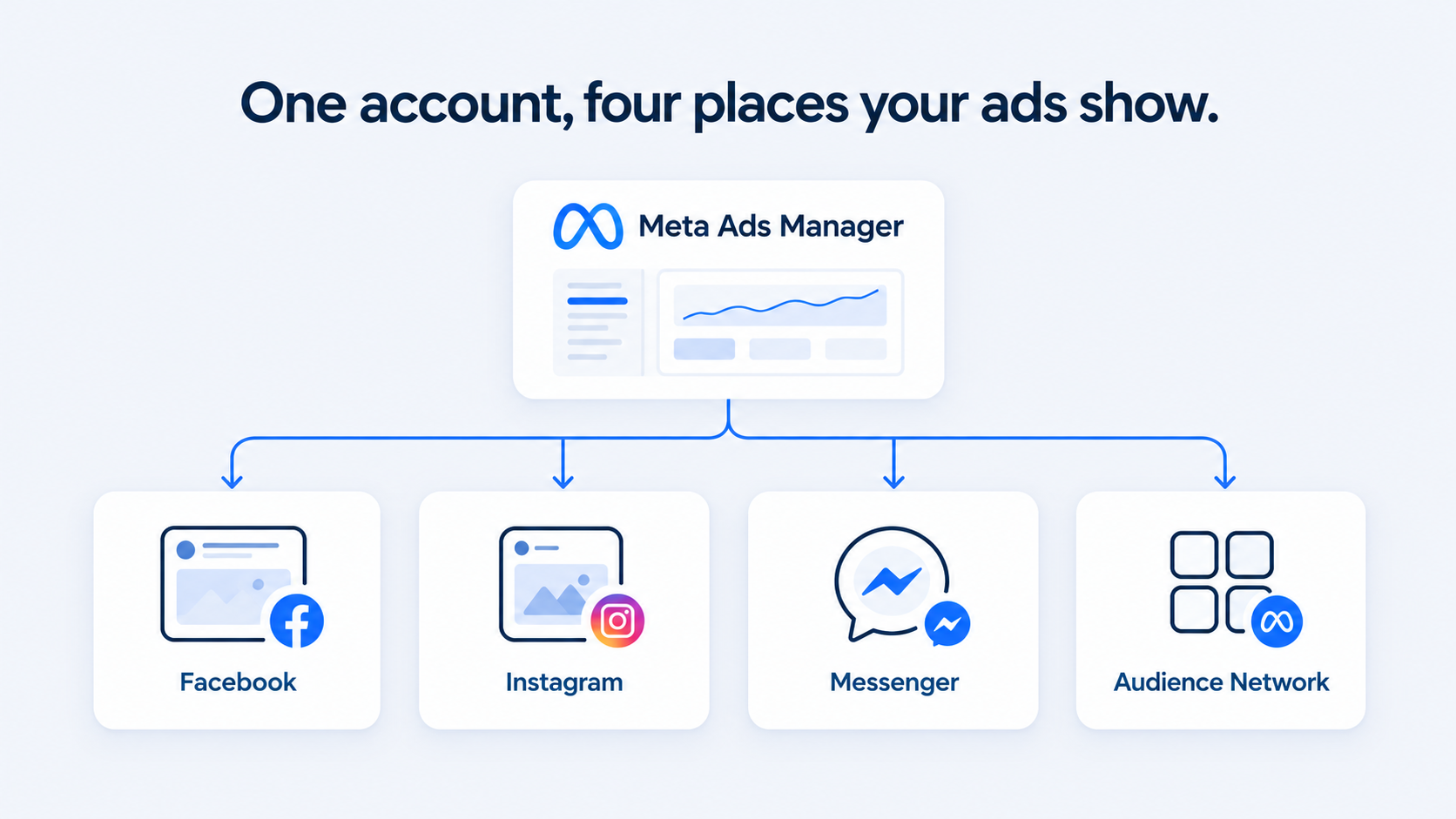
Meta Ads are the paid ads you run across Facebook, Instagram, Messenger, and the Audience Network, all from one place called Meta Ads Manager. A single Meta ad is the same thing people still call a Facebook ad, just under Meta's newer name, and the whole channel is often called Meta marketing. For ecommerce brands, Meta is where you reach cold shoppers who were not searching for you yet, show them your product, and bring them back until they buy. This Meta ads guide covers what Meta ads are, how they work, what they cost, how to run them, and when to hire help, in plain language.
TL;DR
Meta Ads put your product in front of people scrolling Facebook and Instagram. They work best as a system: show new audiences your product (prospecting), then bring back the ones who showed interest (retargeting). Costs vary by industry, but the lever that decides profit is not budget; it is creative, offer, and a store that converts. Start small, test creatives, and scale what wins.
In this guide
- What are Meta Ads
- Do Meta Ads still work for ecommerce
- How much do Meta Ads cost
- How to run Meta Ads, step by step
- The Meta Ads funnel: prospecting and retargeting
- Targeting on Meta
- Meta Ads vs Google Ads
- Common mistakes and how to optimize
- When to hire a Meta Ads agency
- Frequently asked questions
This guide walks you through what Meta Ads are, whether they still work, what they cost, how to set them up, how the prospecting-to-retargeting funnel works, how to target, how they compare to Google, and the mistakes that waste budget, all in plain words.
What are Meta Ads
Meta Ads are paid advertisements run through Meta's platforms: Facebook, Instagram, Messenger, and the Audience Network. You create and manage them in Meta Ads Manager, Meta's control panel for building campaigns, setting budgets, and tracking results.
In plain terms, Facebook ads and Meta Ads are the same thing. Meta just renamed the company, so the ads now sit under the Meta brand. What you get is:
- Reach: Billions of people across Facebook and Instagram.
- Targeting: Show ads based on interests, behaviours, and your own customer data.
- Formats: Image, video, carousel, Stories, Reels, and more.
- A full funnel: From first touch to repeat buyer, in one system.
The key difference from search ads: On Meta, people are not searching for you. You interrupt their scroll with something good enough to stop them. That makes creative (the image or video) the single most important lever.
The point: Meta Ads are interruption, not search. You win by showing the right person a scroll-stopping ad, not by bidding on a keyword.
Do Meta Ads still work for eCommerce?
Short answer: Yes, when run right. Despite rising costs and iOS privacy changes, Meta is still one of the biggest paid channels for most Shopify brands because it reaches people who were never going to search for your product.
- It creates demand: Search captures existing demand. Meta creates it by putting your product in front of people who did not know they wanted it.
- It scales: Few channels can spend budget profitably at the volume Meta can.
- It compounds with retargeting: Even if someone does not buy on the first ad, Meta lets you follow up until they do.
The brands that say "Meta does not work" almost always have weak creative, a weak offer, or a store that does not convert the traffic. The channel is rarely the problem.
The takeaway: Meta Ads still work. What changed is that lazy ads stopped working. Good creative and a store that converts are now non-negotiable.
How much do Meta Ads cost?
The honest answer on Facebook ads cost: it depends on your industry, audience, and creative. You do not pay a fixed price; you pay for attention in an auction, so better ads cost less.
Here are the broad ranges most ecommerce brands see. Treat these as rough guides, not promises; your real numbers depend on your niche and creative.
| Metric | What it means | Typical range |
|---|---|---|
| CPM | Cost per 1,000 impressions | $8 to $20 |
| CPC | Cost per link click | $0.50 to $2.50 |
| CTR | Click-through rate | 1% to 2% |
| CPA | Cost per purchase | Varies widely by price point |
| ROAS | Return on ad spend | 1.5x to 4x+ when healthy |
- The real cost lever is not budget: Two stores spending the same get wildly different results based on creative, offer, and how well the store converts.
- Start small: You do not need a huge budget to test. You need enough to find a winning creative, then scale it.
The point: Do not ask "how much do Meta Ads cost?" Ask "How much does it cost me to acquire a customer, and is that less than they are worth?" That is the number that matters.
How to run Meta Ads, step by step
Here is how to run Facebook ads without wasting your first budget. The whole thing happens inside Meta Ads Manager.
- Set up the foundations: Create a Meta Business account, connect your Facebook page and Instagram, and install the Meta Pixel on your store so Meta can track sales.
- Pick one clear objective: For ecommerce, that is usually Sales (conversions). Let Meta optimise for purchases, not clicks or likes.
- Build your audiences: Start broad for prospecting, and build retargeting audiences from people who visited your site or engaged with you.
- Create strong creative: This is 80% of the result. Make several image and video ads, lead with the hook in the first 3 seconds, and show the product in use.
- Set a test budget: Start small, run a few creatives against each other, and give it enough time and data before judging.
- Read the data and scale: Kill the losers, put more budget behind the winners, and keep feeding in fresh creative.
Use the Meta Ads Library for research
Before you launch, open the free Meta Ads Library. It shows every ad your competitors are currently running.
- See what offers, hooks, and formats rivals use.
- Spot the ads they have run for a long time (long-running usually means profitable).
- Get creative ideas without guessing.
The Meta Ads funnel: Prospecting and retargeting
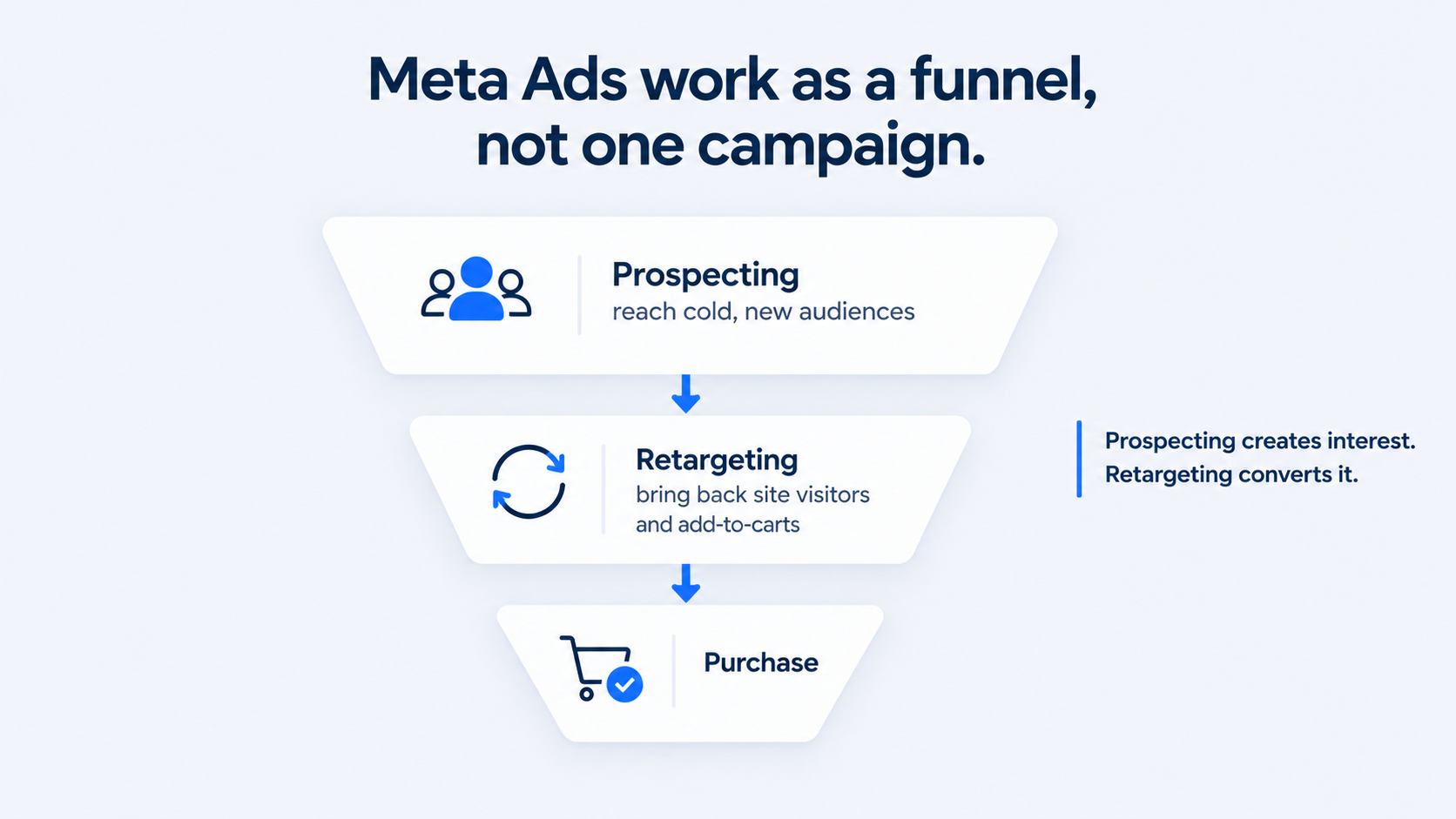
The biggest mistake is treating Meta like one campaign. It is a funnel with two jobs.
| Stage | Who you target | Goal | Ad style |
|---|---|---|---|
| Prospecting | Cold, new audiences | Introduce the product | Scroll-stopping, benefit-led |
| Retargeting | Visited site, added to cart, engaged | Bring them back to buy | Reminders, reviews, offers |
- Prospecting fills the top of the funnel with new people.
- Facebook ads retargeting catches the ones who showed interest but did not buy, usually your cheapest, highest-ROAS sales.
- Lead generation Facebook ads are a third option when you want emails or sign-ups instead of a direct sale, great for higher-ticket or considered purchases.
Retargeting can be small and still matter. In Monster Piercing's 14-day spring sale, £312 of Meta spend on retargeting only supported a campaign that made £23,800, with email and organic bringing in the new visitors.
The takeaway: prospecting without retargeting wastes money; you pay to create interest, then let it leak away. Run both.
Targeting on Meta
Facebook ads targeting has changed. Meta's algorithm is now smart enough that broad targeting often beats narrow, hand-picked interests.
- Broad plus strong creative often wins now. Let Meta find buyers, and let your creative do the filtering.
- Use your own data. Upload customer lists and build lookalike audiences from your best buyers.
- Retarget warm audiences from site visits, video views, and engagement.
- Don't over-slice. Tiny, over-specific audiences starve the algorithm of data and cost more.
The point: modern Meta targeting is less about picking the perfect interest and more about feeding the algorithm good creative and good data, then letting it find your buyers.
Meta Ads vs Google Ads
People often weigh Facebook ads vs. Google. They are not rivals; they do different jobs. Our guide on how to run Google Ads covers the search side.
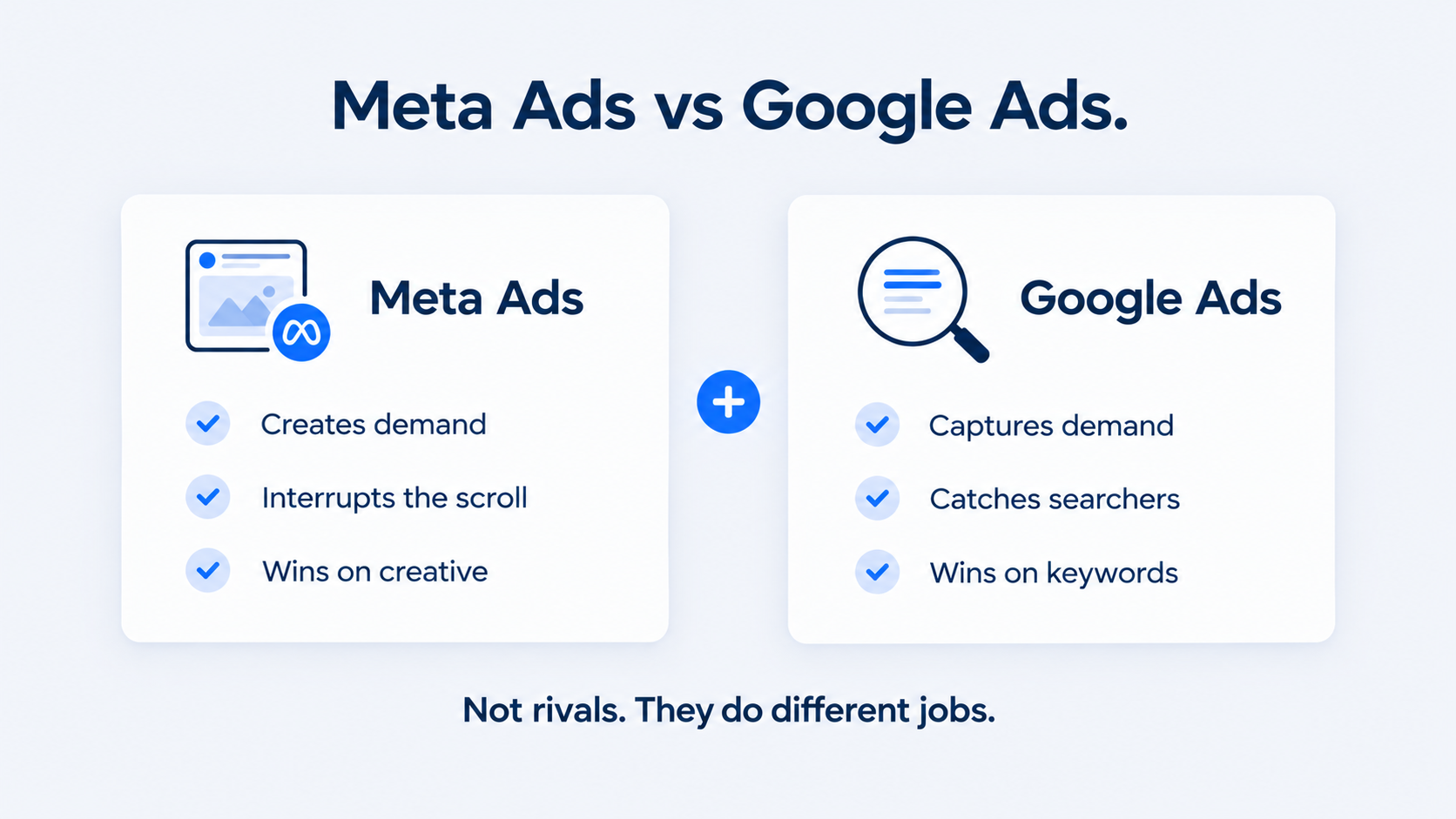
| Meta Ads | Google Ads | |
|---|---|---|
| Intent | Creates demand (interruption) | Captures demand (search) |
| Best for | Discovery, new products, visual brands | People already searching to buy |
| Main lever | Creative and offer | Keywords and bids |
| Cost style | Pay for attention in a feed | Pay per search click |
| Works best | Top and middle of funnel | Bottom of funnel |
- Use both when you can. Google Ads catches people ready to buy. Meta creates the demand that sends them searching in the first place.
- If you only have budget for one and you sell a visual, impulse, or new product, Meta usually comes first.
Common mistakes and how to optimize
Most wasted Meta budget comes from the same handful of errors. Here is where Facebook ads optimization really happens.
- Judging too early: Give campaigns enough data before you kill them. A few clicks is not a verdict.
- Weak creative: One boring ad sinks the whole account. Always be testing fresh hooks and formats.
- No retargeting: Paying to create interest and not catching it is the most common leak.
- Sending traffic to a weak store: Great ads cannot fix a slow or confusing product page. If the store does not convert, Meta just exposes it faster. That loops right back to conversion rate optimization.
- Ignoring the offer: Sometimes the ad is fine, and the offer is the problem. Test offers, not just creatives.
The takeaway: optimising Meta Ads is less about secret settings and more about better creative, better offers, and a store that converts the clicks you paid for.
When to hire a Meta ads agency
You can run Meta yourself, and many owners start that way. But there is a point where a Meta ads agency pays for itself, usually when spend is high enough that small improvements mean real money, or when you simply do not have time to feed the account fresh creative every week.
A good Meta ad agency will:
- Build and test creative constantly, the single biggest lever.
- Run a proper prospecting-to-retargeting funnel, not one campaign.
- Report on ROAS and cost per customer, not vanity metrics like reach.
- Tie the ads to your store, because a Facebook ads agency that ignores your conversion rate is just buying expensive clicks.
Signs it is time to bring in a Meta ads agency:
- You are spending real budget but cannot tell what is working.
- Your results have plateaued and creative has gone stale.
- You want to scale, but every time you increase the budget, performance drops.
When comparing agencies, pick one that shows past results, starts with an audit of your ads and your store, and treats creative as a system, not a one-off.
The takeaway: DIY the basics first. Bring in a Meta ad agency once the math says their fee is smaller than the growth they can unlock.
Frequently asked questions
What is Meta Ads?
Meta Ads are paid ads run across Facebook, Instagram, Messenger, and the Audience Network, all managed in Meta Ads Manager. A single Meta ad is the same thing people call a Facebook ad, just under Meta's newer company name. Unlike search ads, they interrupt people as they scroll, so the creative (image or video) is the most important part.
How do Meta Ads work?
Meta Ads work on an auction. You pick an objective (usually Sales for ecommerce), choose an audience, and upload your creative in Meta Ads Manager. Meta then shows your ad to the people in that audience most likely to take your action, and you pay for the attention. The Meta Pixel on your store tracks results, so Meta learns who buys and finds more people like them. In practice, you run two layers: prospecting to reach new people, and retargeting to bring back those who showed interest.
How much do Facebook ads cost?
There is no fixed price. You pay in an auction, so costs depend on your industry, audience, and how good your ads are. Most ecommerce brands see a CPM of roughly $8 to $20 and a CPC of $0.50 to $2.50, but the number that matters is your customer acquisition cost versus what that customer is worth.
How do I run Facebook ads?
Set up a Meta Business account, connect your page and Instagram, and install the Meta Pixel on your store. Pick the Sales objective, build prospecting and retargeting audiences, create several strong image and video ads, set a small test budget, then scale the winners and cut the losers. It all happens inside Meta Ads Manager.
Do Meta Ads actually work?
Yes, when run well. Meta is still one of the biggest paid channels for most Shopify brands because it creates demand rather than just capturing it. Brands that say it does not work usually have weak creative, a weak offer, or a store that does not convert the traffic, not a channel problem.
What is the Meta Ads Library?
The Meta Ads Library is a free tool that shows every ad any brand is currently running across Meta. Use it to research competitors, see what offers and hooks they use, and spot long-running (likely profitable) ads for creative inspiration before you launch.
Meta Ads vs Google Ads, which is better?
Neither; they do different jobs. Google Ads captures people already searching to buy. Meta Ads create demand by showing your product to people who were not searching yet. If you sell a visual or impulse product and can only pick one, Meta usually comes first. Most brands do best running both.
Are Meta Ads good for small business?
Yes. Facebook ads for small business work because you can start with a small test budget, reach a highly targeted local or niche audience, and scale only what is profitable. The key is strong creative and a clear offer, not a big budget.
Where to go from here
Meta Ads are still the biggest demand-creation engine for ecommerce, but they reward the same things every year: strong creative, a clear offer, a prospecting-to-retargeting funnel, and a store that actually converts. Get those right, and budget becomes a lever you can pull with confidence. Get them wrong, and no amount of spend will save the account.
If you want to know whether your Meta Ads (or your store) are leaving money on the table, book your free Shopify store audit, and we'll show you the quickest wins first.